Pruebas de Pureza de la Miel: Detectar Jarabe de Maíz JMAF, Arroz y Azúcar Invertido
⚡ Veredicto Rápido de 60 Segundos: Pureza de la Miel (Jarabe de Maíz y Azúcar)
Alerta de Fraude Global: Hasta un 70% de la miel comercial en supermercados está adulterada con jarabe de maíz de alta fructosa (JMAF), jarabe de arroz C4 o azúcar invertido ultrafiltrado que elude análisis simples. En España y México se mezclan mieles importadas baratas con denominaciones de origen (como Miel de La Alcarria o Miel de Yucatán).
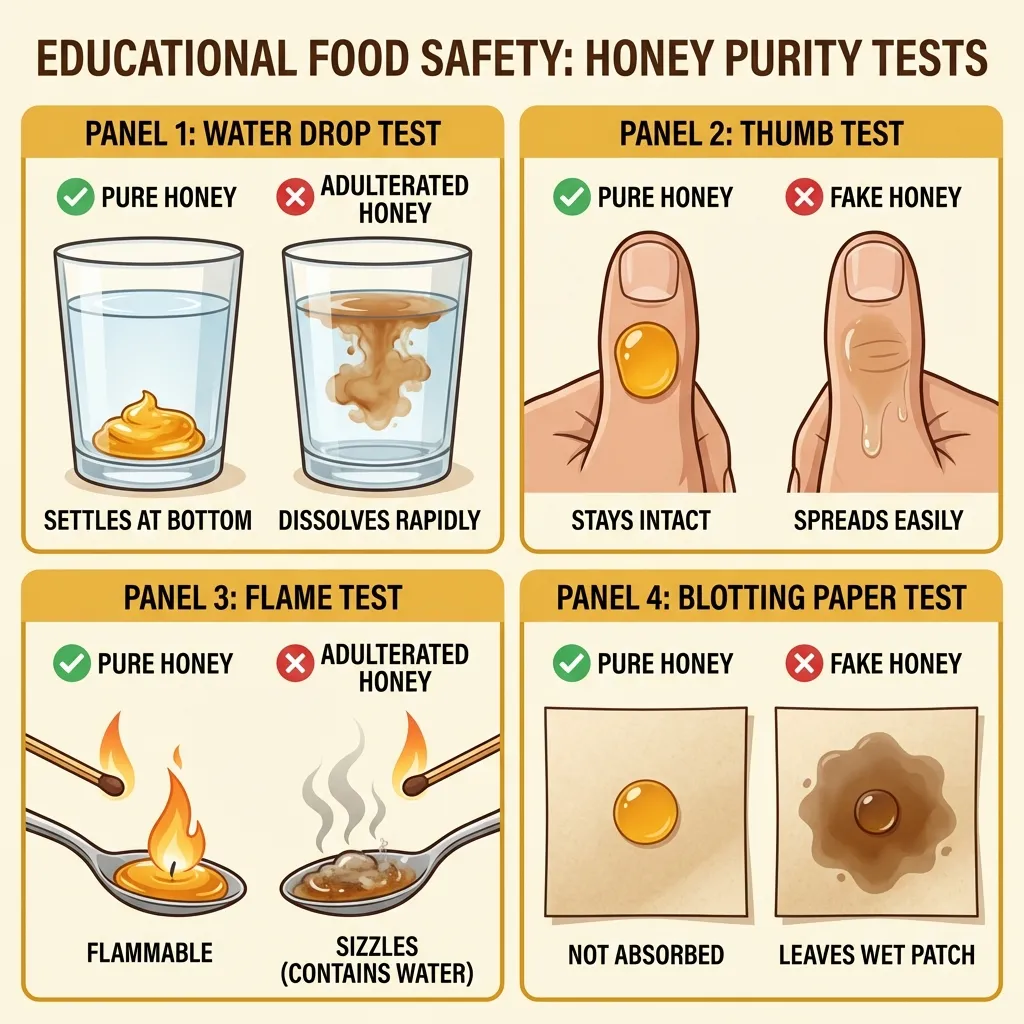
Vierte una cucharadita en agua tibia sin agitar. La miel pura cae al fondo como un bloque denso e intacto. El jarabe adulterado se disuelve de inmediato enturbiando el agua.
Coloca una gota en la uña del pulgar. La miel pura cruda mantiene su forma de cúpula redonda sin escurrirse. La miel con jarabe o agua añadida se desparrama y gotea.
Unta la cabeza de un fósforo seco en miel y raspa la lija. La miel auténtica (<18% humedad) arde con llama limpia. Si chisporrotea y se apaga, tiene humedad adulterada.
Drop Miel (Miel / Honey) photo here to test purity
or click to browse • Supports JPG, PNG, WEBP • Paste with Ctrl+V
Inspection Guide
Click to enlarge
Guía de Inspección y Detección de Adulteración en la Miel
La miel pura es elaborada por abejas a partir del néctar floral, con una humedad naturalmente baja (<20%) y rica en glucosa, fructosa y enzimas vivas (como la glucosa oxidasa). El fraude industrial consiste en diluirla con jarabes de caña, maíz o remolacha para abaratar costes.
1. Prueba de Solubilidad en Agua Fría:
Llena un vaso transparente con agua del grifo o fría. Deja caer una cucharada sopera de miel sin remover. La miel pura permanece compacta en el fondo del vaso en forma de cordón o masa densa durante varios minutos. La miel con jarabe de azúcar se diluye de inmediato formando velos turbios.
2. Prueba del Papel Secante o Papel Toalla:
Coloca una gota de miel sobre un papel absorbente o papel de periódico. La miel de calidad no penetra el papel ni deja cerco húmedo alrededor durante 5 a 10 minutos. La miel adulterada con agua o almíbar se absorbe rápidamente mojando el reverso.
3. Prueba del Pulgar y Viscosidad:
Pon una gota sobre la uña del dedo pulgar. La miel genuina conserva su tensión superficial y se queda firme como una perla convexa. La miel estirada con jarabe de maíz corre libremente y gotea por el dedo.
4. Prueba del Fósforo o Hilo de Algodón:
Moja la punta de una cerilla seca en miel y ráspala contra la caja. La miel pura arderá suavemente porque su bajo contenido de agua no humedece el fósforo. Si el fósforo falla, chisporrotea o no prende, la miel contiene agua añadida.
5. La Prueba del Microondas o Cristalización:
La miel cruda sin pasteurizar cristaliza de forma espontánea con el frío, formando una textura cremosa o granulada. La miel con jarabe industrial ultrafiltrado nunca cristaliza y se mantiene transparente artificialmente.

Click to enlarge
Guía de Frescura, Cristalización y Grados de Calidad de la Miel
La miel pura sellada prácticamente no caduca gracias a su pH ácido y bajísima humedad. Sin embargo, el exceso de calor destruye sus enzimas y la humedad alta produce fermentación:
| Grado de Calidad | Aspecto Visual y Cristalización | Aroma y Textura | Veredicto y Recomendación |
|---|---|---|---|
| 1. Miel Cruda Pura (Óptima) | Densa, opaca o cristalizada de forma homogénea | Aroma floral intenso, notas herbales complejas, textura suave al paladar | ✅ Excelente — Consumo directo, infusiones tibias y propiedades antimicrobianas |
| 2. Miel Líquida Pasteurizada | Brillante, completamente transparente, sin posos | Dulzor plano, aroma suave atenuado por filtración térmica | ⏳ Aceptable — Apta para repostería; enzimas y polen han sido mermados |
| 3. Miel Fermentada (Humedad Alta) | Capa de espuma blanca en superficie, burbujas continuas | Olor agrio, a levadura o alcohol, sabor punzante o efervescente | ⚠️ Deteriorada — Fermentación activa por levaduras osmofílicas; descartar |
| 4. Falsa Miel / Jarabe Ultrafiltrado | Líquido dorado artificial, nunca cristaliza ni en frío | Sabor a caramelo o glucosa pura, sin matices botánicos | ❌ Fraude — Producto adulterado con jarabe de maíz o arroz; denunciar |
Puntos Críticos de Frescura y Fermentación:
- Espuma blanca en el cuello del frasco: Es un indicio inequívoco de que la miel contenía más del 20% de agua al cosecharse y las levaduras fermentaron la fructosa en alcohol y ácido acético.
- Sobrecalentamiento industrial: Someter la miel a más de 45°C para facilitar su envasado eleva el hidroximetilfurfural (HMF) y destruye la invertasa y diastasa activas.
Conservación Óptima:
- Almacenar a temperatura ambiente (15°C–22°C) en lugar oscuro y seco.
- Nunca refrigerar salvo para inducir cristalización cremosa controlada.
- Si la miel ha cristalizado y se desea líquida, calentar al baño María a menos de 40°C.
Quick Safety Tips
- La miel pura siempre se hunde intacta en agua fría sin disolverse.
- La cristalización en invierno es garantía de miel pura y cruda, no de defecto.
- Desconfía de mieles extremadamente baratas con textura de sirope líquido eterno.
- Guarda la miel en frascos de vidrio bien sellados en un armario seco.
Primary Chemical Concerns
Health Risks & Impacts
Multilingual Local Names
Common Storage Pests
Levaduras osmofílicas (Fermentación)
medium riskMicroorganismos que proliferan cuando la humedad de la miel supera el 19%.
Detection
- Capa de espuma blanca en la parte superior
- Aroma agrio a cerveza o vinagre
- Gases al abrir el frasco
Prevention
- Cerrar herméticamente el tarro tras cada uso
- Evitar introducir cucharas húmedas o saliva
Corrective Action: What to do?
Descartar para consumo crudo; solo apta para cocción en altas temperaturas o elaboración de hidromiel.
Hormigas domésticas (Monomorium / Linepithema)
low riskInsectos atraídos por los residuos azucarados en la rosca del frasco.
Detection
- Hileras de hormigas alrededor de la tapa
- Insectos atrapados en la superficie
Prevention
- Limpiar con paño húmedo el borde y la rosca del tarro
- Guardar en un plato con agua como barrera física
Corrective Action: What to do?
Retirar la capa superficial afectada con cuchara limpia si la contaminación es mínima.
Escarabajo de la colmena y polillas de la cera (Residuos en miel rústica)
low riskContaminantes presentes ocasionalmente en mieles cosechadas de panales artesanales sin filtrar.
Detection
- Partículas oscuras flotantes
- Filamentos sedosos en miel rústica
Prevention
- Adquirir miel decantada y filtrada adecuadamente
Corrective Action: What to do?
Filtrar con tamiz fino de tela o retirar manualmente.
Regulatory Corner: AESAN (España) / COFEPRIS (México) / Directiva de la Miel 2001/110/CE
Regulation: Real Decreto 1049/2003 (Norma de calidad para la miel) / Codex Stan 12-1981
Legal Limit:Humedad: Máx. 20,0% (18,0% para miel de brezo); HMF: Máx. 40 mg/kg; Actividad diastásica: Mín. 8 unidades Schade; Azúcares C4: Máx. 7,0%; Marcadores de arroz (SMR/TMR): Ausencia total
Report Adulteration to AESAN (España) / COFEPRIS (México) / Directiva de la Miel 2001/110/CE