
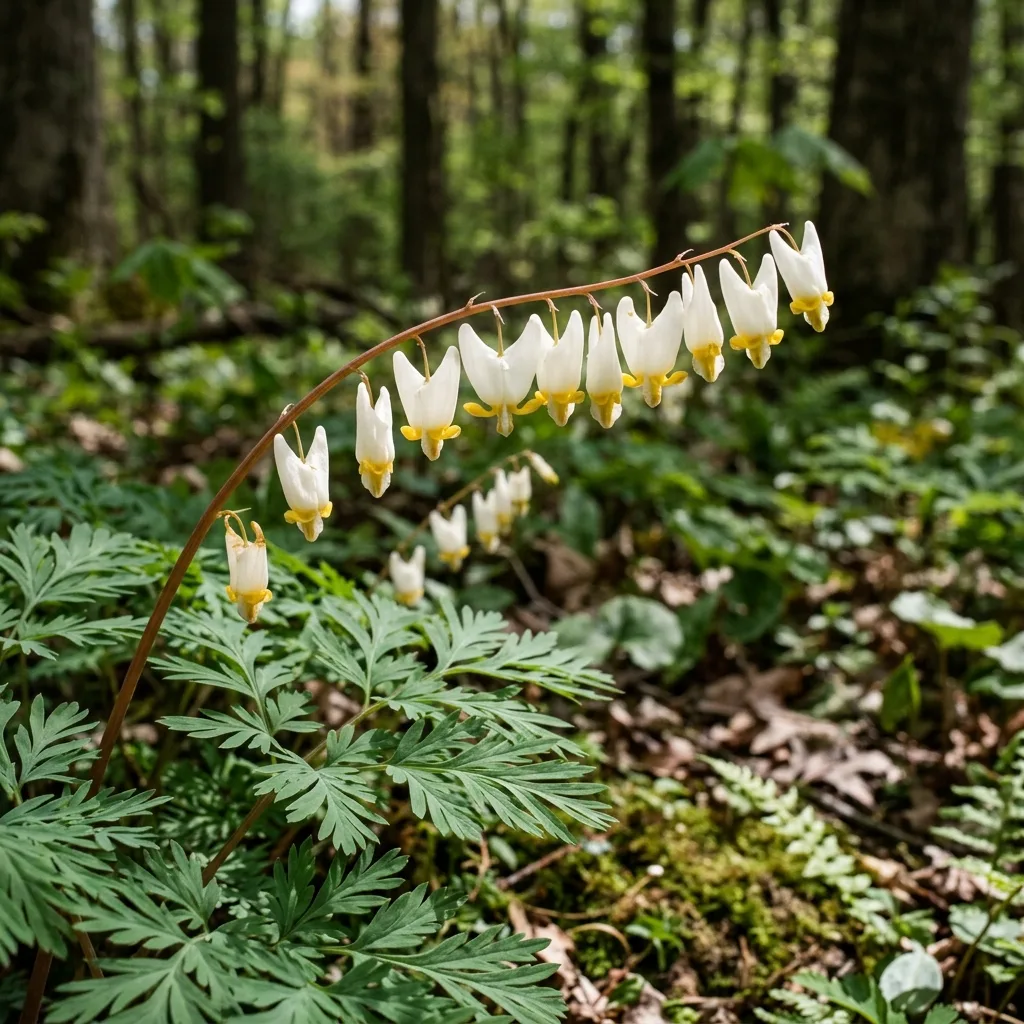
Dutchman's Breeches
Dicentra cucullaria
How to Identify Dutchman's Breeches
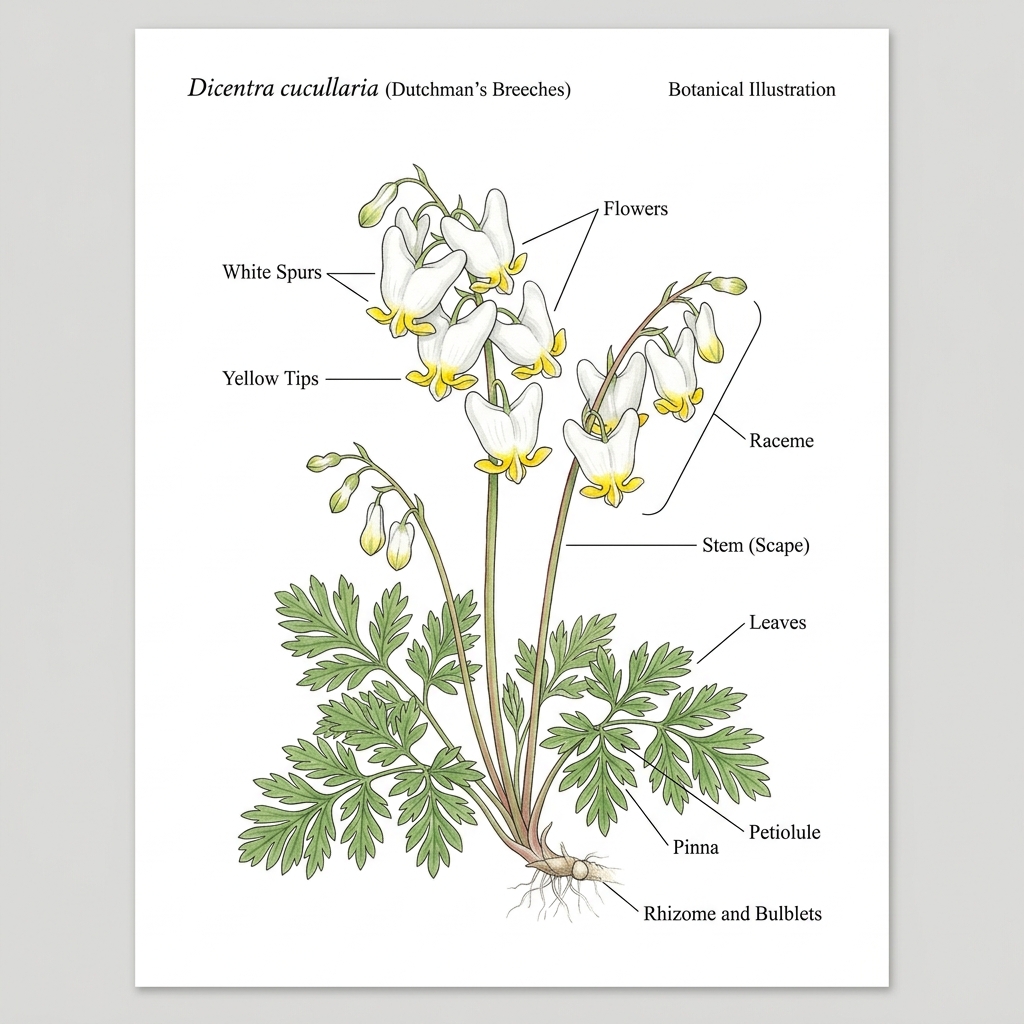
A detailed guide to identifying Dutchman's Breeches (Dicentra cucullaria) by its key features:
- Upside-Down Pantaloons: Hanging rows of white flowers resembling inverted Dutch trousers.
- Vibrant Yellow Waistband: A bright yellow collar at the base of the flaring flower spurs.
- Fern-Like Feathery Foliage: Highly dissected, grey-green leaves resembling delicate fern fronds.
- Underground Bulblets: Small, teardrop-shaped pink bulblets clustered just below the soil surface.
Care & Growing Guide
Dutchman's Breeches Care Guide:
- Light: Partial to full shade
- Soil: Moist, humus-rich woodland soil
- Planting: Plant small pink corms 2 inches deep in fall
- Companion: Plant with hostas and ferns to fill the summer gap
Seasonal Blooming & Hardiness
Seasonal Blooming Calendar:
- Peak Bloom: March–May
- US Range: USDA Zones 3–7; native in eastern and central US deciduous forests
- Note: True spring ephemeral — foliage gone by June
Bloom Timeline
About Dutchman's Breeches
Dutchman's Breeches (Dicentra cucullaria) is one of the most whimsically charming and distinctively shaped wildflowers in the eastern North American spring flora, producing pendulous racemes of pure white flowers shaped precisely like pairs of miniature, upside-down pantaloons or 'breeches' — the puffy white trousers worn by Dutch men in the 16th and 17th centuries. Belonging to the family Papaveraceae (subfamily Fumarioideae), it is a close relative of the popular garden plant Bleeding Heart (Lamprocapnos spectabilis) and shares its similarly ornate, bilaterally symmetrical flowers.
The plant grows from a cluster of small, pink, grain-like corms buried just below the soil surface, producing a rosette of delicate, fern-like, deeply dissected blue-green leaves in early spring. The flower stalk rises 5 to 10 inches above the foliage, bearing a one-sided raceme of 4–10 nodding white flowers, each with two outer petals inflated into prominent upward-pointing spurs (the 'legs of the breeches') and two inner petals forming a narrow, protruding tip at the opening. The flowers are lightly fragrant and bloom in April in most of the eastern US.
Dutchman's Breeches is an early spring ephemeral, completing its entire above-ground life cycle in 6–10 weeks before the forest canopy fills in and shades the woodland floor. Like Bloodroot and Trillium, its seeds are dispersed by ants through myrmecochory. Long-tongued native bumblebee queens, which emerge in early spring when little else is blooming, are the primary pollinators, squeezing into the spurred flowers to reach the nectar. The plant is also notable for being toxic to insects in a unique way — it contains toxic alkaloids that intoxicate short-tongued bees attempting to chew through the flower base to 'steal' nectar.
All parts of Dutchman's Breeches are toxic to mammals — the tubers, leaves, and flowers contain isoquinoline alkaloids that cause narcosis, convulsions, and can be fatal to livestock (cattle that graze it are sometimes intoxicated). It is completely safe to admire and touch, but should never be ingested by humans or pets. In the native woodland garden, it is a magical companion to Bloodroot, Trillium, Virginia Bluebells, and Wild Blue Phlox in the spring ephemeral tapestry. Browse our full Flower Identifier for more native woodland species.
Floral Formula & Features
Zygomorphic, bisexual; 2 small caducous sepals; 4 petals (2 outer spurred, 2 inner narrow); 6 stamens in 2 fascicles; 2 fused carpels with superior ovary
- Scientific Name & Classification: Dicentra cucullaria (Papaveraceae, subfamily Fumarioideae). Closely related to Bleeding Heart (Lamprocapnos spectabilis). Native to eastern North America.
- Identification Markers: White pantaloon-shaped flowers with two upright spurs on a nodding raceme. Delicate, fern-like, deeply dissected blue-green foliage. Height 5–10 in. Spring ephemeral — gone by late spring.
- Floral Formula (↑ ☿ K2 C4 A6 G(2)): Zygomorphic, bisexual; 2 small caducous sepals; 4 petals (2 outer with spurs, 2 inner forming a narrow tip); 6 stamens in 2 bundles; 2 fused carpels with superior ovary.
- Growing Requirements: Partial to full shade; moist, rich, humus-filled woodland soil. Spring ephemeral — dormant by June. USDA Zones 3–7. Plant corms 2 inches deep in fall.
- Cultural Significance: One of the most distinctively shaped wildflowers in North America. Spring ephemeral indicator species of old-growth eastern deciduous forest health.
- Safety & Toxicity: ⚠️ TOXIC. Contains isoquinoline alkaloids (cucullarine) toxic to humans, dogs, cats, and livestock. Do not ingest any part. Keep children and pets away.
- Common Look-alikes: Very similar to Squirrel Corn (D. canadensis), distinguished by its yellow (not pink) corms and more rounded flower spurs. Also related to Bleeding Heart (Lamprocapnos spectabilis).
- Internal Links: Essential component of the eastern spring ephemeral woodland tapestry alongside Bloodroot and Trillium. Explore our Flower Identifier.
- Internal Links: Compare key differences in our Bleeding Heart Vine vs Dutchman's Breeches comparison, or try our instant Flower Identifier.
Names in Different Languages
Botanical Classification: Dutchman's Breeches belongs to the Papaveraceae family. Learn how to identify its floral symmetry, stamen arrangement, and structural formulas in our Botanical Family Classification Guide.
Toxicity & Safety
Always keep toxic plants out of reach of children and pets. Consult a veterinarian or medical professional immediately if ingestion is suspected.
Pet Safety Guide: For detailed toxicity symptoms, first-aid measures, and safe garden alternatives, see our full Pet Guard Profile for Dutchman's Breeches.
Frequently Asked Questions
What is Floral Formula?
A floral formula is a symbolic representation of a flower's structure using letters, numbers, and special symbols. It provides a concise way to describe the arrangement and number of floral parts.
This formula describes the flower's symmetry, sepals, petals, stamens, and carpels in a standardized format.
Formula Sequence
- Bract: Br or Ebr
- Bracteole: Brl or Ebrl
- Symmetry: % (Radial) or ⊕ (Bilateral)
- Sex: ♀ (Female), ♂ (Male), or ⚥ (Bisexual)
- Calyx/Sepal: K<number> (Free or Fused)
- Corolla/Petal: C<number> (Free or Fused)
- Androecium: A<number> (Free or Fused)
- Gynaecium: G<number> (Superior or Inferior Ovary)
Symbol Meanings
- Numbers: Indicate quantity of parts
- Parentheses (): Parts are fused together
- Plus (+): Parts in different whorls
- Underline: Superior ovary position
- Overline: Inferior ovary position
- ∞: Numerous parts (too many to count)
Understanding floral formulas helps botanists quickly identify and classify flowers based on their structural characteristics.
Similar Flowers
Discover flowers that share botanical characteristics
Same Family
4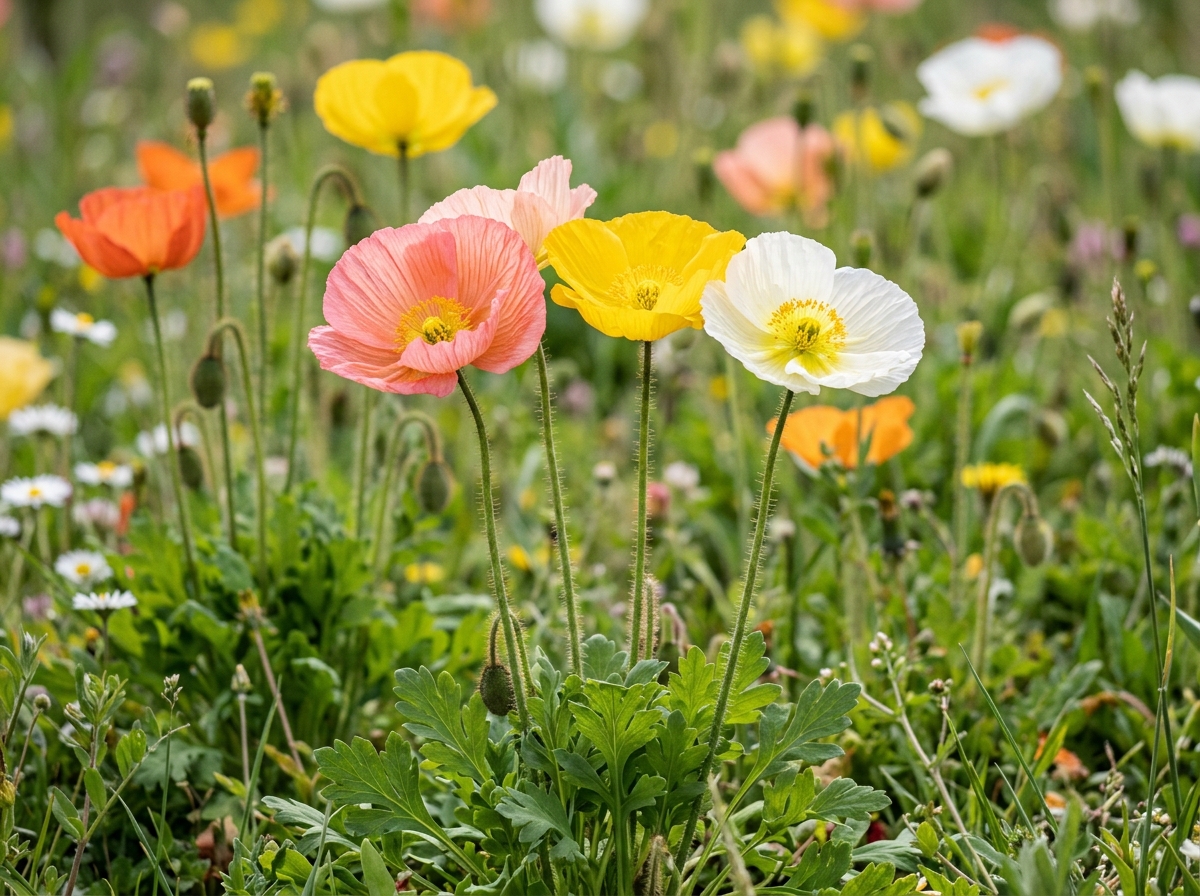
Iceland Poppy
Papaver nudicaule
Iceland Poppy (*Papaver nudicaule*), despite its common name, is native to subpolar regions of Asia and North America rather than Iceland. Beloved for its papery, bowl-shaped blossoms that appear in glowing pastel shades of yellow, orange, salmon, pink, rose, and white, the Iceland Poppy is one o...
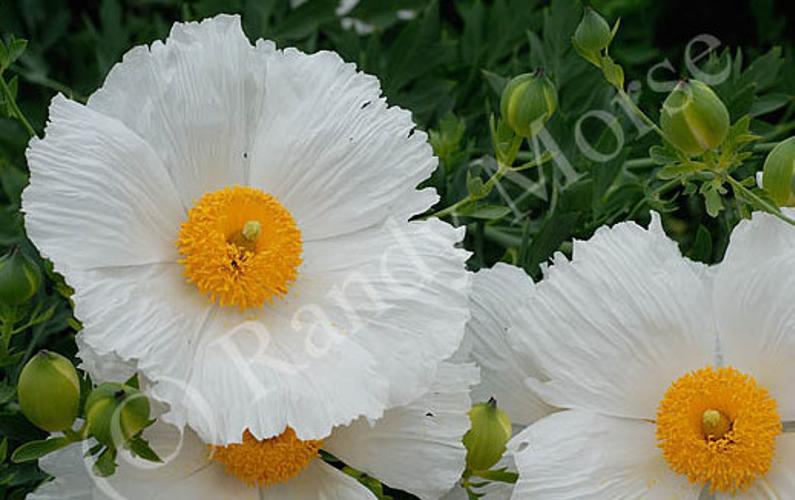
Tree Poppy
Dendromecon rigida
The Tree Poppy, scientifically known as Dendromecon rigida and commonly referred to as the Bush Poppy or California Tree Poppy, is a rare, spectacular evergreen shrub belonging to the Papaveraceae (poppy) family. Endemic to the dry, rocky chaparral slopes and coastal sage scrub of California and...
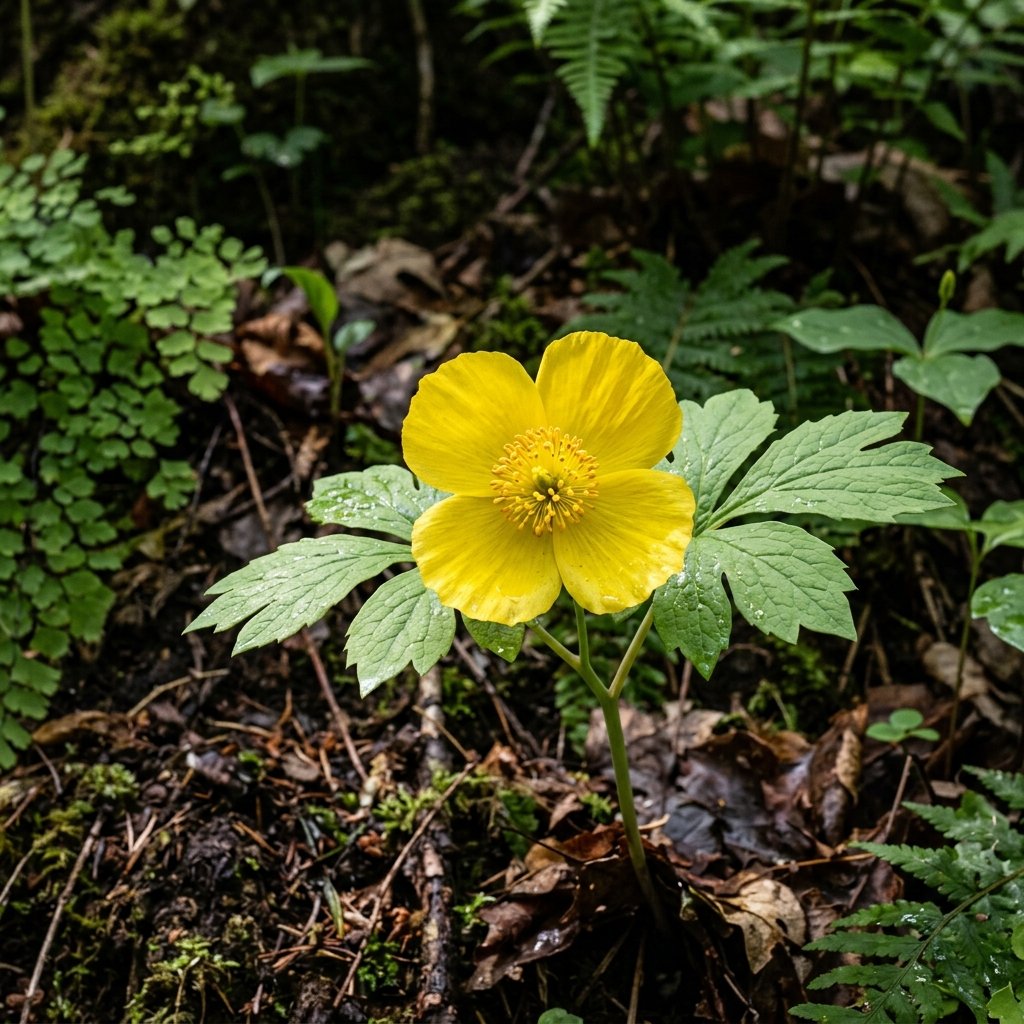
Wood Poppy
Stylophorum diphyllum
Wood Poppy (*Stylophorum diphyllum*), also known as the Celandine Poppy or Yellow Wood Poppy, is one of the showiest and most reliable native wildflowers for the shaded woodland garden, producing large, bright butter-yellow poppy flowers 1.5 to 2 inches across above a rosette of deeply lobed, blu...
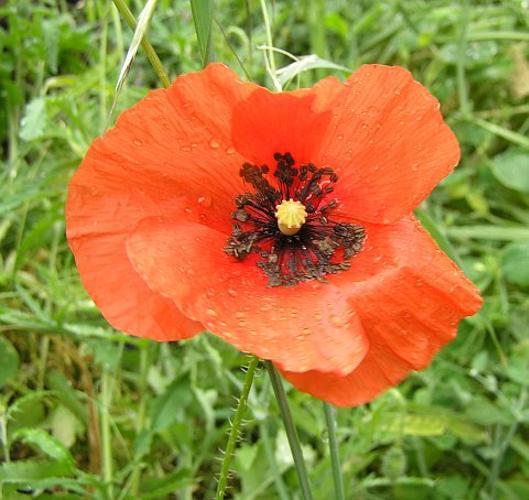
Corn Poppy
Papaver rhoeas
The Corn Poppy, botanically designated as Papaver rhoeas and commonly known as the Field Poppy, Flanders Poppy, or Red Poppy, is an exceptionally iconic, breezy, and resilient annual wildflower. Belonging to the family Papaveraceae (the poppy family, tribe Papavereae), this historically rich plan...
Similar Characteristics
4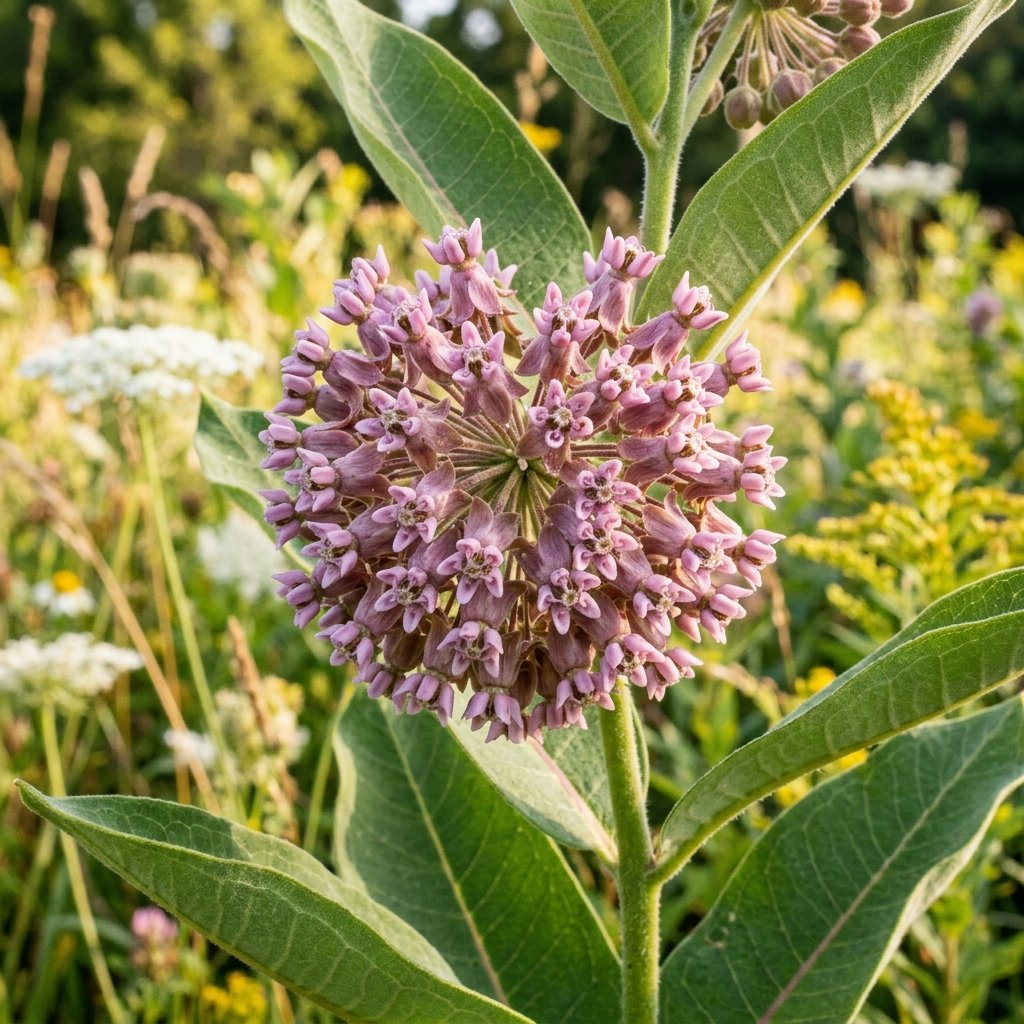
Common Milkweed
Asclepias syriaca
Common Milkweed (*Asclepias syriaca*) is the quintessential wildflower of eastern North American roadsides, meadows, and prairies — a robust, upright perennial producing large, globe-shaped clusters of dusky pink to mauve flowers with an intoxicating sweet fragrance in midsummer, followed by the...
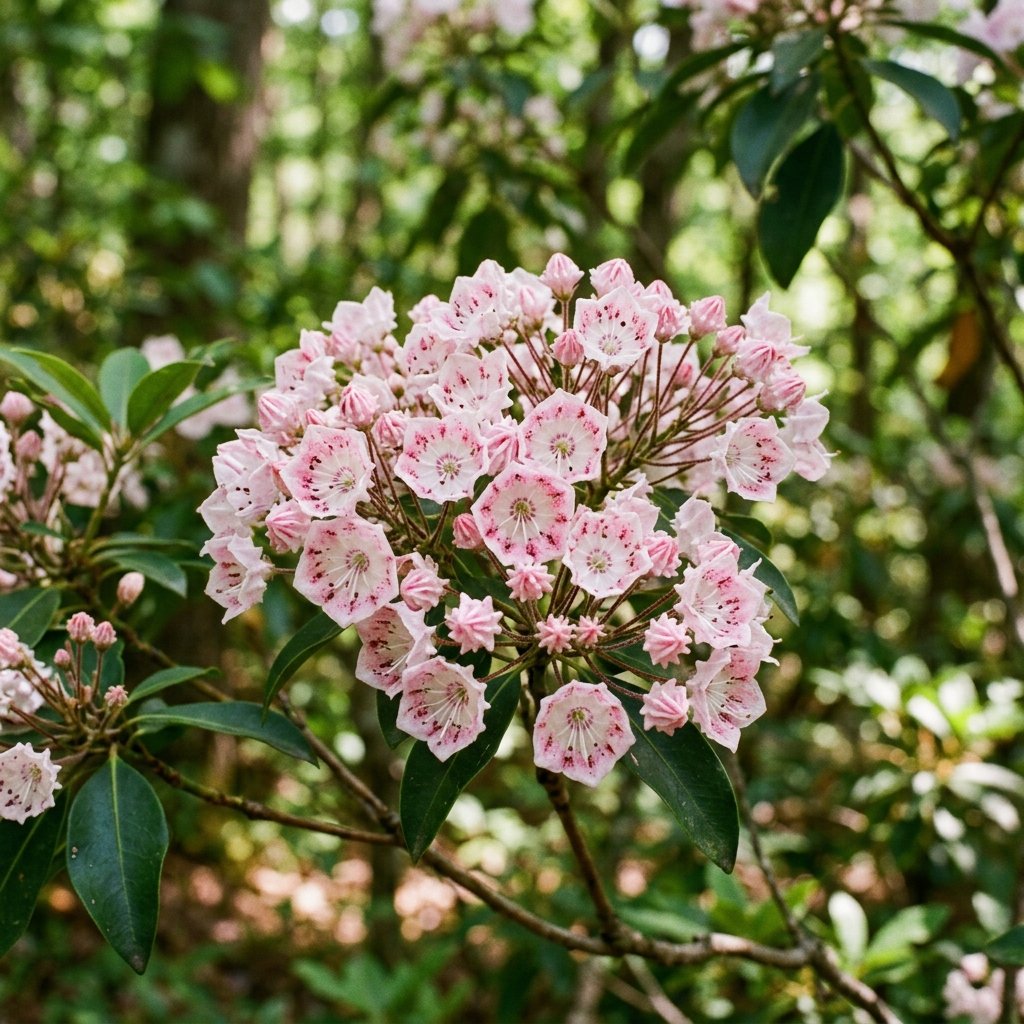
Mountain Laurel
Kalmia latifolia
Mountain Laurel (*Kalmia latifolia*) is one of the most spectacular native flowering shrubs of the eastern United States, producing extraordinary clusters of cup-shaped flowers in shades of white, pink, and deep rose — each blossom decorated with a ring of ten maroon spots and a unique pentagonal...
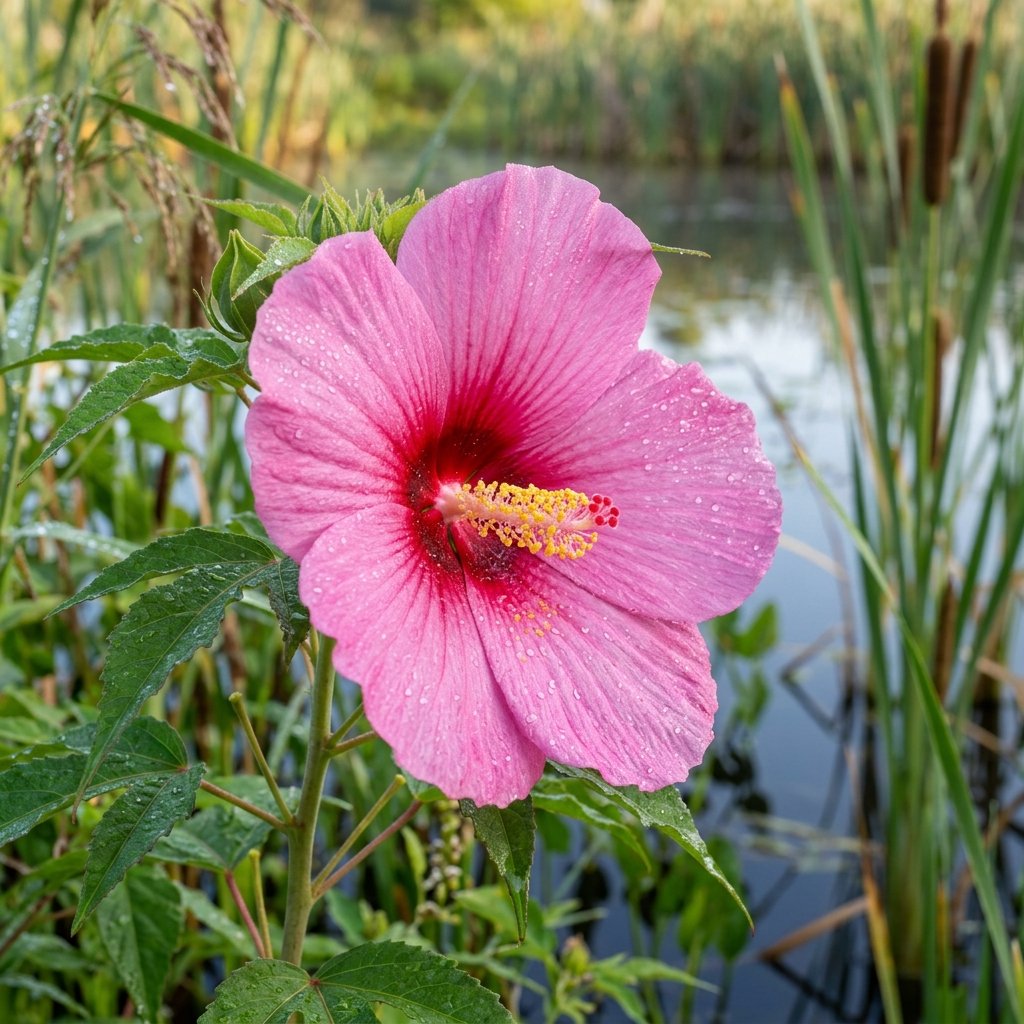
Swamp Rose Mallow
Hibiscus moscheutos
Swamp Rose Mallow (*Hibiscus moscheutos*) produces some of the largest flowers of any hardy perennial wildflower in North America — dinner-plate-sized blooms reaching 6 to 12 inches in diameter — in shades of white, pink, and rose, typically adorned with a dramatic deep crimson or rose-pink centr...
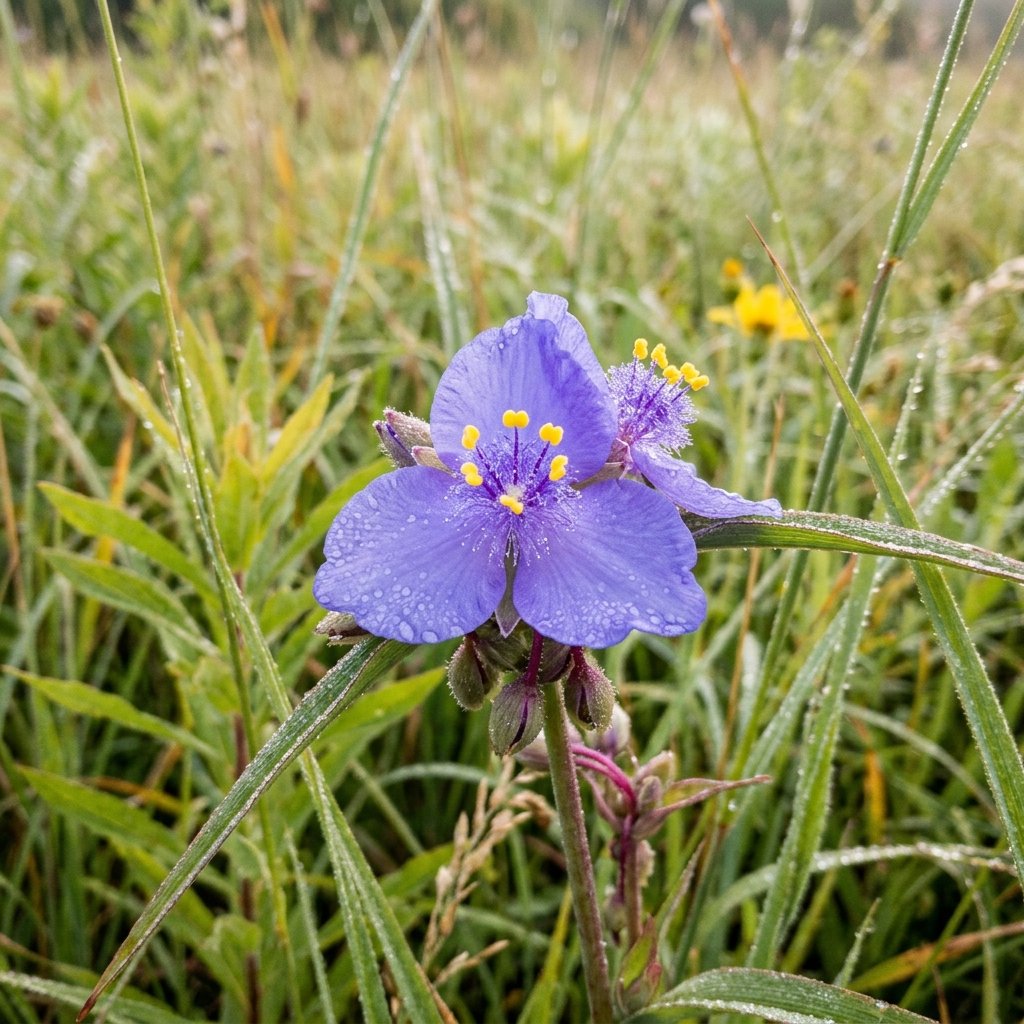
Spiderwort
Tradescantia ohiensis
Spiderwort (*Tradescantia ohiensis* and related species) is a quietly enchanting native wildflower of eastern North America, producing clusters of vivid three-petaled flowers in shades of deep blue-violet, blue, and occasionally white from late spring through summer. Belonging to the Commelinacea...