
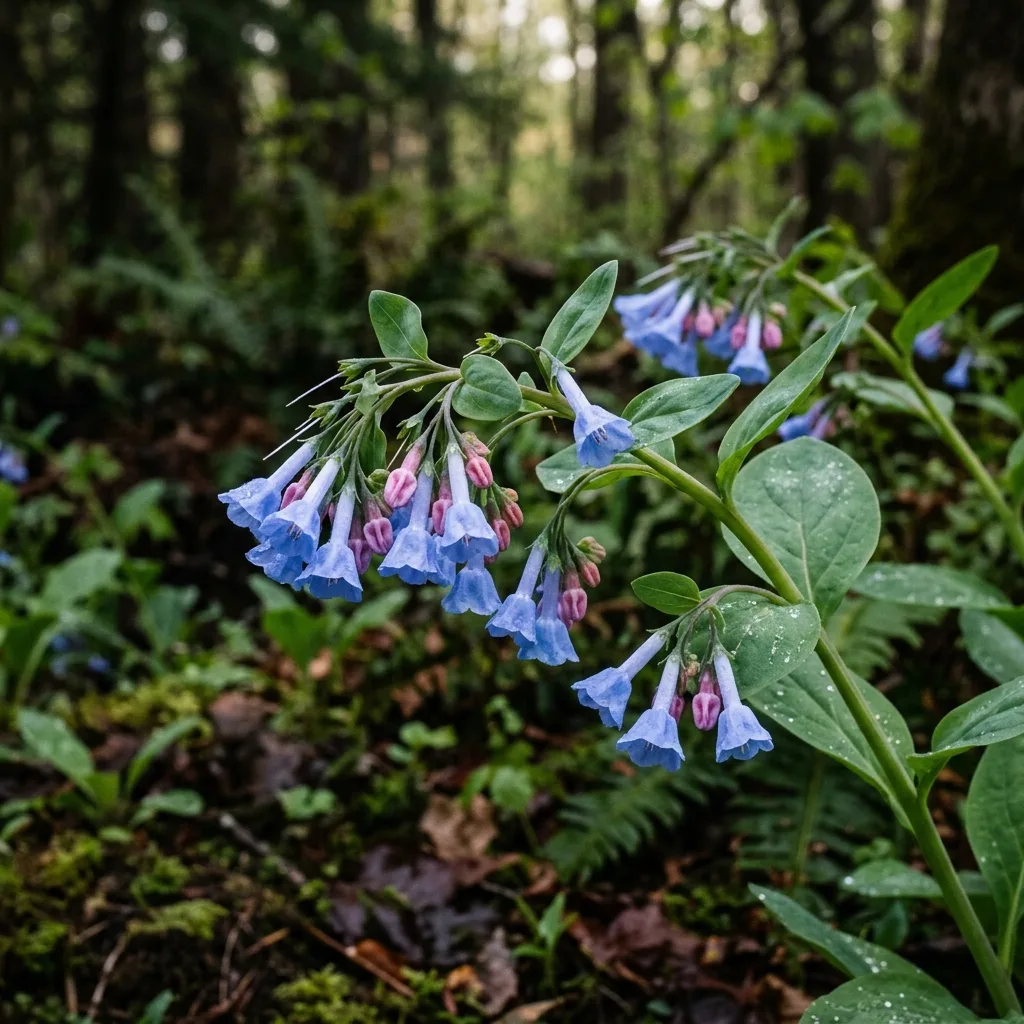
Virginia Bluebells
Mertensia virginica
How to Identify Virginia Bluebells
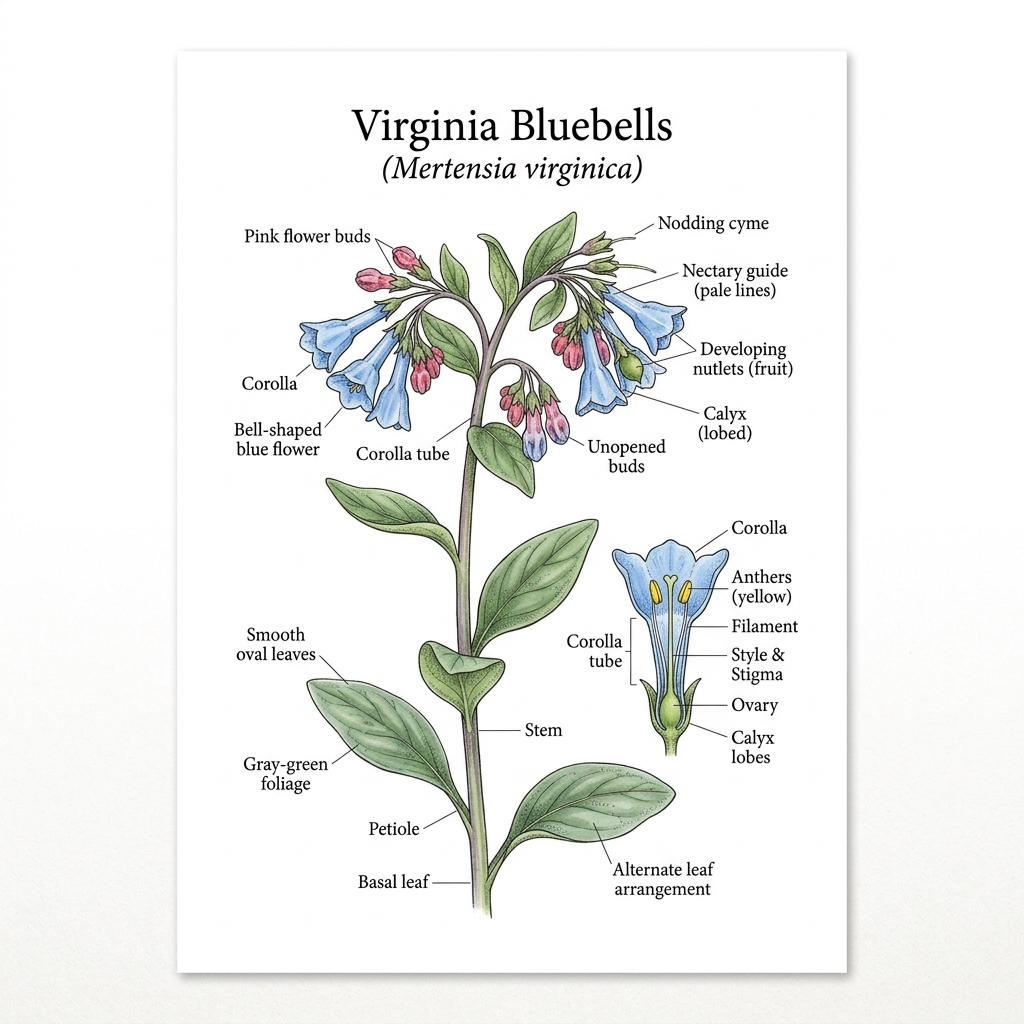
A detailed guide to identifying Virginia Bluebells (Mertensia virginica) by its key features:
- Trumpet-Shaped Bell Clusters: Nodding, bell-like flowers hanging in loose clusters at the stem ends.
- Pink to Blue Color Shift: Flaring buds start bright pink and open into sky-blue bell flowers.
- Smooth Glaucous Foliage: Fleshy, light green, hairless leaves covered in a waxy, bluish-grey bloom.
- Woodland Colony Growth: Spreads via fleshy rhizomes to form carpets in damp, shaded woods.
Care & Growing Guide
Virginia Bluebells Care Guide:
- Light: Partial to full shade; does well in morning sun
- Soil: Moist, rich, humus-filled — near streams or low areas is ideal
- Water: Keep moist during spring growing season; drought-tolerant when dormant
- Companion Planting: Interplant with ferns, hostas, or Wild Ginger to fill summer gap
Seasonal Blooming & Hardiness
Seasonal Blooming Calendar:
- Peak Bloom: March–May in eastern US
- US Range: USDA Zones 3–9; native to eastern US from New York to Kansas
- Note: True spring ephemeral — foliage vanishes entirely by June
Bloom Timeline
About Virginia Bluebells
Virginia Bluebells (Mertensia virginica) is among the most enchanting spring wildflowers of eastern North America, producing nodding clusters of sky-blue, trumpet-shaped flowers on arching stems in early spring. A member of the Boraginaceae (borage family), it is native to moist, rich floodplain forests and stream banks from New York to Kansas and south to Tennessee and North Carolina, blooming in a spectacular blue wave in April that lasts only a few precious weeks before the plant retreats entirely underground as summer approaches — a true spring ephemeral.
The flowers of Virginia Bluebells begin as pink or lavender-pink buds arranged in coiled cymes (a flower arrangement called a 'scorpioid cyme' characteristic of the borage family), gradually opening into pure, soft sky-blue trumpet-shaped flowers approximately three-quarters of an inch long. This color change from pink to blue is caused by a shift in the flower's pH as it matures, and the two-toned clusters of pink buds and blue open flowers create a particularly delicate and beautiful effect. The smooth, blue-green, ovate leaves are equally distinctive, with a glaucous (powdery) surface that gives them a soft, almost succulent appearance.
Ecologically, Virginia Bluebells are a crucial early-spring nectar source, with their tubular flowers perfectly sized for long-tongued native bumblebees and hummingbirds just returning from their winter grounds. The plant forms large, spreading colonies over time in ideal conditions, carpeting the forest floor with blue in April. In natural riparian settings, large stands of Virginia Bluebells along streambanks are one of the signature wildlife spectacles of the Appalachian spring, drawing nature photographers and wildflower enthusiasts from across the country.
In the native garden, Virginia Bluebells excel as a companion to other spring ephemerals and ferns, which will fill the space they vacate by summer. Plant them with Hostas, Ferns, or Wild Ginger — which emerge as Bluebells fade and mask the bare spots left behind. They spread reliably from seed dropped around the parent plant and gradually naturalize into colonies. They are completely non-toxic to pets and children, making them an excellent choice for family gardens with a woodland or shade setting. Discover more blue-flowered native wildflowers in our Flower Identifier.
Floral Formula & Features
Slightly zygomorphic, bisexual, 5 fused sepals, 5 fused petals (tubular), 5 attached stamens, 4 free carpels (characteristic Boraginaceae nutlets) with superior ovary
- Scientific Name & Classification: Mertensia virginica (Boraginaceae, tribe Eritricheae). The most celebrated species of the Mertensia genus, native to eastern North America.
- Identification Markers: Sky-blue, nodding, tubular trumpet flowers in coiled clusters. Buds open pink then turn blue. Smooth, glaucous blue-green ovate leaves. Height 1–2 ft. Spring ephemeral — disappears by June.
- Floral Formula (↑ ☿ K(5) [C(5) A5] G(4)): Slightly zygomorphic, bisexual, 5 fused sepals, 5 fused petals forming a tube, 5 stamens, 4 carpels (nutlets) with superior ovary.
- Growing Requirements: Moist, rich, humus-filled soil in partial to full shade. Thrives near streams and in woodland gardens. USDA Zones 3–9. Goes dormant by late spring — interplant with ferns or hostas.
- Cultural Significance: One of the most celebrated spring wildflowers of the eastern US. Forms breathtaking blue carpets along Appalachian stream valleys in April. Popular in native plant restoration and wildflower gardens.
- Safety & Toxicity: NON-TOXIC. Safe for cats, dogs, and humans. An excellent choice for family woodland gardens.
- Common Look-alikes: Sometimes confused with Forget-Me-Not (Myosotis), which is much smaller and has flat, open flowers rather than tubular trumpets. Also confused with Blue-Eyed Mary (Collinsia).
- Internal Links: Combines perfectly with Trillium and Wild Blue Phlox for a full spring woodland tapestry. Explore our Flower Identifier.
Names in Different Languages
Toxicity & Safety
Frequently Asked Questions
What is Floral Formula?
A floral formula is a symbolic representation of a flower's structure using letters, numbers, and special symbols. It provides a concise way to describe the arrangement and number of floral parts.
This formula describes the flower's symmetry, sepals, petals, stamens, and carpels in a standardized format.
Formula Sequence
- Bract: Br or Ebr
- Bracteole: Brl or Ebrl
- Symmetry: % (Radial) or ⊕ (Bilateral)
- Sex: ♀ (Female), ♂ (Male), or ⚥ (Bisexual)
- Calyx/Sepal: K<number> (Free or Fused)
- Corolla/Petal: C<number> (Free or Fused)
- Androecium: A<number> (Free or Fused)
- Gynaecium: G<number> (Superior or Inferior Ovary)
Symbol Meanings
- Numbers: Indicate quantity of parts
- Parentheses (): Parts are fused together
- Plus (+): Parts in different whorls
- Underline: Superior ovary position
- Overline: Inferior ovary position
- ∞: Numerous parts (too many to count)
Understanding floral formulas helps botanists quickly identify and classify flowers based on their structural characteristics.
Similar Flowers
Discover flowers that share botanical characteristics
Similar Colors
4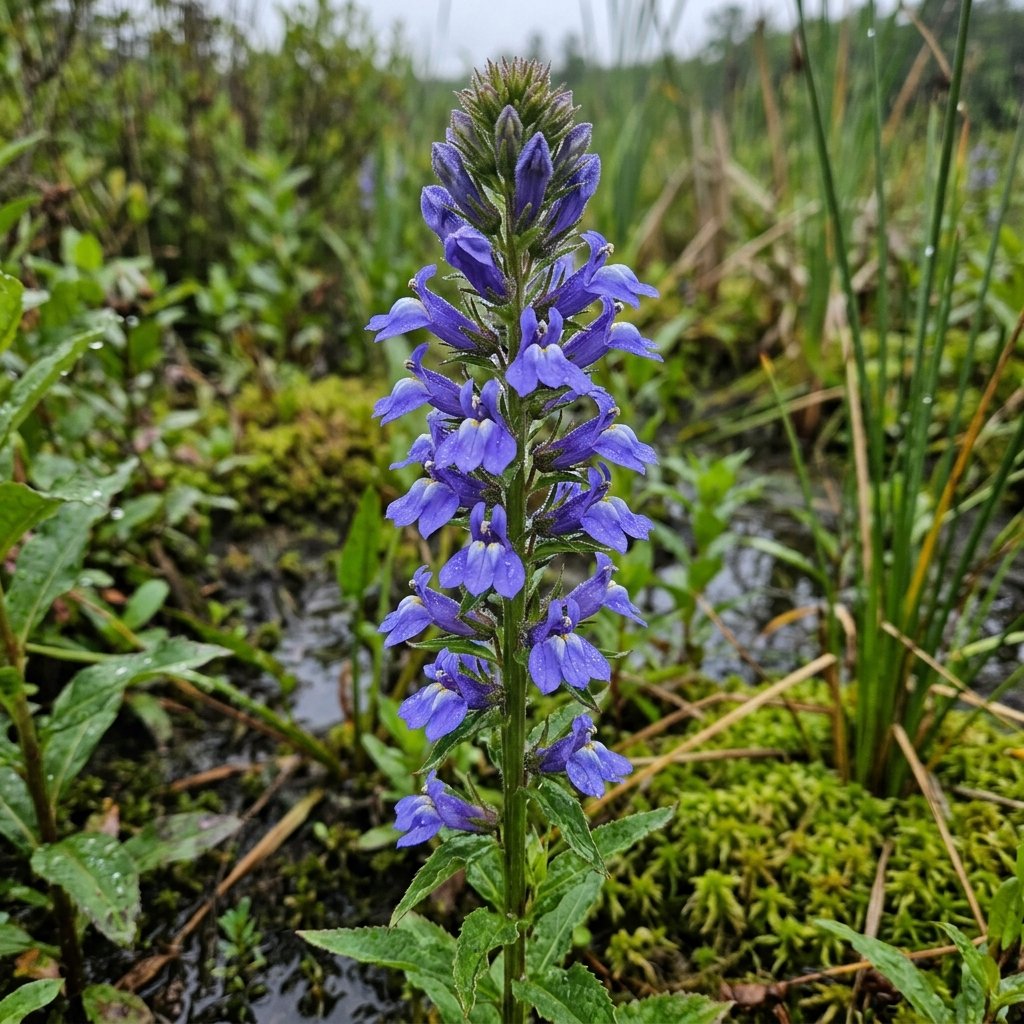
Great Blue Lobelia
Lobelia siphilitica
Great Blue Lobelia (*Lobelia siphilitica*) is a stunning native wildflower of eastern North America, producing tall spikes of vivid blue-violet to true blue flowers from late summer through fall in moist meadows, stream banks, and woodland edges. The blue-flowered counterpart to the scarlet Cardi...
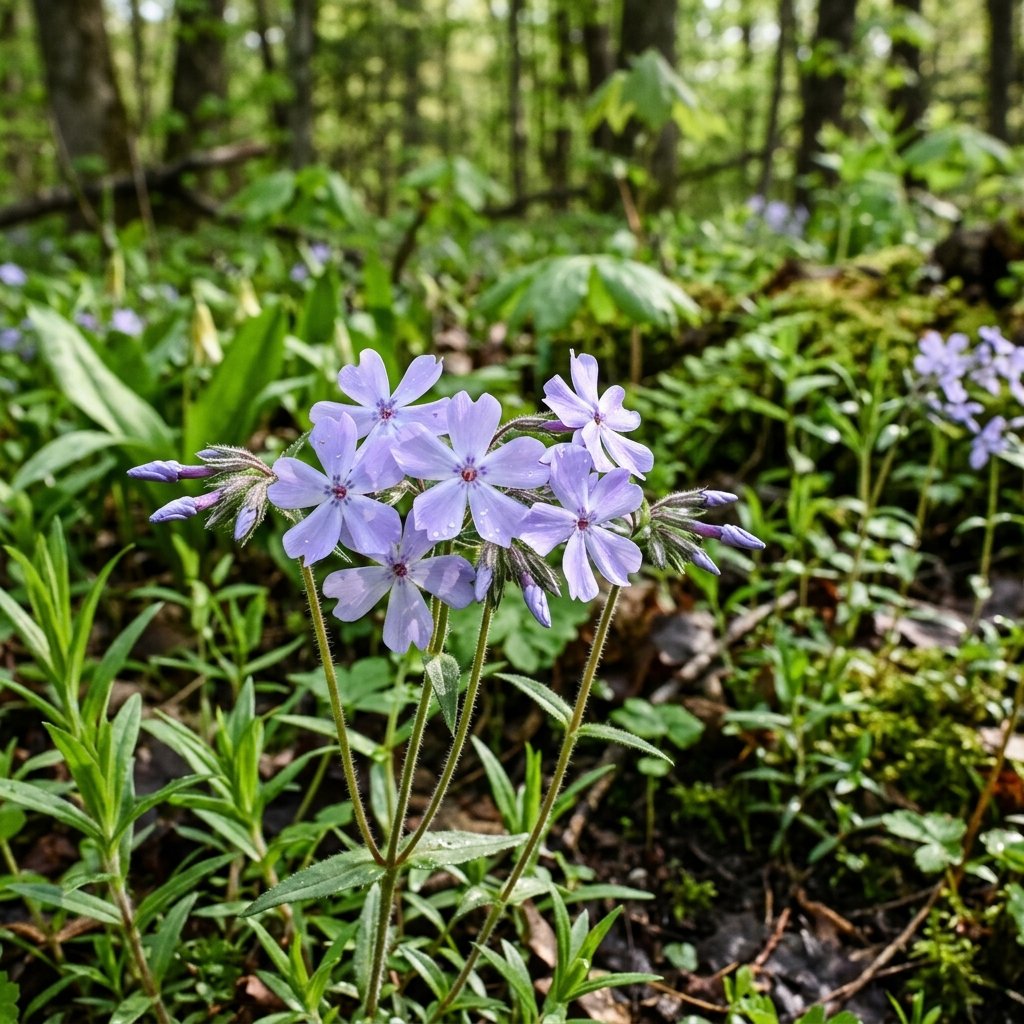
Wild Blue Phlox
Phlox divaricata
Wild Blue Phlox (*Phlox divaricata*), also widely known as Blue Phlox or Woodland Phlox, is one of the most fragrant and visually graceful native wildflowers of eastern North American woodlands, producing loose, open clusters of pale blue to lavender-blue flowers with a sweet, light perfume in Ap...
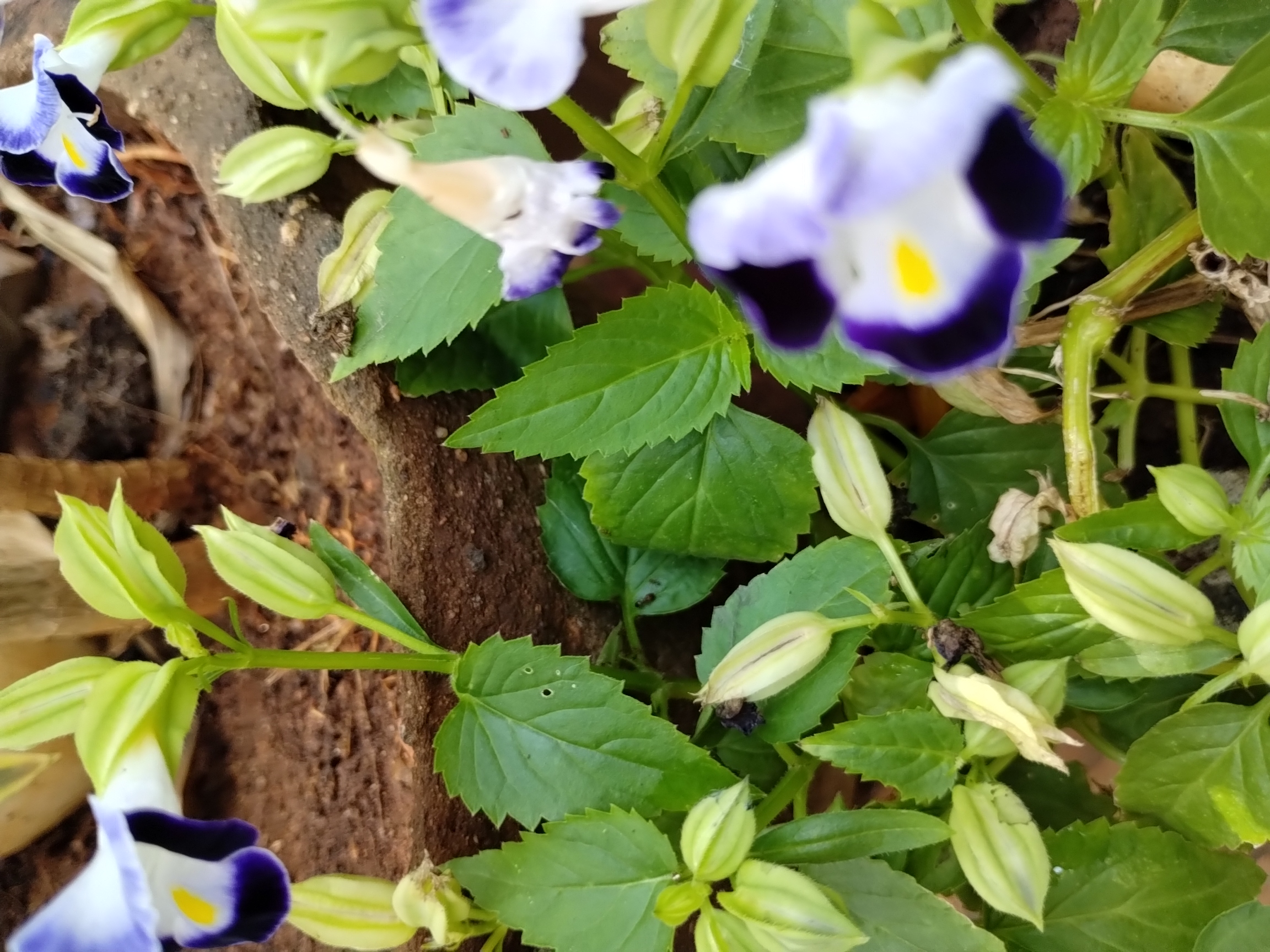
Bluewings
Torenia fournieri
The Wishbone Flower, botanically designated as Torenia fournieri and commonly called Bluewings, is an exceptionally charming, shade-loving tender annual. Belonging to the family Linderniaceae (formerly grouped under Scrophulariaceae), this beautiful plant is native to the moist, shady forest floo...
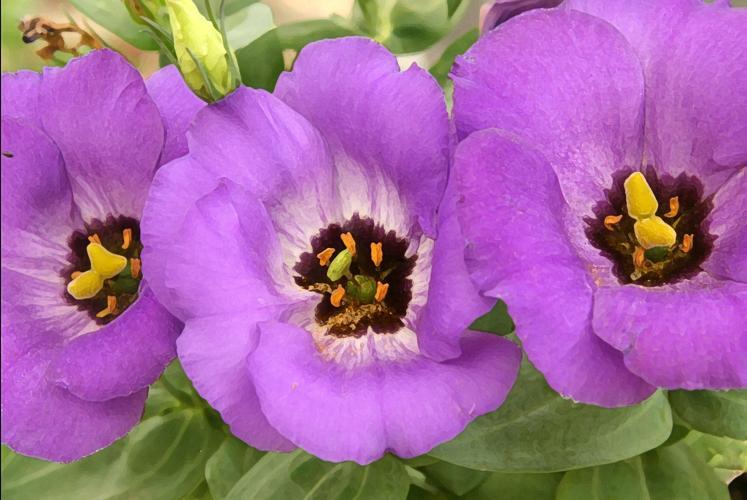
Texas Bluebell (Lisianthus)
Eustoma grandiflorum 'Bolero Deep Blue'
The 'Bolero Deep Blue' is a spectacular cultivar of Eustoma grandiflorum, widely known by its common names: Texas Bluebell, Prairie Gentian, or Lisianthus. Belonging to the Gentianaceae family, this elegant herbaceous annual (or short-lived perennial) is native to the warm, dry prairies and field...
Similar Characteristics
4
Primrose (Cowslip)
Primula veris
Cheerful spring wildflower with clusters of nodding yellow flowers on tall stems above rosettes of wrinkled leaves. One of first flowers to bloom in spring, earning name from Latin 'prima rosa' (first rose). Sweet honey scent attracts early bees. Used in herbal medicine for centuries. Popular in...
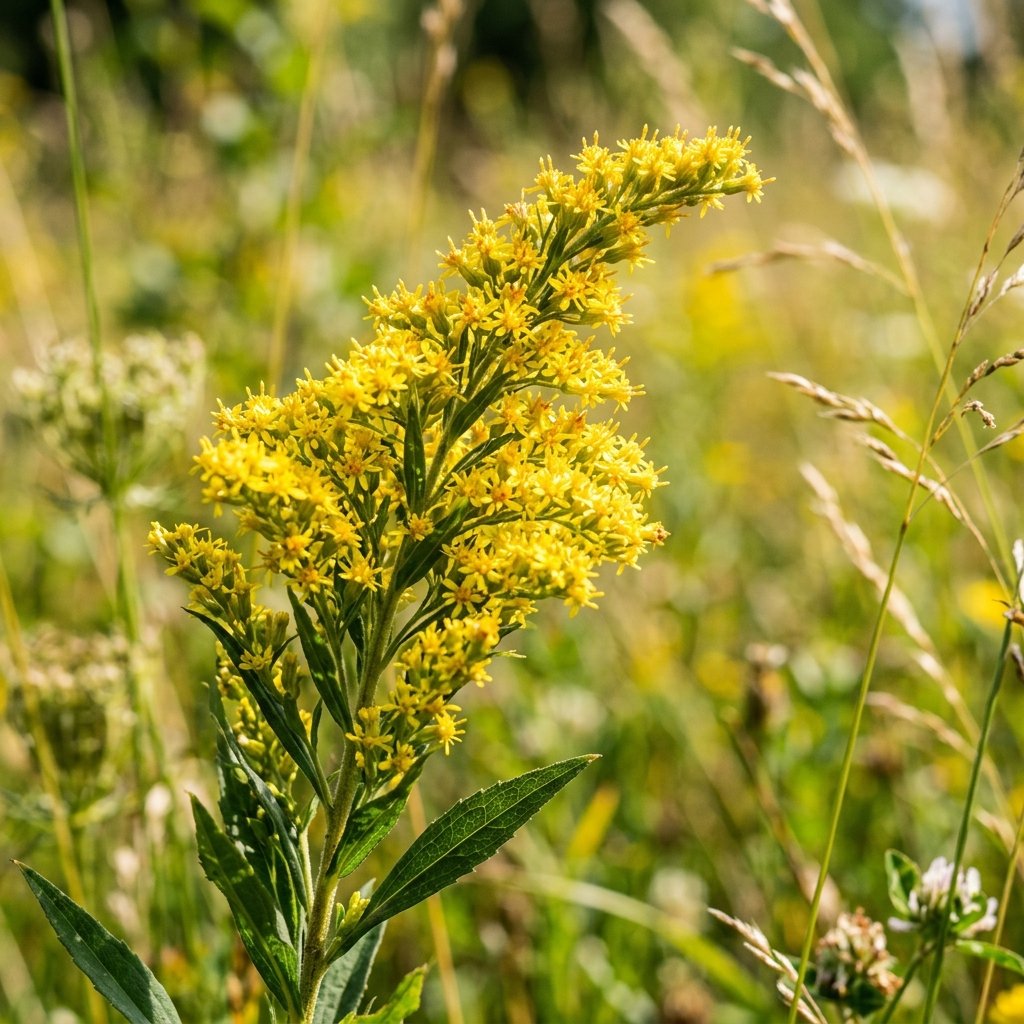
Goldenrod
Solidago canadensis
Goldenrod (*Solidago* spp.) is one of the most ecologically important and visually spectacular native wildflowers of North America, producing brilliant cascading plumes of tiny golden-yellow flowers from late summer through autumn. With over 100 species native to the Americas (most concentrated i...
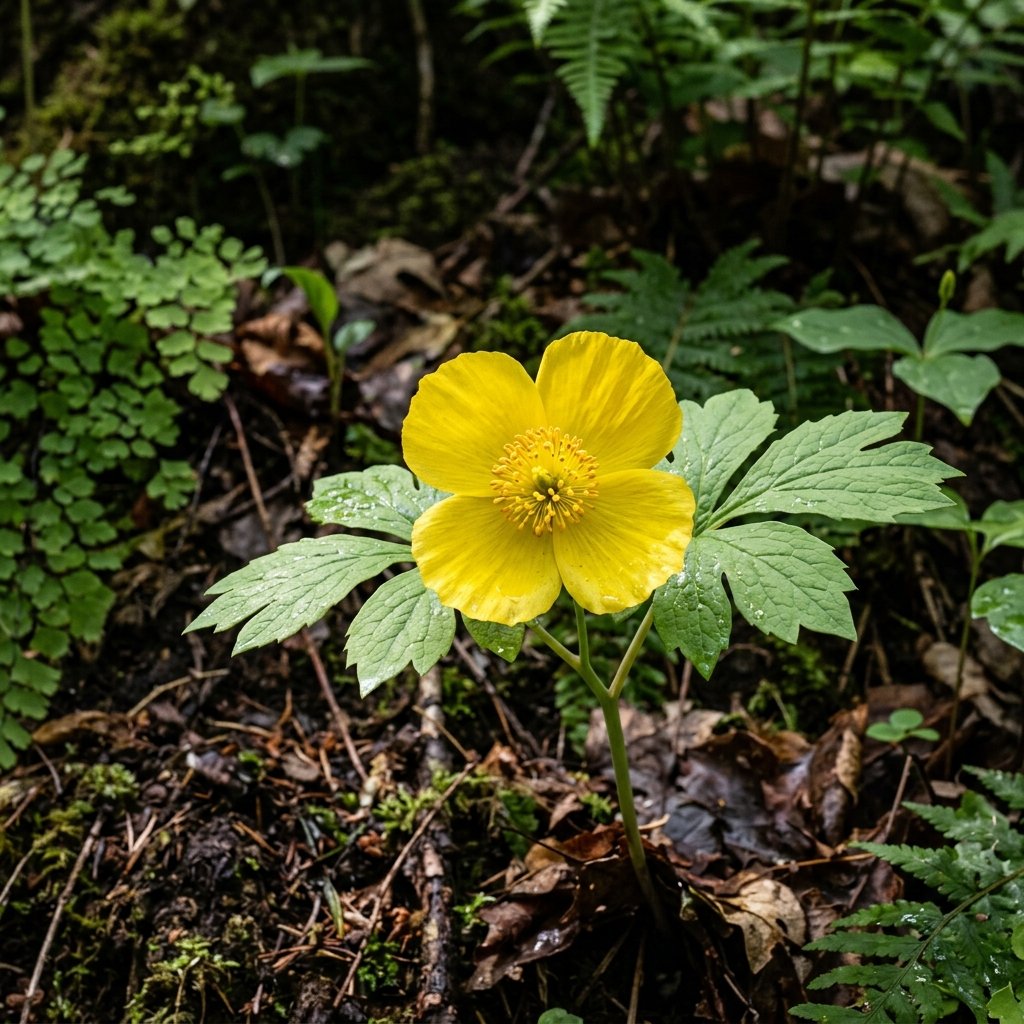
Wood Poppy
Stylophorum diphyllum
Wood Poppy (*Stylophorum diphyllum*), also known as the Celandine Poppy or Yellow Wood Poppy, is one of the showiest and most reliable native wildflowers for the shaded woodland garden, producing large, bright butter-yellow poppy flowers 1.5 to 2 inches across above a rosette of deeply lobed, blu...
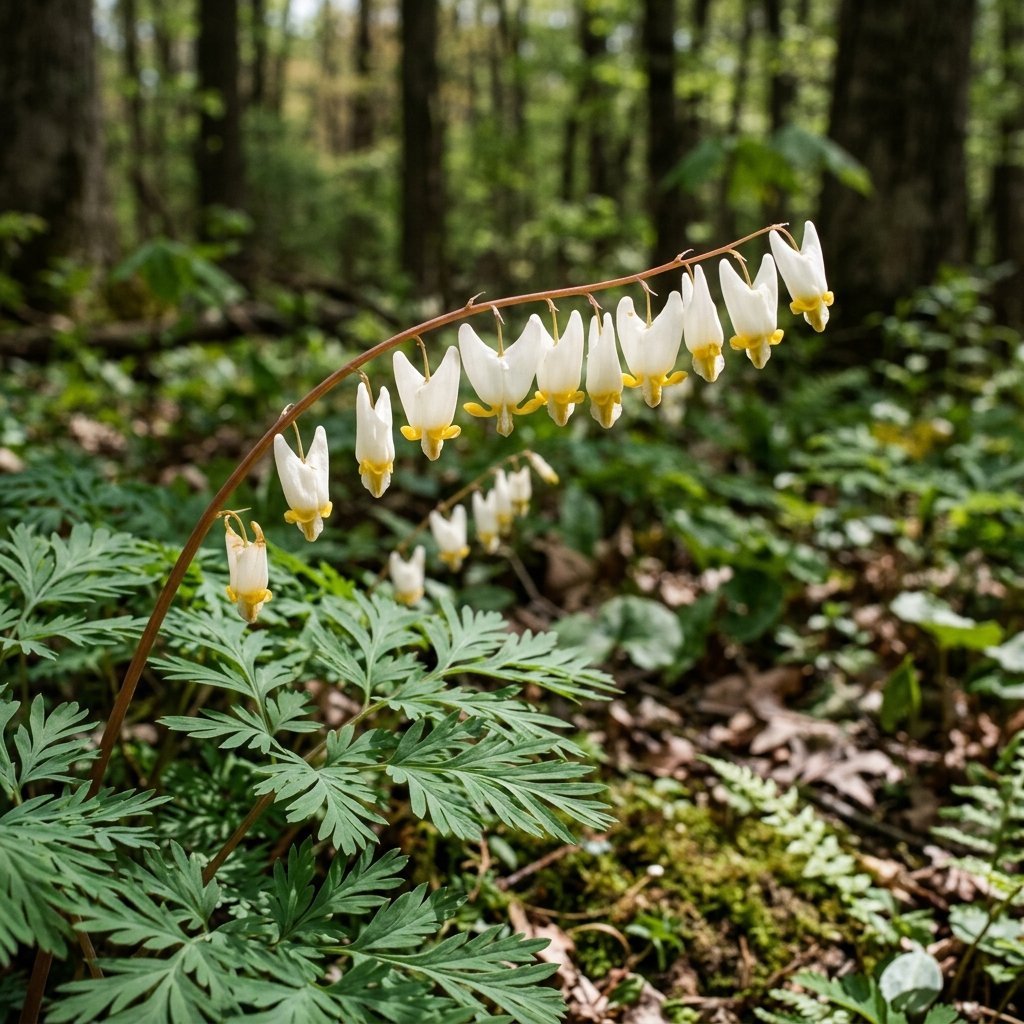
Dutchman's Breeches
Dicentra cucullaria
Dutchman's Breeches (*Dicentra cucullaria*) is one of the most whimsically charming and distinctively shaped wildflowers in the eastern North American spring flora, producing pendulous racemes of pure white flowers shaped precisely like pairs of miniature, upside-down pantaloons or 'breeches' — t...