
Toad Lily
Tricyrtis
How to Identify Toad Lily
TOXIC TO CATS. Classified as Lethal due to its membership in the Liliaceae (lily) family. Ingestion causes stomach upset (vomiting, drooling, diarrhea) but lacks the severe kidney toxicity of true Lilium species.
Care & Growing Guide
Seasonal Blooming & Hardiness
Seasonal Blooming Calendar:
- Peak Bloom: Late summer to autumn (August through October).
- Planting Time: Sow seeds directly outdoors in early spring after the last frost, or transplant nursery starts in late spring.
Bloom Timeline
About Toad Lily
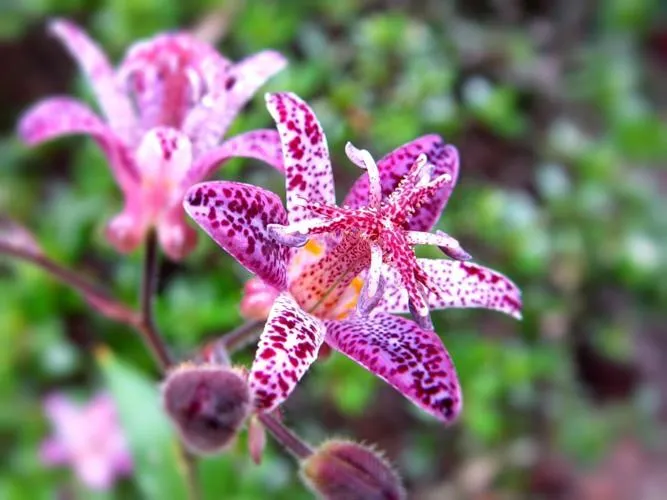
The Toad Lily, botanically classified under the genus Tricyrtis and belonging to the family Liliaceae (the lily family, tribe Lilieae), is an exceptionally exotic, shade-loving perennial. Native to the damp forest understories, shaded mountain valleys, and rocky stream banks of eastern Asia—with the greatest species diversity centered in Japan, Taiwan, China, Korea, and the foothills of the Himalayas—this unique flower is highly valued for bringing orchid-like color to deep shade gardens.
This elegant perennial stands 1 to 3 feet (30 to 90 cm) tall and spreads 1 to 2 feet wide, slowly forming dense clumps from a creeping network of shallow underground rhizomes. It features graceful, arching, fountain-like stems that are covered in fine, soft hairs (particularly in Tricyrtis hirta). Its alternate, lance-shaped, and strongly parallel-veined leaves measure 2 to 6 inches long and clasp the stems at their bases, often displaying subtle dark green speckling.
Toad Lily is legendary for blooming from late summer through mid-autumn (August through October)—a critical window when most other woodland shade perennials have completed their flowering cycles. It produces intricate, star-shaped, and highly patterned flowers measuring 1 to 2 inches across. The petals are pure white or pale amethyst-pink, completely covered in striking, dense purple or maroon spots and speckles that resemble a toad's patterned skin, giving the plant its unusual name.
The highly unique reproductive morphology of individual flowers is represented by the family-specific floral formula EBr ⊕ ☿ P3+3 A3+3 G(3). This formula indicates that the flowers are ebracteate (lacking bracts), radially symmetrical (actinomorphic), and bisexual. The perianth is composed of 6 free, petaloid tepals in two whorls of three, with the three outer tepals carrying nectar-storing sacs at their bases. The androecium contains 6 free stamens that arch outward, and the gynoecium contains 3 fused carpels forming a superior ovary topped by a three-branched style resembling a spotted chandelier.
The genus name Tricyrtis is derived from the Greek words 'tri,' meaning three, and 'kyrtos,' meaning curved, directly referencing the three pocket-like nectar sacs at the base of the outer tepals. Famed in Sanskrit as Tricyrtis (टुक्यर्टिस) and in Hindi as Tod Lili (टोड लिली), it is known in Japan as 'Hototogisu' due to its spotted petals resembling the speckled breast feathers of the native Japanese Cuckoo bird.
For pet owners and veterinarians, the Toad Lily requires careful attention. In the BioLens database, Toad Lily is classified as Lethal because it belongs to the Liliaceae (lily) family. True lilies (Lilium and Hemerocallis species) are highly lethal to cats, causing rapid renal failure. While Tricyrtis is a separate genus and does not typically trigger the same catastrophic kidney failure, it should still be treated with high caution. Ingestion of its leaves or spotted flowers can cause mild to moderate gastrointestinal distress (vomiting, drooling, or diarrhea) in cats and dogs. For comprehensive safety tips, visit our general Pet Guard page.
Toad Lily is occasionally confused with wild orchids or passionflowers due to its complex floral structure. It is easily distinguished because true Tricyrtis possesses alternate clasping leaves on arching, hairy stems, and upright, spotted star-shaped flowers with a prominent three-branched style. It is a premier choice for moist shade borders; To explore more late-season woodland perennials, browse our Flower Identifier.
Floral Formula & Features
Ebracteate (no bracts), Actinomorphic (radially symmetrical), bisexual, 6 free tepals in 2 whorls of 3 (perianth - no distinction between sepals and petals), 6 free stamens in 2 whorls of 3, 3 fused carpels with superior ovary
- Scientific Name & Classification: Tricyrtis (Lamiaceae). Globally famed as Toad Lily, Hairy Toad Lily, and Japanese Toad Lily.
- Identification Markers: Arching hairy stems, alternate clasping leaves, and 1-2 inch orchid-like star-shaped flowers with white or pale lavender petals heavily speckled with purple spots.
- Floral Formula (EBr ⊕ ☿ P3+3 A3+3 G(3)): Radially symmetrical, bisexual flowers with 6 free tepals (3 outer with nectar sacs), 6 free stamens, and superior ovary with a branched spotted style.
- Growing Requirements: Partial to deep dappled shade; cool, organic, humus-rich, consistently moist, well-draining soils. Mulch heavily to keep roots cool (Zones 4-9).
- Cultural Significance: Name comes from Greek 'tri' (three) and 'kyrtos' (curved) for nectar sacs. Japanese name 'Hototogisu' compares spotted petals to cuckoo bird feathers.
- Safety & Toxicity: TOXIC TO CATS. Classified as Lethal due to its membership in the Liliaceae (lily) family. Ingestion causes stomach upset (vomiting, drooling, diarrhea) but lacks the severe kidney toxicity of true Lilium species.
- Common Look-alikes: Confused with Wild Orchids, but easily distinguished by its clasping leaves, fuzzy upright stems, and star-shaped, spotted flowers with a three-branched style.
- Brings a vibrant, late-season color burst to damp shade paths when planted alongside other foliage favorites like hostas or ferns.
Names in Different Languages
Botanical Classification: Toad Lily belongs to the Liliaceae family. Learn how to identify its floral symmetry, stamen arrangement, and structural formulas in our Botanical Family Classification Guide.
Toxicity & Safety
Always keep toxic plants out of reach of children and pets. Consult a veterinarian or medical professional immediately if ingestion is suspected.
Frequently Asked Questions
What is Floral Formula?
A floral formula is a symbolic representation of a flower's structure using letters, numbers, and special symbols. It provides a concise way to describe the arrangement and number of floral parts.
This formula describes the flower's symmetry, sepals, petals, stamens, and carpels in a standardized format.
Formula Sequence
- Bract: Br or Ebr
- Bracteole: Brl or Ebrl
- Symmetry: % (Radial) or ⊕ (Bilateral)
- Sex: ♀ (Female), ♂ (Male), or ⚥ (Bisexual)
- Calyx/Sepal: K<number> (Free or Fused)
- Corolla/Petal: C<number> (Free or Fused)
- Androecium: A<number> (Free or Fused)
- Gynaecium: G<number> (Superior or Inferior Ovary)
Symbol Meanings
- Numbers: Indicate quantity of parts
- Parentheses (): Parts are fused together
- Plus (+): Parts in different whorls
- Underline: Superior ovary position
- Overline: Inferior ovary position
- ∞: Numerous parts (too many to count)
Understanding floral formulas helps botanists quickly identify and classify flowers based on their structural characteristics.
Similar Flowers
Discover flowers that share botanical characteristics
Same Family
4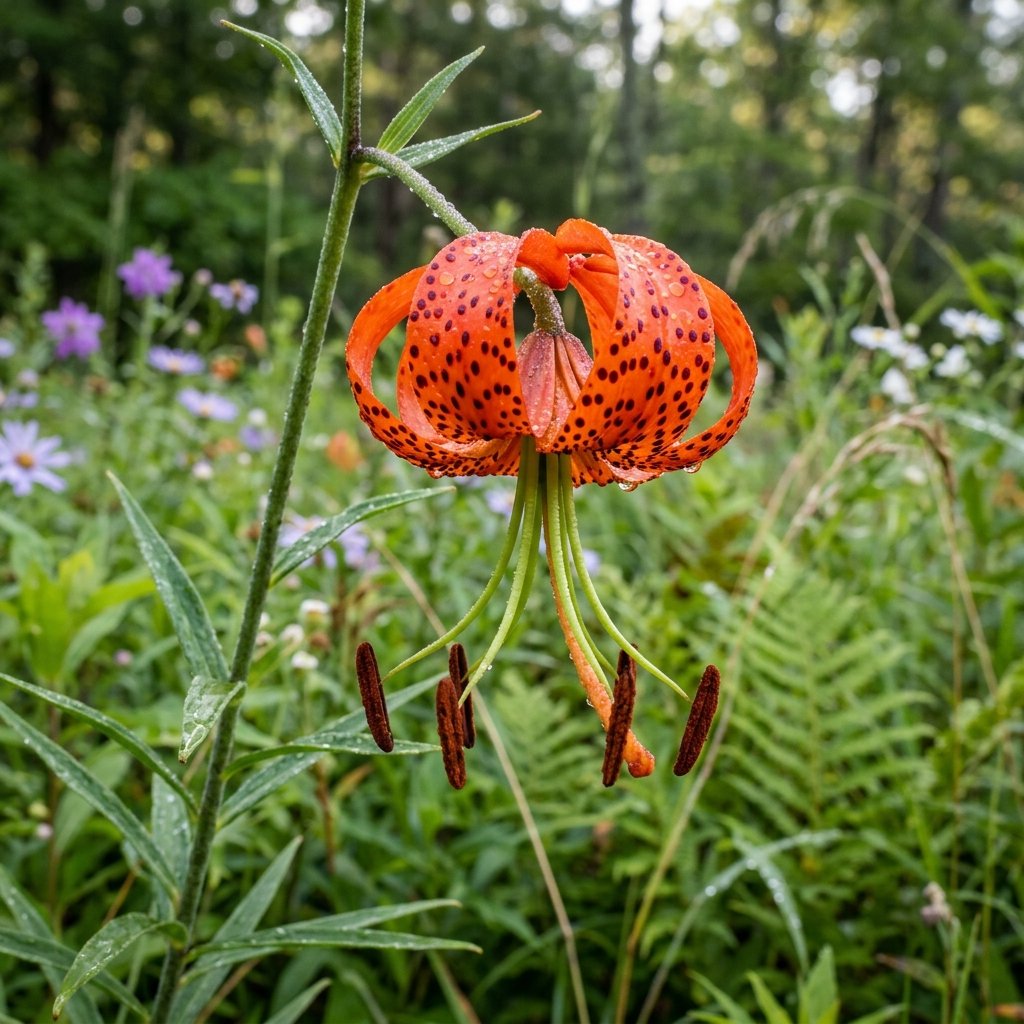
Turk's Cap Lily
Lilium superbum
Turk's Cap Lily (*Lilium superbum*) is the tallest native lily in North America and one of the most spectacular wildflowers of the eastern United States, reaching heights of 4 to 8 feet with multiple nodding, bright orange flowers dramatically spotted with purple-brown and with their petals fully...
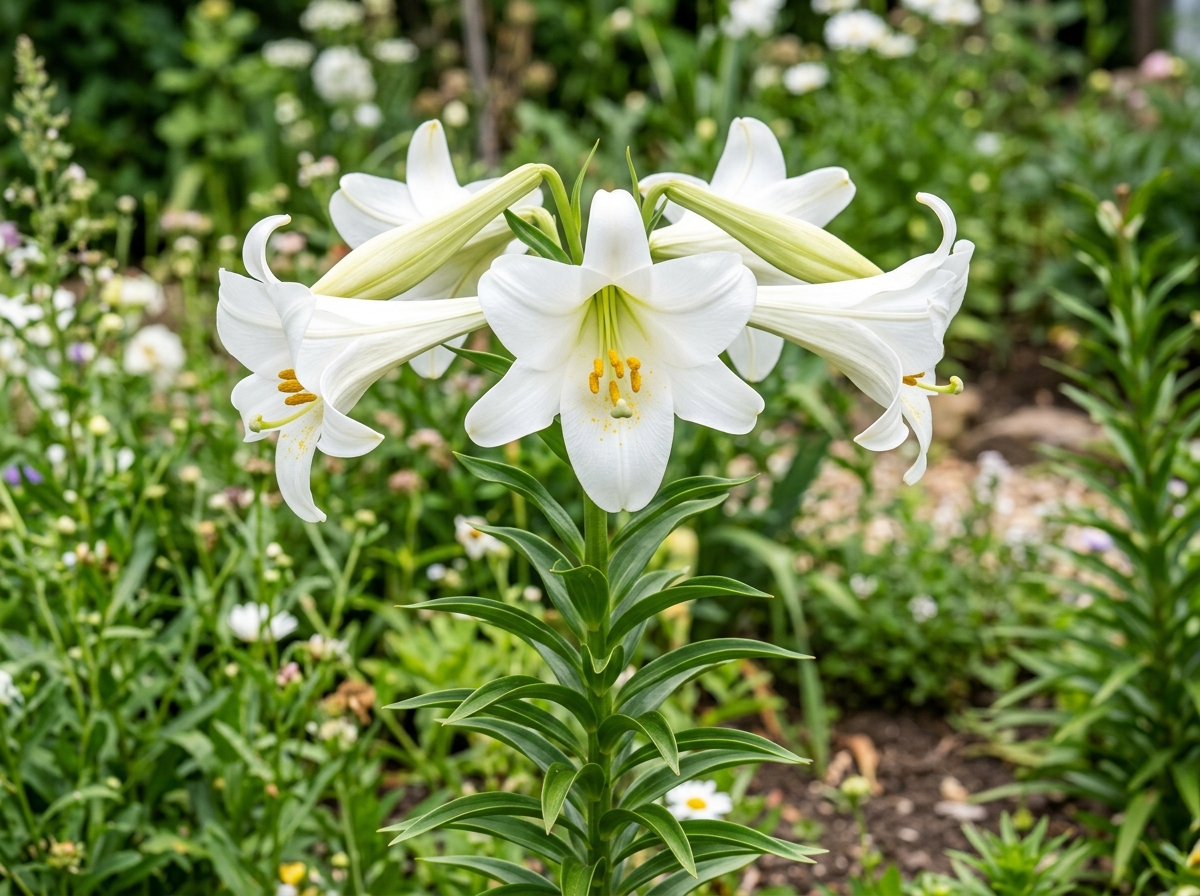
Easter Lily
Lilium longiflorum
Easter Lily (*Lilium longiflorum*), native to the Ryukyu Islands of Japan, is a classic trumpet-shaped white lily famed for its elegant pure white blooms and intense sweet fragrance. It is traditionally forced into bloom in spring for Easter celebrations and spring floral displays. Historically,...

Tulip
Tulipa
The Tulip, botanically designated under the genus Tulipa and belonging to the family Liliaceae (the lily family, tribe Lilieae), is an exceptionally iconic, globally celebrated spring-blooming bulbous herbaceous perennial. Native to the dry, mountainous heights, rocky slopes, and sweeping grassla...
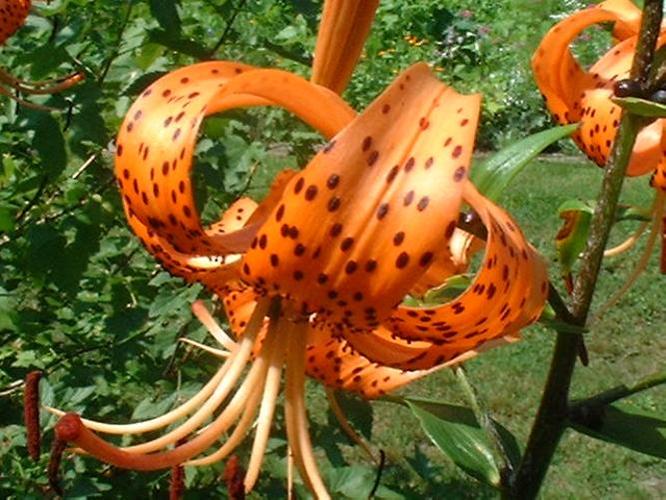
Tiger Lily
Lilium lancifolium
The Tiger Lily (Lilium lancifolium), a standout member of the Liliaceae family, is one of the most recognizable and striking lilies in the world. Native to the temperate regions of Eastern Asia, including China, Japan, and Korea, this herbaceous perennial has captivated gardeners for centuries wi...
Similar Characteristics
4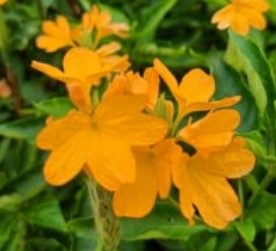
Crossandra Firecracker
Crossandra infundibuliformis
The Firecracker Flower, scientifically known as Crossandra infundibuliformis and popularly called Aboli or Kanakambaram in India, is a beautiful tropical evergreen shrub belonging to the Acanthaceae family. Native to the shady forest understories of southern India and Sri Lanka, particularly the...
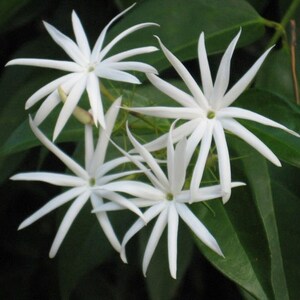
AngelWing Jasmine (Star Jasmine)
Jasminum laurifolium, Jasminum nitidum
The Angelwing Jasmine, botanically classified as Jasminum nitidum (and often associated with Jasminum laurifolium), is an exceptionally beautiful and intensely fragrant evergreen sprawling shrub. Native to the warm, tropical lowlands, coastal woodlands, and river valleys of the Indian Subcontinen...

Black eyed Susan
Rudbeckia hirta
Rudbeckia hirta, famously known as the "Black-Eyed Susan" or "Yellow Ox-Eye Daisy," is a quintessentially American wildflower that brings a burst of radiant sunshine to North American landscapes. A member of the Asteraceae (Daisy) family, this resilient species is native to much of the central an...
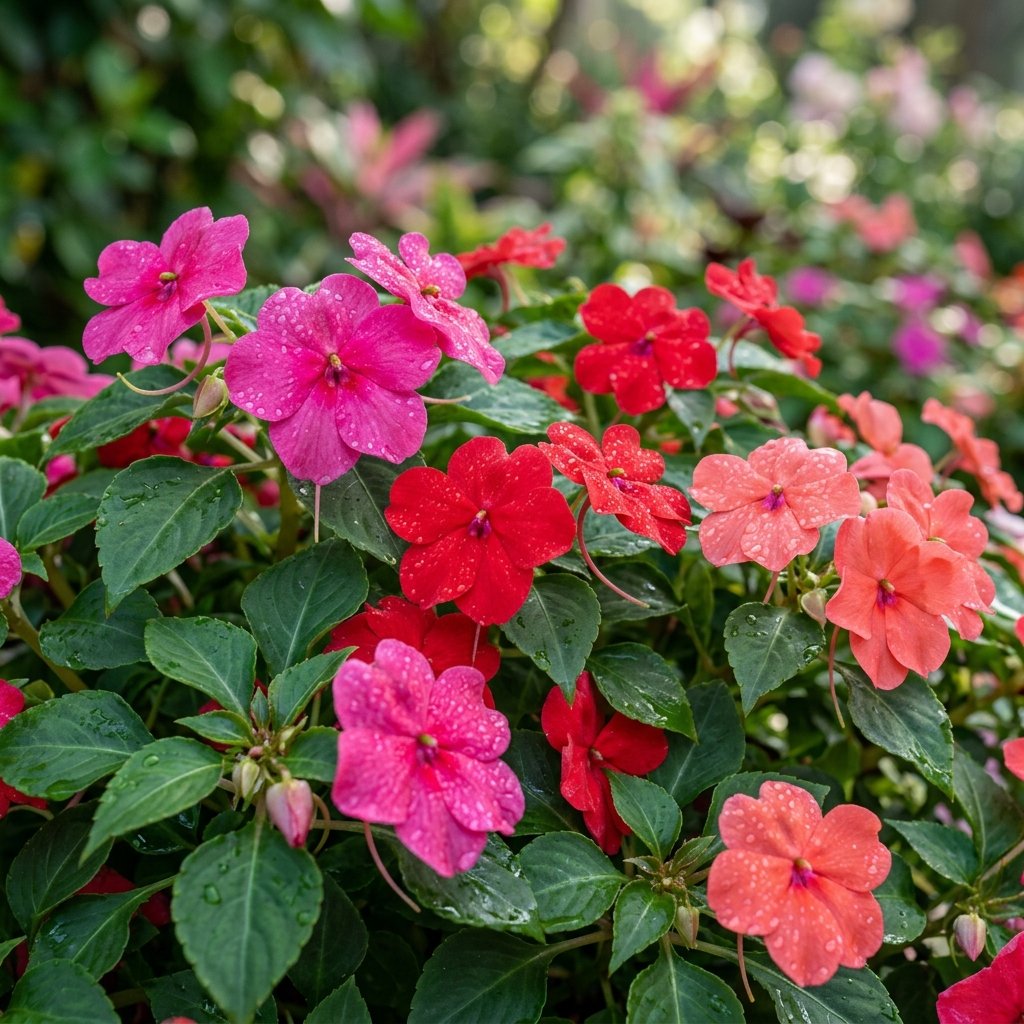
Impatiens Walleriana
Impatiens walleriana
Impatiens Walleriana, botanically classified as *Impatiens walleriana* and universally celebrated across the gardening world as Busy Lizzie, Sultana, or Patient Lucy, is an exceptionally popular, prolific, and shade-tolerant herbaceous perennial commonly cultivated as an annual. Belonging to the...