
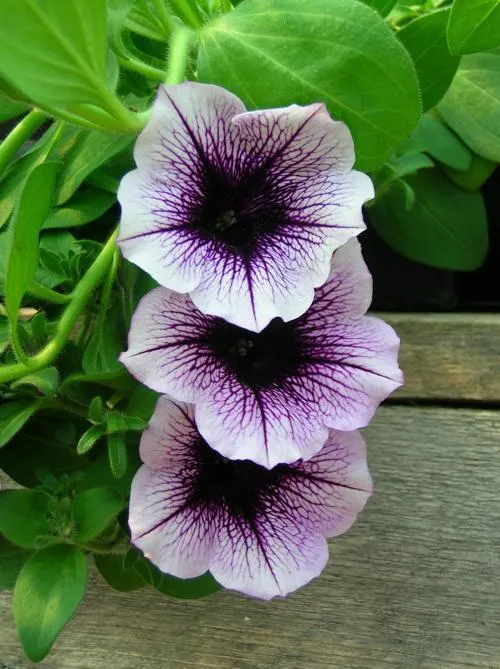
Petunia
Petunia
How to Identify Petunia
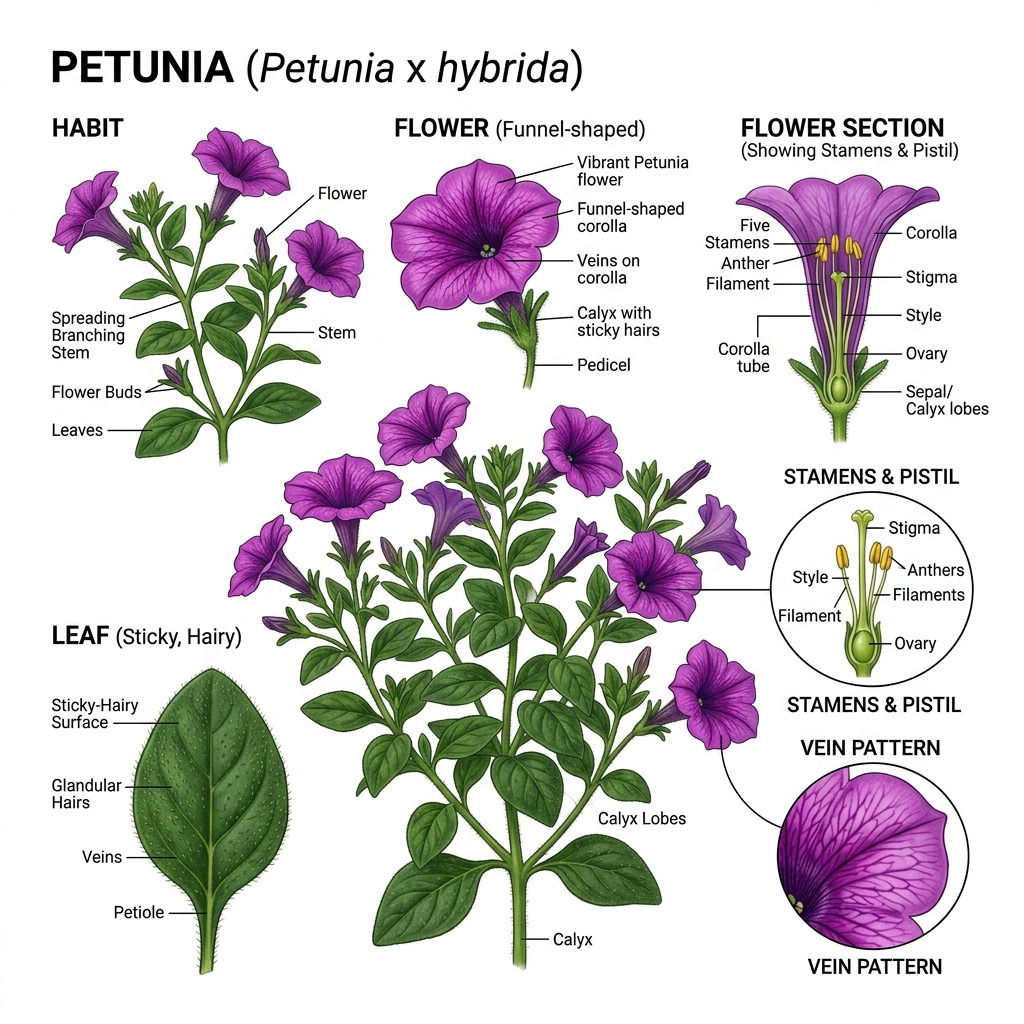
How to identify Petunias (Petunia genus):
- Funnel-Shaped Flowers: Petals are fused into a clean trumpet or funnel shape, displaying distinct veins running to the edges.
- Sticky, Hairy Leaves: Oval, alternate leaves covered in fine hairs that release a sticky sap when handled.
- Spreading Growth Habit: Branching, trailing, or mounding stems ideal for hanging baskets and groundcover.
- Five Stamens: The flower contains 5 stamens, with 4 arranged in unequal pairs and 1 smaller stamen.
Types & Sub-types of Petunias
Cultivated petunias are categorized into four main classes based on flower size and habit:
- Grandiflora: Produce massive, single flowers (up to 4 inches across). Susceptible to rain damage.
- Multiflora: Produce smaller, abundant flowers. Highly weather-resistant and ideal for garden beds.
- Milliflora: Very compact plants with tiny, abundant flowers (1 inch across). Ideal for containers.
- Wave/Spreaders: Fast-growing trailing varieties that spread up to 4 feet, creating cascades of color.
Care & Growing Guide
Petunia Care & Growing Guide:
- Light: Full sun (at least 6 hours of direct light daily) is essential to keep them blooming continuously.
- Soil: Light, fertile, well-draining soil. Susceptible to root rot in dense, clay soils.
- Watering: Water deeply weekly for garden beds; container petunias may need daily watering in hot summer weather.
- Fertilizer: Heavy feeders. Apply a liquid balanced fertilizer weekly for trailing varieties to maintain flower production.
Seasonal Blooming & Hardiness
Seasonal Blooming Calendar (US Hardiness Zones 9-11 as perennials; Zones 2-8 as summer annuals):
- Native Region: Native to tropical South America, where they grow as evergreen perennials.
- US Cultivation: Grown as summer annuals. Sow seeds indoors in late winter, or plant transplants in spring after frost. Blooms continuously from spring through the first autumn frost.
Bloom Timeline
About Petunia
The Petunia, botanically designated under the genus Petunia (particularly the widely grown garden hybrid Petunia × atkinsiana), is an exceptionally popular, highly prolific annual or tender perennial. Belonging to the family Solanaceae (the nightshade family, tribe Petunioideae), this South American native is found growing wild along the riverbanks, dry grassy plains, and sandy hillsides of Argentina, Brazil, and Uruguay, and has become a global favorite since its hybridization in the 19th century.
Growing 6 to 18 inches (15 to 45 cm) tall and spreading 1 to 3 feet wide, this branching herb features opposite, oval-shaped, and light green leaves covered in tiny glandular hairs that feel sticky to the touch. From late spring through the first autumn frost, it produces an endless, highly spectacular display of trumpet-shaped or funnel-shaped flowers measuring 1.5 to 4 inches across. Blossoms display flat, radially symmetrical lobes in almost every imaginable color—including royal purple, deep red, hot pink, soft yellow, pure white, and striking striped, speckled, or ruffled bicolors (such as 'Night Sky').
The flower's morphology is represented by the family-specific floral formula ⊕ ⚥ K(5) [C(5) A5] G(2). This formula states that individual flowers are radially symmetrical (actinomorphic) and bisexual. The calyx consists of 5 fused sepals forming a green star. The corolla consists of 5 fused petals forming the classic trumpet-shaped corolla tube. The androecium contains 5 stamens fused to the inner wall of the corolla tube, and the gynoecium contains 2 fused carpels with a superior ovary that matures into a small, dry, two-valved capsule releasing hundreds of tiny black seeds.
Cultivating Petunias is exceptionally rewarding, as they are high-performance plants. They require full, direct sunlight (at least 6 hours daily) to maximize flower production and keep the stems dense and compact; partial shade will cause them to become leggy and slow down blooming. They thrive in average, moderately fertile, and sharply well-draining sandy loam soils with a neutral pH. They are heavy feeders and require regular balanced fertilizing and deep watering, provided the soil is allowed to dry out slightly between waterings.
The genus name Petunia is derived from the local Tupi-Guarani word petum, meaning 'tobacco,' celebrating the plant's close botanical relationship to the commercial tobacco plant (Nicotiana). Famed in Sanskrit as Petunia (पिटूनिया) and in Hindi as Petuniya (पेटुनिया), they represent anger, resentment, or the soothing presence of a comforting spirit in the Victorian language of flowers.
For pet owners and veterinarians, the Petunia represents an exceptionally safe, low-risk, and non-toxic choice. Unlike its highly toxic nightshade relatives (like belladonna or tobacco), Petunia species are completely safe for dogs, cats, and horses. If a pet brushes past its sticky hanging baskets or chews on its colorful trumpets, there is absolutely no danger of toxic chemical poisoning. For complete pet safety tips and container layouts, visit our specific Pet Guard Petunia guide. It is easily distinguished from Calibrachoa by its larger flower size. It pairs beautifully with Geranium or Lobelia. To search more container annuals, browse our Flower Identifier.
Floral Formula & Features
Ebracteate, radially symmetrical (actinomorphic), bisexual, 5 fused sepals forming calyx tube, 5 fused petals forming funnel-shaped corolla, 5 stamens attached to corolla tube, 2 fused carpels with superior ovary
- Name from French 'pétun' (tobacco) from Tupi-Guarani language - related to tobacco plant. About 20 Petunia species. Main types: Grandiflora (large 3-5 inch flowers), Multiflora (smaller 2 inch flowers, more blooms), Wave/Spreading (ground cover), Milliflora (tiny 1 inch flowers)
- Flowers 2-5 inches (5-12 cm) across, funnel or trumpet-shaped. 5 fused petals forming tube. Colors: purple, pink, red, white, yellow, blue, black, bicolors, stripes, veining. Single or double forms. Some varieties fragrant (especially white, night-scented). Blooms late spring through frost (May-October)
- Tender perennial grown as annual in most climates. Bushy or trailing habit depending on variety. Sticky, hairy leaves and stems. Upright types 6-18 inches tall, spreading types trail 2-4 feet. Self-cleaning (flowers drop when spent) or need deadheading depending on variety
- Grows 6-24 inches (15-60 cm) tall for upright types. Trailing types spread 2-4 feet (60-120 cm). Lifespan one season as annual, 2-3 years in frost-free zones. Propagated from seeds (tiny, need light to germinate) or cuttings. Blooms 60-90 days from seed
- Native to South America, particularly Argentina, Brazil, Uruguay, Paraguay, Bolivia. Found in grasslands and along roadsides. Now cultivated worldwide as ornamental. Thrives in temperate and subtropical climates
- Requires full sun (6-8 hours daily) for best blooming. Tolerates partial shade but fewer flowers. Needs well-drained soil. Regular watering - don't let dry out completely. Fertilize every 2 weeks. Hardy zones 9-11 as perennial, grown as annual elsewhere. Heat and drought tolerant once established
- Excellent for beds, borders, containers, hanging baskets, window boxes. Trailing types perfect for cascading displays. Attracts hummingbirds, butterflies, moths. Deer resistant. Low maintenance - some varieties self-clean. Provides continuous color all summer
- Easy for beginners - very forgiving. Pinch back leggy stems to encourage bushiness. Deadhead spent flowers (except self-cleaning types) for more blooms. Can get leggy in midsummer - trim back by half to rejuvenate. Symbolizes anger or resentment in flower language, but also comfort and soothing
- Internal Links: Compare key differences in our Petunia vs Geranium comparison, or try our instant Flower Identifier.
Names in Different Languages
Botanical Classification: Petunia belongs to the Solanaceae family. Learn how to identify its floral symmetry, stamen arrangement, and structural formulas in our Botanical Family Classification Guide.
Toxicity & Safety
Pet Safety Guide: For detailed toxicity symptoms, first-aid measures, and safe garden alternatives, see our full Pet Guard Profile for Petunia.
Frequently Asked Questions
What is Floral Formula?
A floral formula is a symbolic representation of a flower's structure using letters, numbers, and special symbols. It provides a concise way to describe the arrangement and number of floral parts.
This formula describes the flower's symmetry, sepals, petals, stamens, and carpels in a standardized format.
Formula Sequence
- Bract: Br or Ebr
- Bracteole: Brl or Ebrl
- Symmetry: % (Radial) or ⊕ (Bilateral)
- Sex: ♀ (Female), ♂ (Male), or ⚥ (Bisexual)
- Calyx/Sepal: K<number> (Free or Fused)
- Corolla/Petal: C<number> (Free or Fused)
- Androecium: A<number> (Free or Fused)
- Gynaecium: G<number> (Superior or Inferior Ovary)
Symbol Meanings
- Numbers: Indicate quantity of parts
- Parentheses (): Parts are fused together
- Plus (+): Parts in different whorls
- Underline: Superior ovary position
- Overline: Inferior ovary position
- ∞: Numerous parts (too many to count)
Understanding floral formulas helps botanists quickly identify and classify flowers based on their structural characteristics.
Similar Flowers
Discover flowers that share botanical characteristics
Same Family
2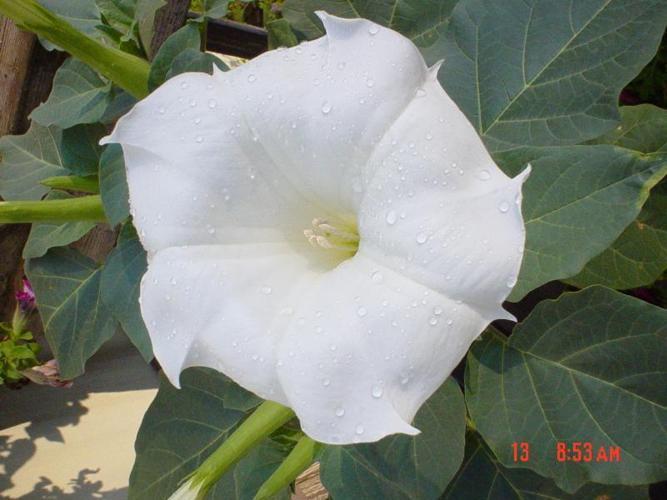
Thorn Apple
Datura stramonium
The Thorn Apple, botanically classified as Datura stramonium and widely known by folk names like Jimsonweed, Devil's Trumpet, or Hell's Bells, is an aggressive, fast-growing annual herb belonging to the Solanaceae (nightshade) family. Native to Mexico and Central America, this highly resilient sp...
Thorn Apple
Datura stramonium
The Thorn Apple, botanically classified as Datura stramonium and widely known by folk names like Jimsonweed, Devil's Trumpet, or Hell's Bells, is an aggressive, fast-growing annual herb belonging to the Solanaceae (nightshade) family. Native to Mexico and Central America, this highly resilient sp...
Similar Characteristics
4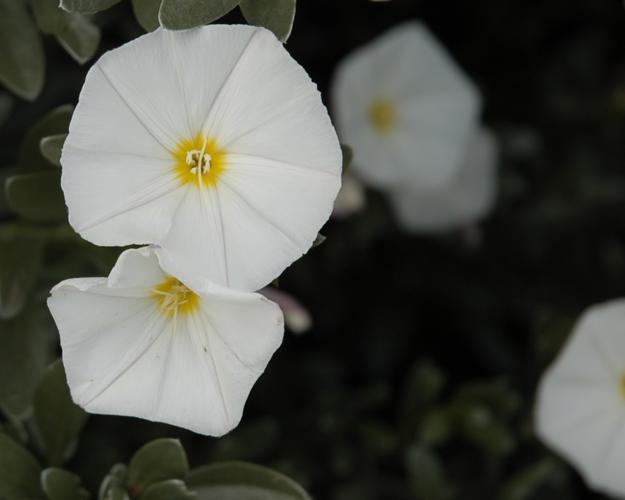
Silverbush
Convolvulus cneorum
The Silverbush, botanically classified as Convolvulus cneorum and widely referred to as the Silvery Bindweed or Bush Morning Glory, is an exceptionally elegant, compact evergreen shrub belonging to the Convolvulaceae (morning glory) family. Unlike its sprawling, climbing vine cousins, this specie...
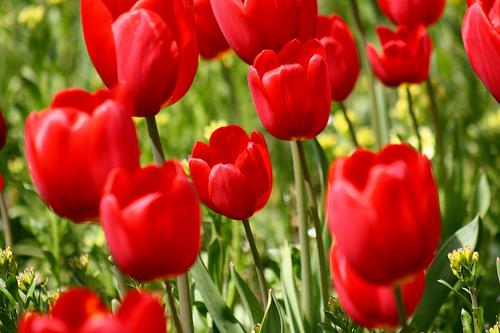
Tulip
Tulipa
The Tulip, botanically designated under the genus Tulipa and belonging to the family Liliaceae (the lily family, tribe Lilieae), is an exceptionally iconic, globally celebrated spring-blooming bulbous herbaceous perennial. Native to the dry, mountainous heights, rocky slopes, and sweeping grassla...
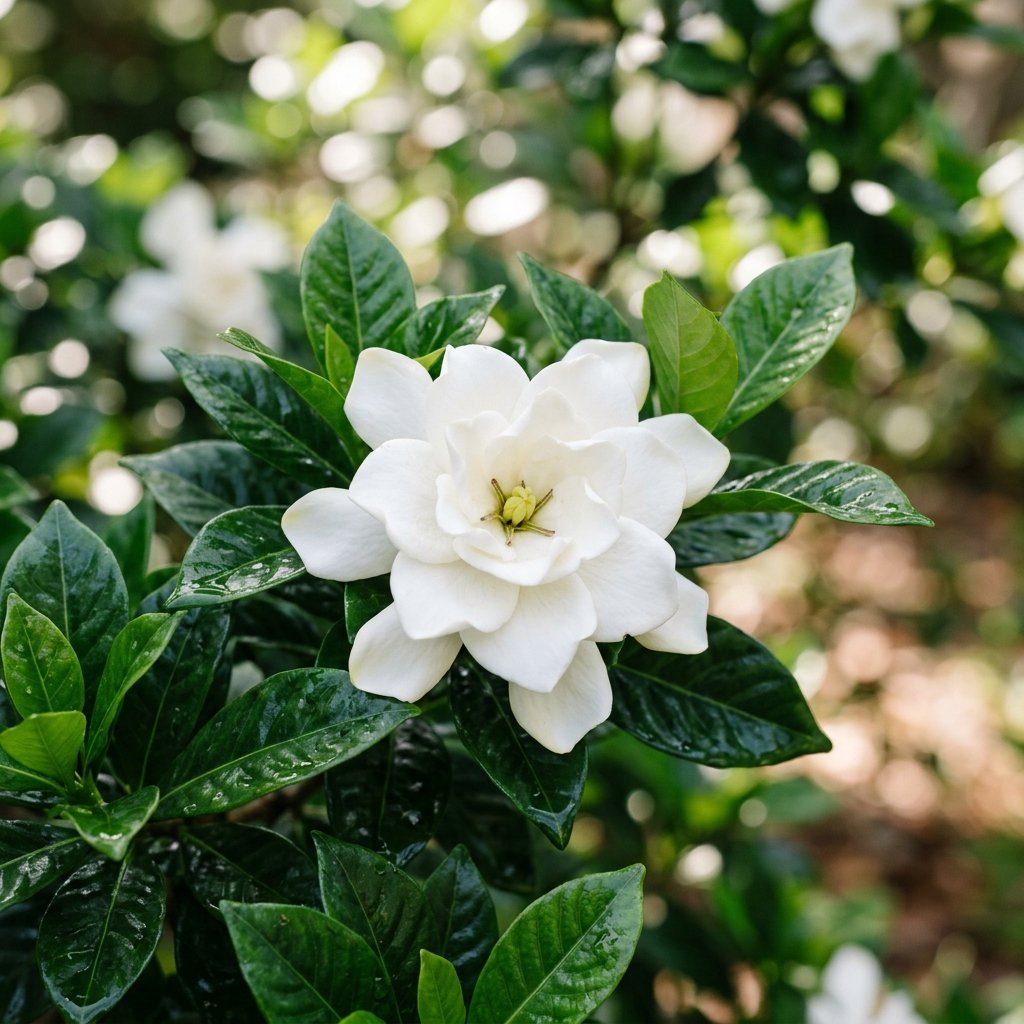
Gardenia
Gardenia jasminoides
Gardenia, botanically classified as Gardenia jasminoides and commonly known as Cape Jasmine, is an exceptionally popular evergreen shrub in the coffee family, Rubiaceae. Native to the subtropical regions of East Asia, it is celebrated worldwide for its waxy, creamy-white blossoms and sweet, intox...
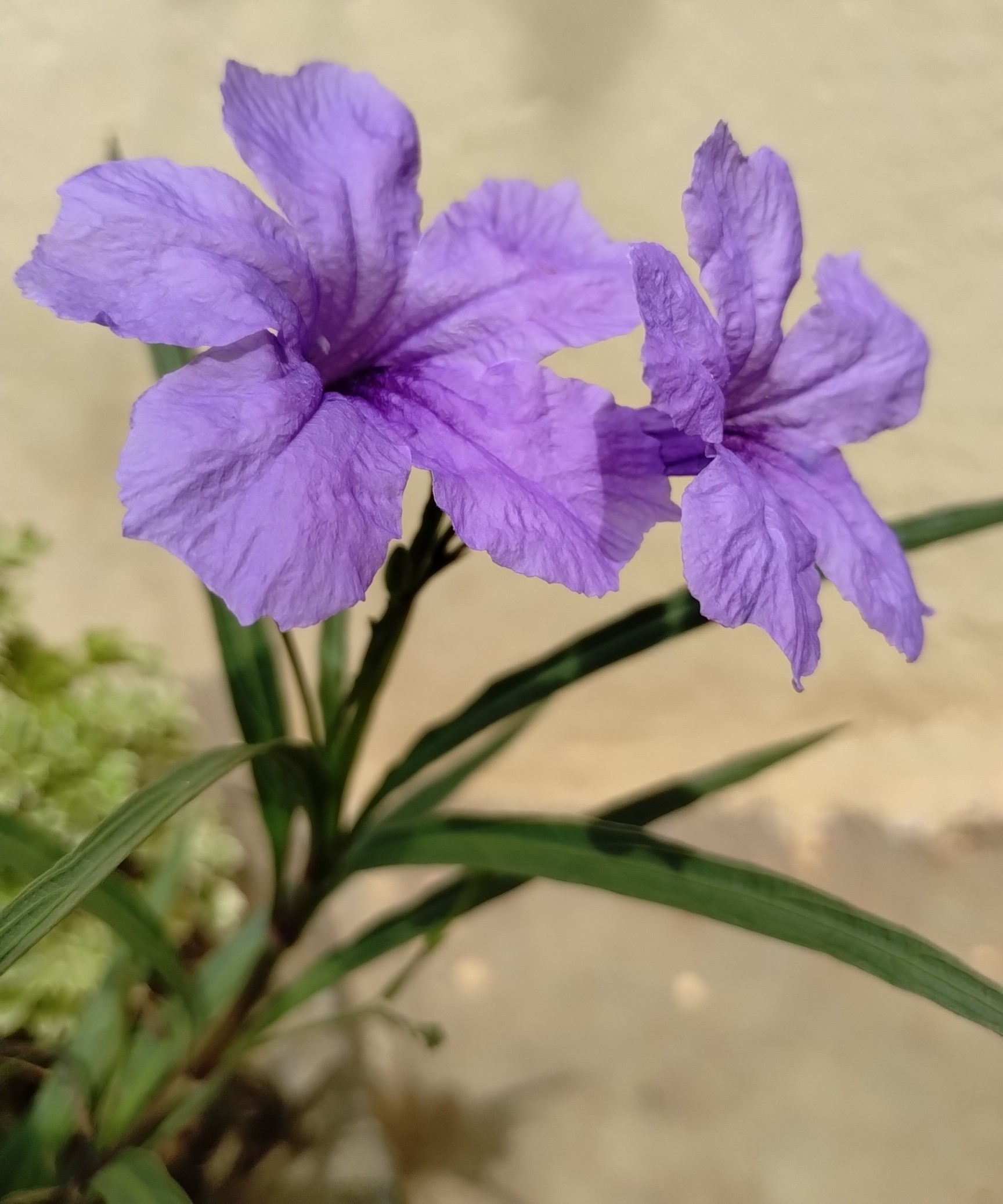
Mexican Petunia
Ruellia simplex
The Mexican Petunia, botanically classified as Ruellia simplex (and historically referred to as Ruellia brittoniana), is an exceptionally vigorous, upright herbaceous perennial belonging to the Acanthaceae (acanthus) family. Native to the warm, moisture-rich woodlands, riverbanks, and wet meadows...