
Anthurium
Anthurium andraeanum
How to Identify Anthurium
TOXIC TO PETS. Packed with insoluble calcium oxalate crystals, causing severe oral burning, intense drooling, difficulty swallowing, and vomiting.
Care & Growing Guide
Seasonal Blooming & Hardiness
Seasonal Blooming Calendar:
- Peak Bloom: Summer (typically June through September).
- Planting Time: Sow seeds directly outdoors in early spring after the last frost, or transplant nursery starts in late spring.
Bloom Timeline
About Anthurium
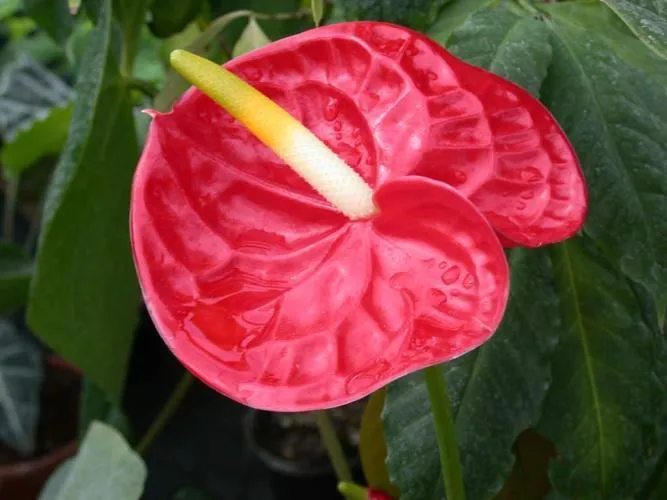
The Anthurium, botanically designated as Anthurium andraeanum and commonly known as the Flamingo Flower, Tailflower, or Painter's Palette, is a spectacular tropical evergreen perennial. Belonging to the family Araceae (the arum or aroid family), this extraordinary plant is native to the wet, humid tropical rainforests of Colombia, Ecuador, and southwestern South America. Growing naturally as an epiphyte in mossy tree canopies or on damp forest floors, it is celebrated worldwide for its waxy, heart-shaped blooms and glossy green leaves.
This popular tropical plant typically grows in lush, upright clumps reaching a height of 1 to 3 feet with a similar spread. It features large, leathery, and deeply heart-shaped (cordate) leaves that hang from long, slender leaf stalks (petioles). It blooms continuously throughout the year under ideal conditions. What appears to be a bright, waxy flower is actually a highly modified leaf called a spathe, displaying a smooth, lacquered, and glossy texture in brilliant shades of scarlet-red, pink, orange, purple, or pure white.
Protruding from the center of this heart-shaped spathe is a finger-like, tail-like central rod called a spadix. This spadix is densely packed with hundreds of tiny, inconspicuous, true botanical flowers. These tiny florets open sequentially over several weeks, and the glossy spathes are exceptionally durable, lasting 6 to 8 weeks on the living plant, or up to 3 weeks as highly prized cut flowers in exotic floral arrangements. Following successful pollination, the spadix produces small, fleshy, colorful berries.
The reproductive morphology of individual true flowers on the spadix is represented by the aroid floral formula ⊕ ⚥ P(4) A4 G(2-3). This formula denotes that each tiny flower is radially symmetrical (actinomorphic) and bisexual. The perianth comprises 4 fused tepals with no clear structural distinction between sepals and petals. The androecium contains 4 free stamens, and the gynoecium contains 2 to 3 fused carpels forming a superior ovary. This structure is highly representative of primitive, beetle-pollinated aroids.
The genus name Anthurium is derived from the ancient Greek words 'anthos', meaning 'flower,' and 'oura', meaning 'tail,' a literal translation of 'tailflower' in reference to the tail-like spadix. Famed in Sanskrit as Chitrakarasya Palette (चित्रकारस्य पॅलेट) and in Hindi as Lal Paudha (लाल पौधा), it has become a staple of modern interior design. In international flower language, its heart-shaped spathes represent hospitality, warm friendship, open abundance, and exotic tropical beauty.
For pet owners and veterinarians, Anthurium represents a notable hazard. The plant is classified as TOXIC TO PETS, including dogs, cats, and horses. All parts of the plant contain highly concentrated insoluble calcium oxalate crystals. If chewed or ingested, these needle-sharp crystals cause immediate, severe oral burning, pain, and irritation. Clinical symptoms include excessive drooling (salivation), difficulty swallowing, foaming at the mouth, vomiting, and dangerous swelling of the upper airway. (Note: Since there is no existing pet-guard page in our database for this species, we do NOT include a pet-guard link here; we advise keeping plants on high shelves.)
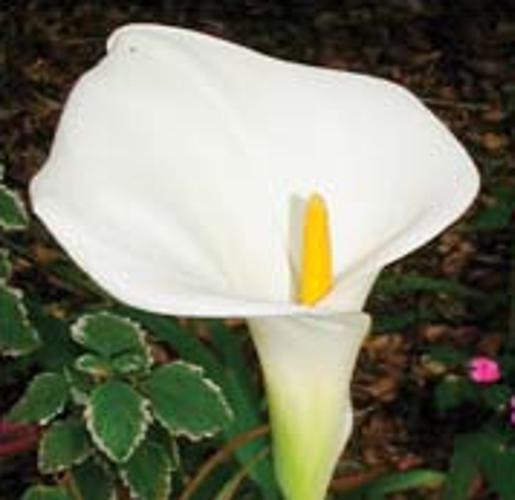
Anthurium is occasionally confused with calla lilies or peace lilies (Spathiphyllum). It is easily distinguished because Anthurium possesses a highly glossy, waxy, lacquered spathe and a protruding spadix, whereas Peace Lilies have soft, thin, non-glossy white spathes. It makes a striking indoor accent; we recommend pairing it beside other high-impact, bold tropical foliage plants like Bromelia or Kalanchoe. To discover more exotic houseplants and indoor care instructions, browse our Flower Identifier.
Floral Formula & Features
Radially symmetrical, bisexual, perianth of 4 fused tepals (no distinction between sepals and petals), 4 stamens, 2-3 fused carpels with superior ovary. This formula describes individual tiny flowers on the spadix, not the showy spathe
- Scientific Name & Classification: Anthurium andraeanum (Araceae). Commonly called Flamingo Flower, Tailflower, and Painter's Palette.
- Identification Markers: Leathery heart-shaped leaves, and waxy lacquered heart-shaped spathes in red, pink, or white surrounding a tail-like yellow-white spadix.
- Floral Formula (⊕ ⚥ P(4) A4 G(2-3)): Radially symmetrical, bisexual tiny florets with 4 fused tepals, 4 stamens, and a 2-3 carpelled superior ovary.
- Growing Requirements: Bright indirect light; warm temperatures (65-80°F) and high humidity (60-80%). Requires porous, highly draining orchid bark soil mix (Zones 10-12).
- Cultural Significance: Name comes from Greek 'anthos' (flower) and 'oura' (tail). Heart shape widely used to symbolize hospitality, warm friendship, and tropical beauty.
- Safety & Toxicity: TOXIC TO PETS. Packed with insoluble calcium oxalate crystals, causing severe oral burning, intense drooling, difficulty swallowing, and vomiting.
- Common Look-alikes: Confused with Peace Lilies or Calla Lilies, but easily distinguished by its highly lacquered waxy spathes and stiff, leathery green foliage.
- Internal Links: Pairs beautifully as an indoor accent beside other tropical, high-impact houseplants like Bromelia or Kalanchoe; find more in our Flower Identifier.
Names in Different Languages
Botanical Classification: Anthurium belongs to the Araceae family. Learn how to identify its floral symmetry, stamen arrangement, and structural formulas in our Botanical Family Classification Guide.
Toxicity & Safety
Always keep toxic plants out of reach of children and pets. Consult a veterinarian or medical professional immediately if ingestion is suspected.
Frequently Asked Questions
What is Floral Formula?
A floral formula is a symbolic representation of a flower's structure using letters, numbers, and special symbols. It provides a concise way to describe the arrangement and number of floral parts.
This formula describes the flower's symmetry, sepals, petals, stamens, and carpels in a standardized format.
Formula Sequence
- Bract: Br or Ebr
- Bracteole: Brl or Ebrl
- Symmetry: % (Radial) or ⊕ (Bilateral)
- Sex: ♀ (Female), ♂ (Male), or ⚥ (Bisexual)
- Calyx/Sepal: K<number> (Free or Fused)
- Corolla/Petal: C<number> (Free or Fused)
- Androecium: A<number> (Free or Fused)
- Gynaecium: G<number> (Superior or Inferior Ovary)
Symbol Meanings
- Numbers: Indicate quantity of parts
- Parentheses (): Parts are fused together
- Plus (+): Parts in different whorls
- Underline: Superior ovary position
- Overline: Inferior ovary position
- ∞: Numerous parts (too many to count)
Understanding floral formulas helps botanists quickly identify and classify flowers based on their structural characteristics.
Similar Flowers
Discover flowers that share botanical characteristics
Similar Characteristics
4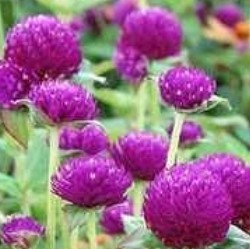
Globe Amaranth (Gomphrena)
Gomphrena globosa
The Globe Amaranth, botanically designated as Gomphrena globosa and belonging to the family Amaranthaceae (the amaranth family), is an exceptionally tough, durable, and drought-tolerant tropical annual. Native to the sunny, warm, and highly humid forest edges, fields, and coastal plains of Centra...
Pincushion
Scabiosa
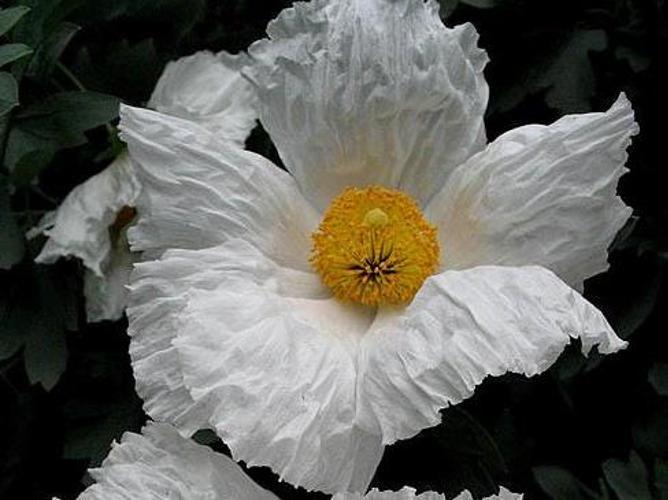
The Pincushion Flower, botanically designated under the genus *Scabiosa* (particularly *Scabiosa atropurpurea*, known as the Sweet Scabious or Pincushion Flower), is an exceptionally charming, airy herbaceous perennial or annual. Belonging to the family Caprifoliaceae (the honeysuckle family, tri...
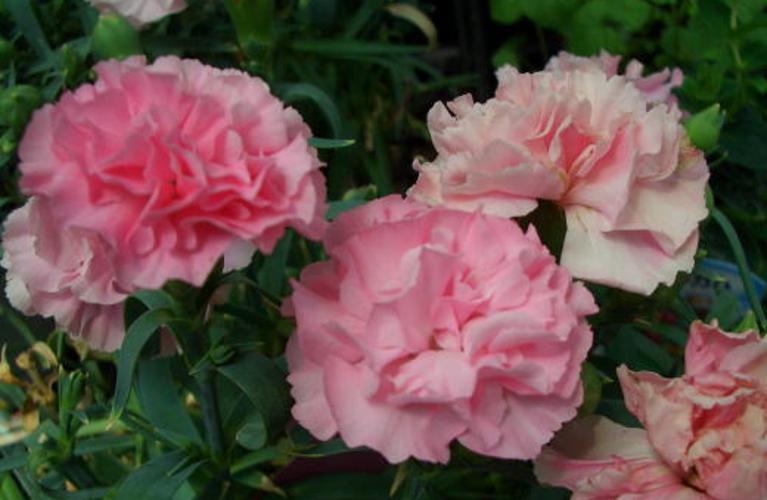
Carnation flower
Dianthus caryophyllus
The Carnation, botanically known as Dianthus caryophyllus and classically called the Clove Pink or Gillyflower, is an extraordinarily famous herbaceous perennial belonging to the Caryophyllaceae (pink or carnation) family. Native to the rocky slopes and coastal scrub of the Mediterranean region—p...
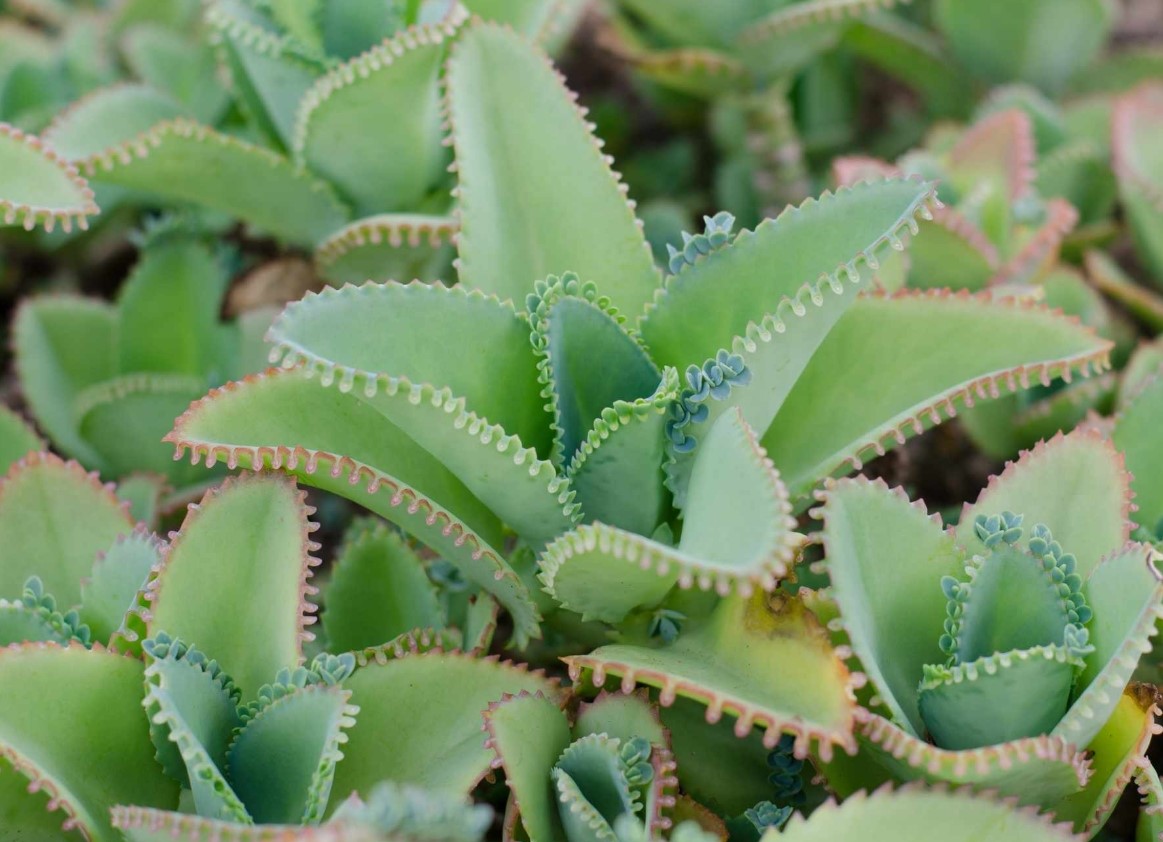
Kalanchoe
Kalanchoe
Kalanchoe, belonging to the Crassulaceae (stonecrop) family, is a highly popular and stunning genus of tropical flowering succulent plants. Comprising approximately 125 distinct species, this genus is predominantly native to the dry, arid, sun-baked landscape of Madagascar, with a few species ori...