
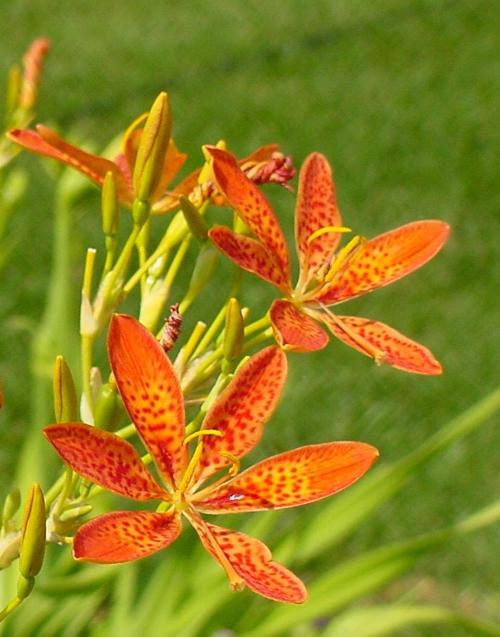
Leopard Lily
Iris domestica (syn. Belamcanda chinensis)
Basic Details
Floral Formula & Features
Ebracteate (no bracts), radially symmetrical (actinomorphic), bisexual, 6 tepals in 2 whorls of 3 (perianth not differentiated into sepals and petals), 3 free stamens, 3 fused carpels with inferior ovary, characteristic of Iridaceae
- Name 'Leopard Lily' from leopard-spotted flowers. 'Blackberry Lily' from clusters of shiny black seeds resembling blackberries that persist into winter. Recently reclassified from Belamcanda to Iris genus. 'Belamcanda' from Hindi name. Used in traditional Chinese medicine for over 2,000 years
- Flowers 2-2.5 inches (5-6 cm) across, star-shaped with 6 spreading tepals (3 petals, 3 sepals). Bright orange to red-orange heavily spotted with maroon, purple, or dark red dots. Blooms open in succession along branched stems, each lasting one day. Flowers July-August. Seed capsules split to reveal shiny black seeds in blackberry-like clusters
- Herbaceous perennial growing from rhizomes. Iris-like, sword-shaped leaves arranged in flat fans. Dies back in winter. After flowering, decorative seed pods develop, splitting open to display glossy black seeds that persist for months. Self-seeds readily, can naturalize
- Grows 2-4 feet (60-120 cm) tall with 1-2 foot (30-60 cm) spread. Lifespan of 3-5 years for individual plants, but self-seeds to perpetuate. Propagated from seed (blooms in 2-3 years), division of rhizomes in spring or fall, or by separating seedlings
- Native to China, Japan, Korea, and eastern Russia. Found in meadows, forest edges, and disturbed areas. Introduced to Europe and North America in 1800s. Now naturalized in parts of eastern and central United States, sometimes considered invasive in certain regions
- Thrives in full sun to partial shade (6+ hours sun for best flowering). Adapts to various well-drained soils. Moderately drought tolerant once established. Heat tolerant. Prefers consistent moisture during growing season. Hardy zones 5-10. Low maintenance, rarely needs division
- Excellent for cottage gardens, wildflower meadows, and mixed borders. Seed pods prized for dried arrangements, lasting months. Attracts butterflies and hummingbirds. Deer resistant. Rhizomes used in traditional Chinese medicine for throat inflammation (caution: seeds toxic). Self-seeds freely, can spread aggressively in favorable conditions
Names in Different Languages
What is Floral Formula?
A floral formula is a symbolic representation of a flower's structure using letters, numbers, and special symbols. It provides a concise way to describe the arrangement and number of floral parts.
This formula describes the flower's symmetry, sepals, petals, stamens, and carpels in a standardized format.
Formula Sequence
- Bract: Br or Ebr
- Bracteole: Brl or Ebrl
- Symmetry: % (Radial) or ⊕ (Bilateral)
- Sex: ♀ (Female), ♂ (Male), or ⚥ (Bisexual)
- Calyx/Sepal: K<number> (Free or Fused)
- Corolla/Petal: C<number> (Free or Fused)
- Androecium: A<number> (Free or Fused)
- Gynaecium: G<number> (Superior or Inferior Ovary)
Symbol Meanings
- Numbers: Indicate quantity of parts
- Parentheses (): Parts are fused together
- Plus (+): Parts in different whorls
- Underline: Superior ovary position
- Overline: Inferior ovary position
- ∞: Numerous parts (too many to count)
Understanding floral formulas helps botanists quickly identify and classify flowers based on their structural characteristics.
Similar Flowers
Discover flowers that share botanical characteristics
Same Genus
2
Same Family
3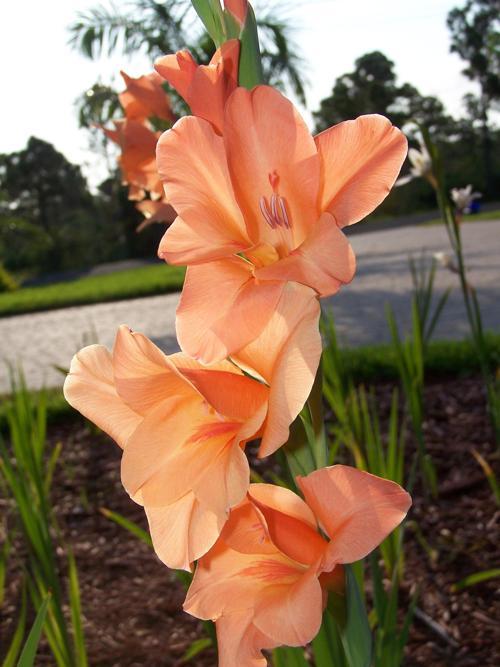
Sword Lily
Gladiolus
Slender flower spikes with numerous funnel-shaped blooms in a wide range of vibr...
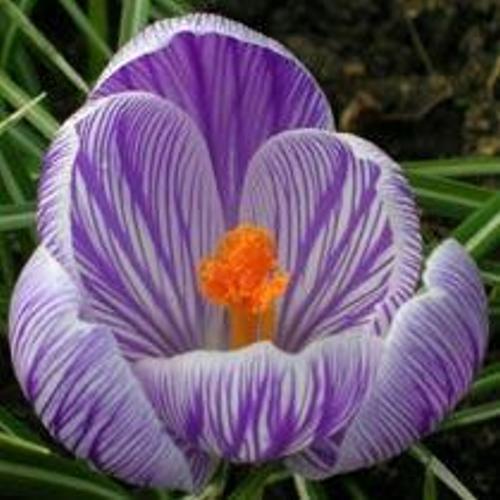
Spring Crocus
Crocus vernus
Cheerful early spring bulb that blooms while snow still on ground. Cup-shaped fl...
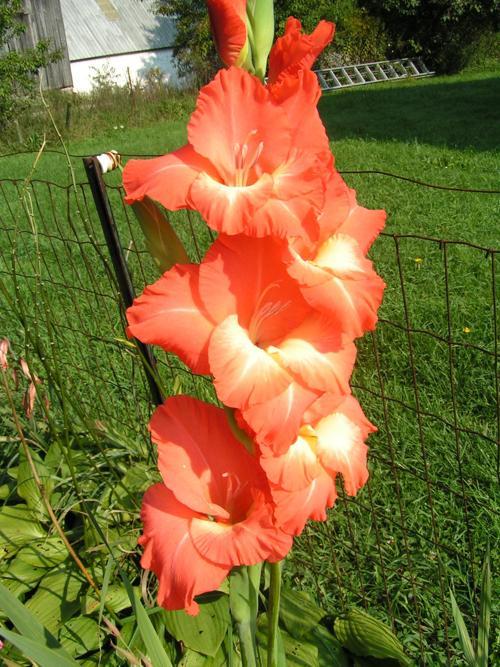
Gladiolus
Gladiolus
Spectacular cormous perennial featuring tall, dramatic spikes of large, funnel-s...
Similar Characteristics
4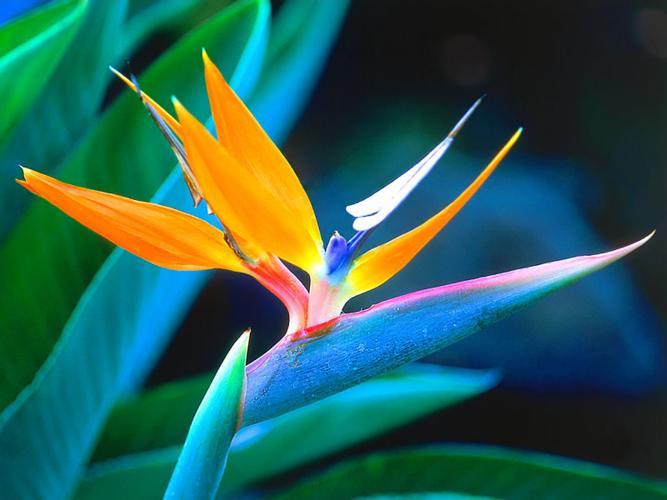
Bird of Paradise
Strelitzia reginae
Spectacular tropical perennial featuring exotic flowers that resemble a brightly...
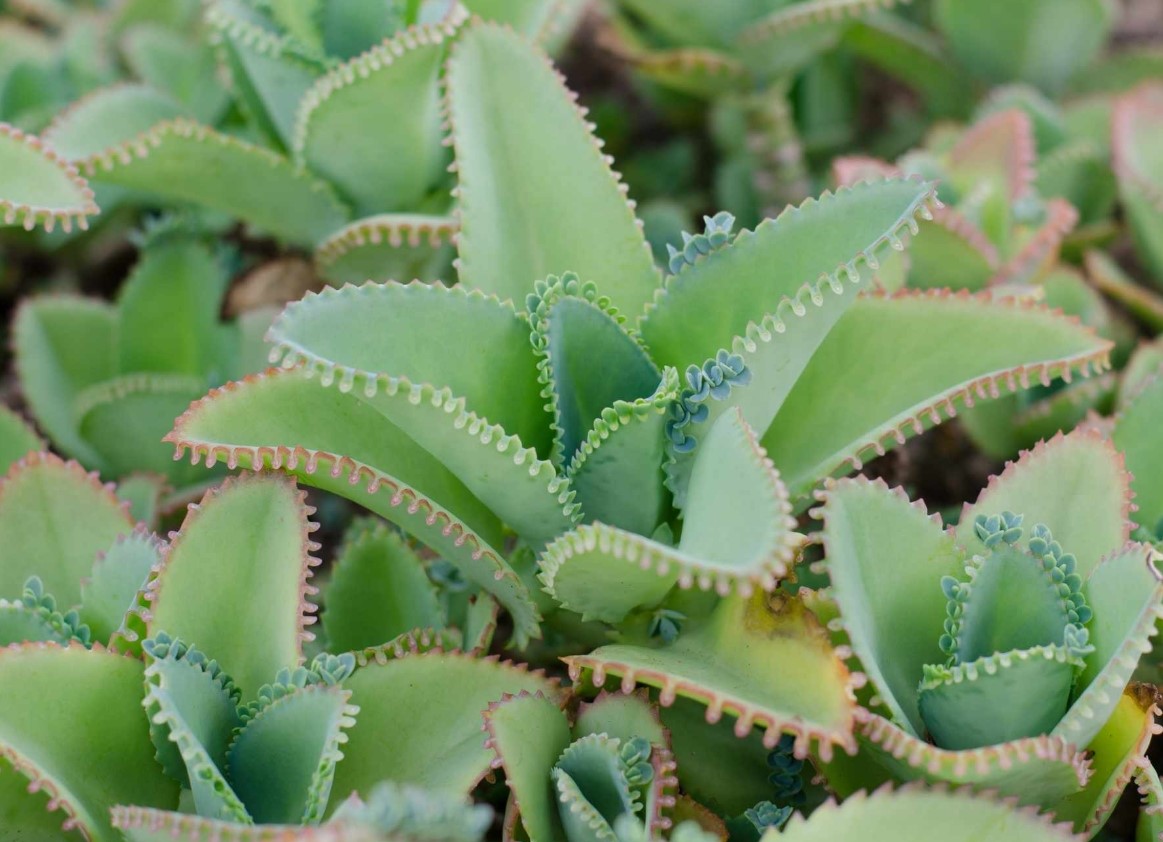
Kalanchoe
Kalanchoe
Popular flowering succulent native to Madagascar and tropical Africa, beloved as...
Spring Crocus
Crocus vernus
Cheerful early spring bulb that blooms while snow still on ground. Cup-shaped fl...
Caesalpinia
Caesalpinia pulcherrima
Spectacular tropical shrub featuring brilliant flame-colored flower clusters wit...