
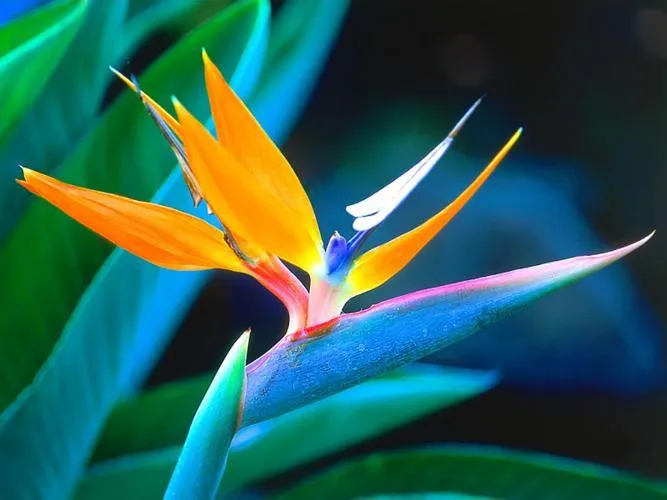
Bird of Paradise
Strelitzia reginae
How to Identify Bird of Paradise
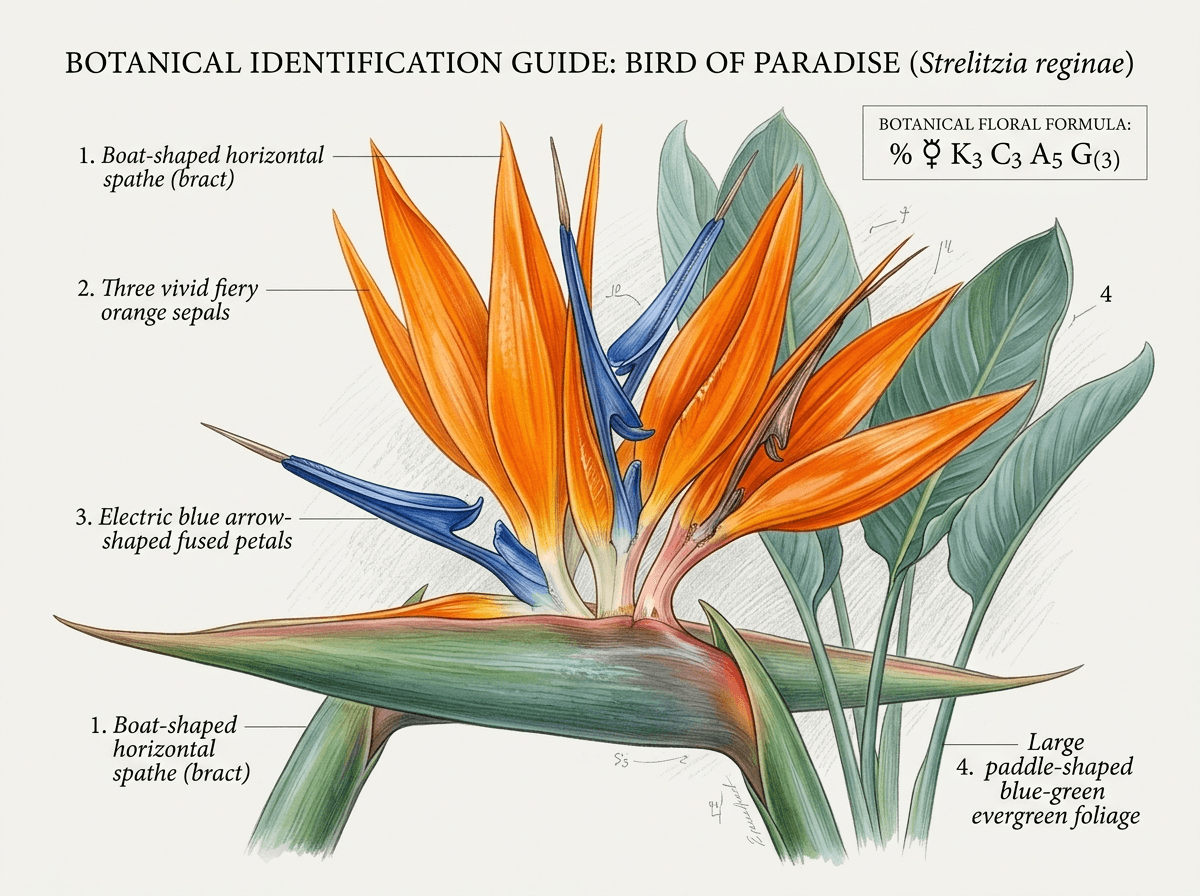
How to Identify Bird of Paradise (Strelitzia reginae):
- Boat-Shaped Spathe (Bract): A rigid, horizontal green bract (often tinged with red or purple) from which vibrant floral parts emerge sequentially.
- Three Fiery Orange Sepals: Brilliant orange, erect, petal-like sepals that stand upright like the colorful crest of a bird in flight.
- Three Electric Blue Petals: Two lower blue petals are fused into a rigid, arrow-shaped tongue that serves as a sunbird landing perch and houses the 5 stamens; one small third petal acts as a nectar gland cover.
- Floral Formula & Symmetry (% ⚥ K3 C3 A5 G(3)): Bilaterally symmetrical (zygomorphic), bisexual flower with 3 free orange sepals, 3 blue petals, 5 fertile stamens, and a 3-locular inferior ovary.
- Large Paddle Foliage: Stiff, leathery, blue-green (glaucous) evergreen leaves measuring 1 to 2 feet long on upright petioles, forming a dense fan-shaped crown.
- Pet Safety Notice: Contains gastrointestinal irritants and cyanogenic precursors. View the full Bird of Paradise Pet Guard Guide for veterinary toxicology, symptoms, and first aid.
Care & Growing Guide
Seasonal Blooming & Hardiness
Seasonal Blooming Calendar:
- Peak Bloom: Late winter through spring (September to May in warm climates, intermittent year-round under optimal greenhouse warmth).
- Planting & Division Time: Divide root clumps in early spring just before new vegetative growth begins.
Bloom Timeline
About Bird of Paradise
Strelitzia reginae, globally acclaimed as the 'Bird of Paradise' or 'Crane Flower,' is an iconic evergreen perennial native to the subtropical coastal thickets and riverbanks of South Africa's Eastern Cape and KwaZulu-Natal. Belonging to the family Strelitziaceae (closely allied to bananas and heliconias), the plant was introduced to the Royal Botanic Gardens at Kew in 1773 and named in honor of Queen Charlotte of Mecklenburg-Strelitz. Renowned for its extraordinary crane-like floral architecture, this majestic plant has become an international symbol of tropical splendor, freedom, and paradise.
The floral morphology of Strelitzia reginae represents an exceptional evolutionary adaptation to ornithophily (pollination by birds). Each inflorescence is cradled within a sturdy, horizontal boat-shaped bract known as a spathe. From this rigid sheath emerge three brilliant orange sepals and three vivid electric-blue petals. Two of the blue petals are fused together into a spear-shaped structure containing the five stamens and the style, while the third small petal forms a nectary. In its native habitat, Cape weavers and sunbirds alight on the blue 'tongue' to sip copious nectar; the bird's weight depresses the petals, dusting pollen onto its feet and chest for transfer to neighboring blooms.
The botanical floral formula for Strelitzia reginae is % ⚥ K3 C3 A5 G(3). The blooms display strict zygomorphic (bilateral) symmetry, are bisexual (hermaphroditic), and feature 3 free orange calyx lobes (sepals), 3 corolla lobes (petals), 5 distinct fertile stamens, and a 3-carpellate inferior ovary with axile placentation that matures into a woody capsule bearing bright orange-tufted (arillate) seeds.
Beyond its dramatic blossoms, the plant is treasured for its striking architectural foliage. Large, paddle-shaped, glaucous blue-grey leaves arise in a two-ranked fan directly from underground fleshy rhizomes, reaching heights of 4 to 6 feet with a similar spread. The leathery, banana-like leaves resist wind damage, making it a dramatic container centerpiece or tropical landscape specimen.
Culturally, Bird of Paradise requires 4 to 6 hours of bright, direct sunlight daily, warm temperatures (above 50°F / 10°C), and well-draining, rich loamy soil to initiate bloom spikes. While completely safe to admire, pet owners should note that its tissues and especially its seeds contain mild irritants and tannins. For comprehensive veterinary symptoms and safety steps, visit our dedicated Pet Guard Profile for Bird of Paradise.
Bird of Paradise is sometimes confused with its giant arboreal relative Strelitzia nicolai (Giant White Bird of Paradise), which grows 20–30 feet tall with enormous white and blue blooms, or with Heliconia species, which feature pendent or upright zig-zag bracts. In gardens, pair Bird of Paradise with lush companions like Anthurium, Canna Lily, or Passion Flower.
Floral Formula & Features
Bilaterally symmetrical (zygomorphic), bisexual, 3 free orange sepals, 3 petals (2 fused forming arrow-shaped nectary/perch, 1 free), 5 free stamens, 3 fused carpels with inferior ovary
- Scientific Name & Family: Strelitzia reginae (Strelitziaceae). Common names include Crane Flower and Queen's Bird of Paradise.
- Visual Identification: Horizontal boat-shaped spathe with 3 fiery orange erect sepals and 2 fused arrow-shaped electric blue petals forming a crane-like head.
- Floral Formula (% ⚥ K3 C3 A5 G(3)): Zygomorphic, bisexual, 3 free orange sepals, 3 blue petals, 5 stamens, and a 3-carpellate inferior ovary with axile placentation.
- Foliage & Growth Habit: Evergreen stemless clump (4–6 ft) with large, leathery, paddle-shaped blue-green leaves arranged in a distinct two-ranked fan.
- Pollination Ecology: Adapted for ornithophily (bird pollination) via sunbirds and sugarbirds perching on the fused blue petals to access deep nectar.
- Growing Requirements: Full sun to bright indirect light (Zones 10–12), fertile well-drained soil, moderate moisture, and winter protection below 50°F (10°C).
- Safety & Pet Guidance: MODERATELY TOXIC. Ingestion of leaves or seeds causes vomiting and drowsiness in dogs and cats. View Pet Guard Guide.
- Look-alike Distinction: Easily separated from Giant White Bird of Paradise (Strelitzia nicolai) by its smaller size and brilliant orange/blue flowers instead of tree-like stature with white blooms.
Names in Different Languages
Toxicity & Safety
Always keep toxic plants out of reach of children and pets. Consult a veterinarian or medical professional immediately if ingestion is suspected.
Pet Safety Guide: For detailed toxicity symptoms, first-aid measures, and safe garden alternatives, see our full Pet Guard Profile for Bird of Paradise.
Frequently Asked Questions
What is Floral Formula?
A floral formula is a symbolic representation of a flower's structure using letters, numbers, and special symbols. It provides a concise way to describe the arrangement and number of floral parts.
This formula describes the flower's symmetry, sepals, petals, stamens, and carpels in a standardized format.
Formula Sequence
- Bract: Br or Ebr
- Bracteole: Brl or Ebrl
- Symmetry: % (Radial) or ⊕ (Bilateral)
- Sex: ♀ (Female), ♂ (Male), or ⚥ (Bisexual)
- Calyx/Sepal: K<number> (Free or Fused)
- Corolla/Petal: C<number> (Free or Fused)
- Androecium: A<number> (Free or Fused)
- Gynaecium: G<number> (Superior or Inferior Ovary)
Symbol Meanings
- Numbers: Indicate quantity of parts
- Parentheses (): Parts are fused together
- Plus (+): Parts in different whorls
- Underline: Superior ovary position
- Overline: Inferior ovary position
- ∞: Numerous parts (too many to count)
Understanding floral formulas helps botanists quickly identify and classify flowers based on their structural characteristics.
Similar Flowers
Discover flowers that share botanical characteristics
Similar Characteristics
3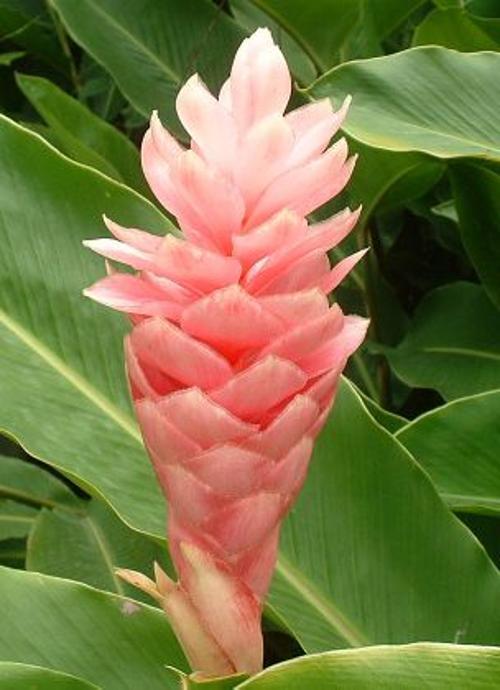
Red Ginger (Ostrich Plume)
Alpinia purpurata
The Red Ginger, botanically classified as Alpinia purpurata and commonly known as the Ostrich Plume, Tahitian Ginger, or Jungle King, is an exceptionally spectacular, exotic tropical rhizomatous perennial. Belonging to the family Zingiberaceae (the ginger family, tribe Alpinieae), this high-impac...
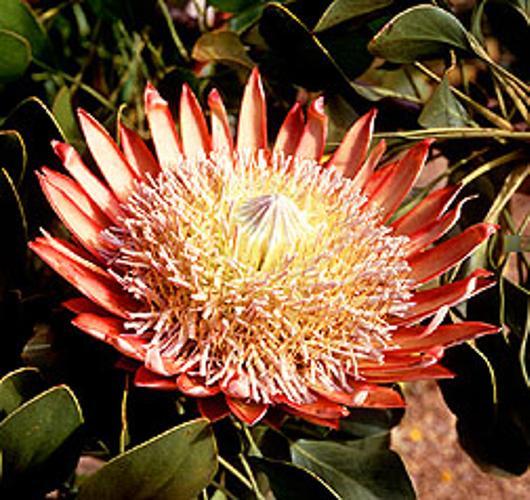
King Protea
Protea cynaroides
The King Protea, botanically known as Protea cynaroides and often called the King Sugar Bush or Cape Artichoke Flower, is a magnificent, evergreen woody shrub in the Proteaceae family. Endemic to the mountainous slopes and rocky sandstone ridges of South Africa's Western and Eastern Cape province...
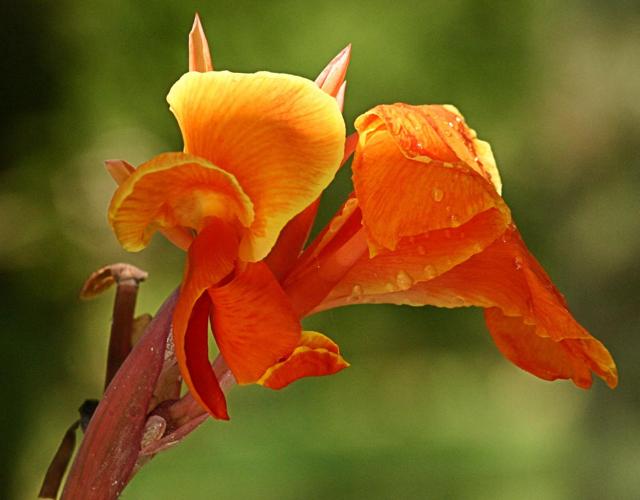
Canna lily
Canna indica
Canna indica, commonly known as the Canna Lily, is a bold and flamboyant tropical perennial that brings a dramatic, exotic flair to temperate and tropical gardens alike. Despite its common name, it is not a true lily but rather the sole genus in the Cannaceae family, closely related to gingers an...