
Coconut
Coconut palms are vital plantation crops in tropical coastal regions. Frond yellowing and crown distortions are typical signs of major deficiencies like Potassium and Boron, or deadly fungal bud rots.
Nitrogen Deficiency
Nitrogen Deficientia
Key Visual Symptoms
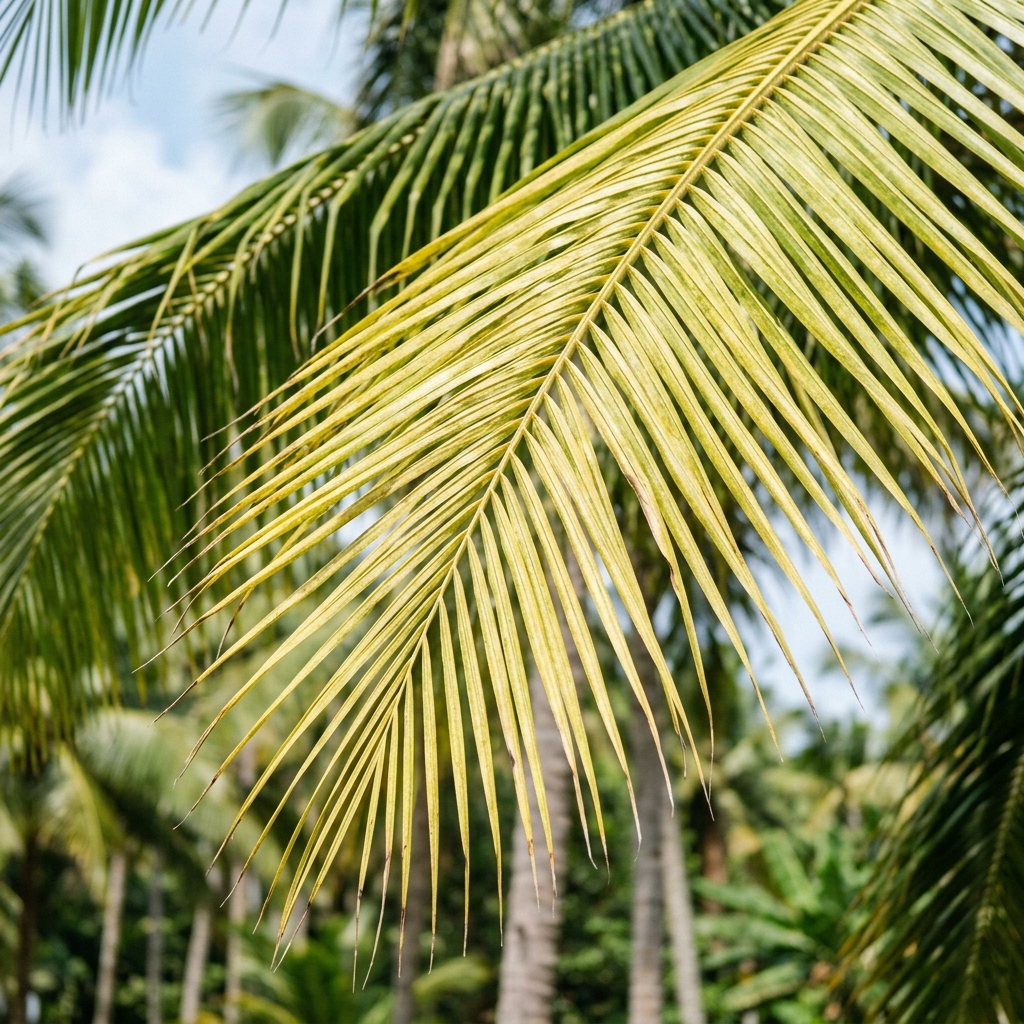
Lower older fronds turn pale green to yellowish-green. Frond count and overall crown size decrease, and the leaflets emerge shorter and thinner.
Organic Remedy
- Sow nitrogen-fixing cover crops (Calopogonium mucunoides, Pueraria phaseoloides, or Mucuna pruriens) in plantation interspaces to add 15–20 tons of organic biomass per hectare annually.
- Excavate a circular basin 1.8 meters in radius around each palm trunk to a depth of 15 cm; incorporate 50 kg of well-rotted cattle manure or compost enriched with 5 kg neem cake.
- Mulch the root basin with coconut husks, green loppings, or dried fronds to conserve soil moisture and foster Azotobacter nitrogen-fixing soil bacteria.
- Avoid waterlogging in low-lying coastal plantations by digging drainage channels; flooded anaerobic roots cannot absorb nitrate ions.
Chemical Correction
- Apply 1.0 to 1.3 kg of technical Urea (46% N) per adult bearing palm annually, split into two equal doses: one-third in May–June (pre-monsoon) and two-thirds in September–October (post-monsoon).
- On acidic sandy or laterite soils (pH < 5.5), substitute Urea with Calcium Ammonium Nitrate (CAN at 2.0 kg/palm/year) to prevent soil acidification and supply secondary calcium.
- Apply fertilizer strictly in a circular band 1.5 to 2.0 meters away from the trunk where active tertiary and quaternary feeder roots are concentrated; never pile fertilizer directly against the bole.
Potassium Deficiency
Potassium Deficientia
Key Visual Symptoms
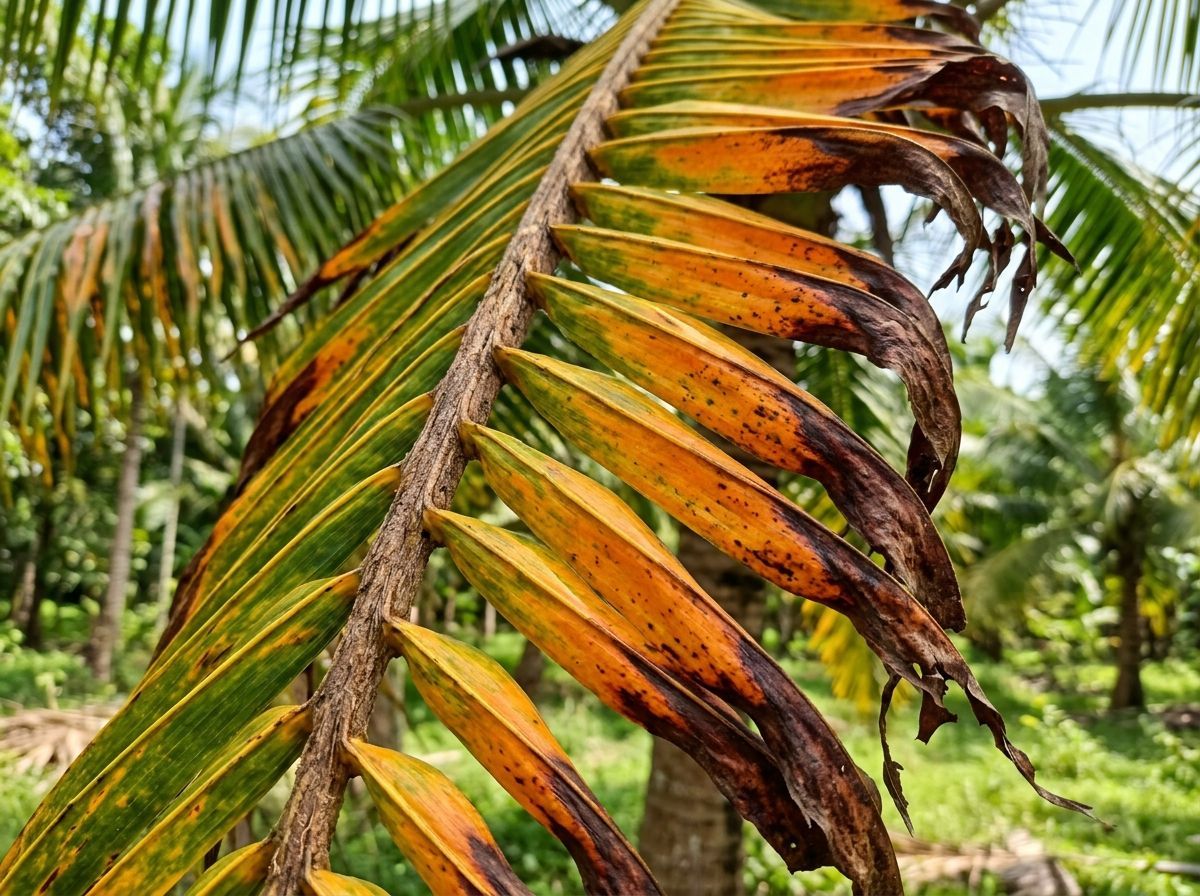
Older fronds turn bright orange-yellow. Pinnae (leaflets) show yellow spots followed by marginal scorching and dry, necrotic tips. The crown size is severely reduced, and the trunk tapers significantly near the crown ('pencil point').
Organic Remedy
- Bury 100 to 150 coconut husks in a circular trench (1.5 m from trunk, 30 cm wide and 45 cm deep) around each palm; husks act as a slow-release potassium sponge that retains monsoon rainwater.
- Recycle all fallen fronds and bunch stalks by chopping and layering them in the 2-meter basin; one healthy palm's annual frond fall returns up to 400 g of potash to the soil.
- Apply screened wood ash or biomass ash (8–10 kg/palm/year) in non-alkaline soils to provide soluble potassium carbonate and trace minerals.
- Incorporate green manure biomass (sunn hemp, calopo) into the basin to increase soil cation exchange capacity (CEC), reducing potassium leaching in porous sands.
Chemical Correction
- Apply Muriate of Potash (MOP, 60% K2O) at 1.5 to 2.0 kg per adult palm annually in two equal splits: May–June (pre-monsoon) and September–October (post-monsoon).
- In coastal soils with high water tables or salinity, substitute MOP with Sulfate of Potash (0:0:50 at 1.8–2.2 kg/palm) to provide potassium while avoiding chloride accumulation.
- Where drip irrigation is installed, fertigate with water-soluble potassium (MOP or potassium nitrate) at 35 g per palm weekly to sustain continuous fruit sizing during dry months.
Magnesium Deficiency
Magnesium Deficientia
Key Visual Symptoms
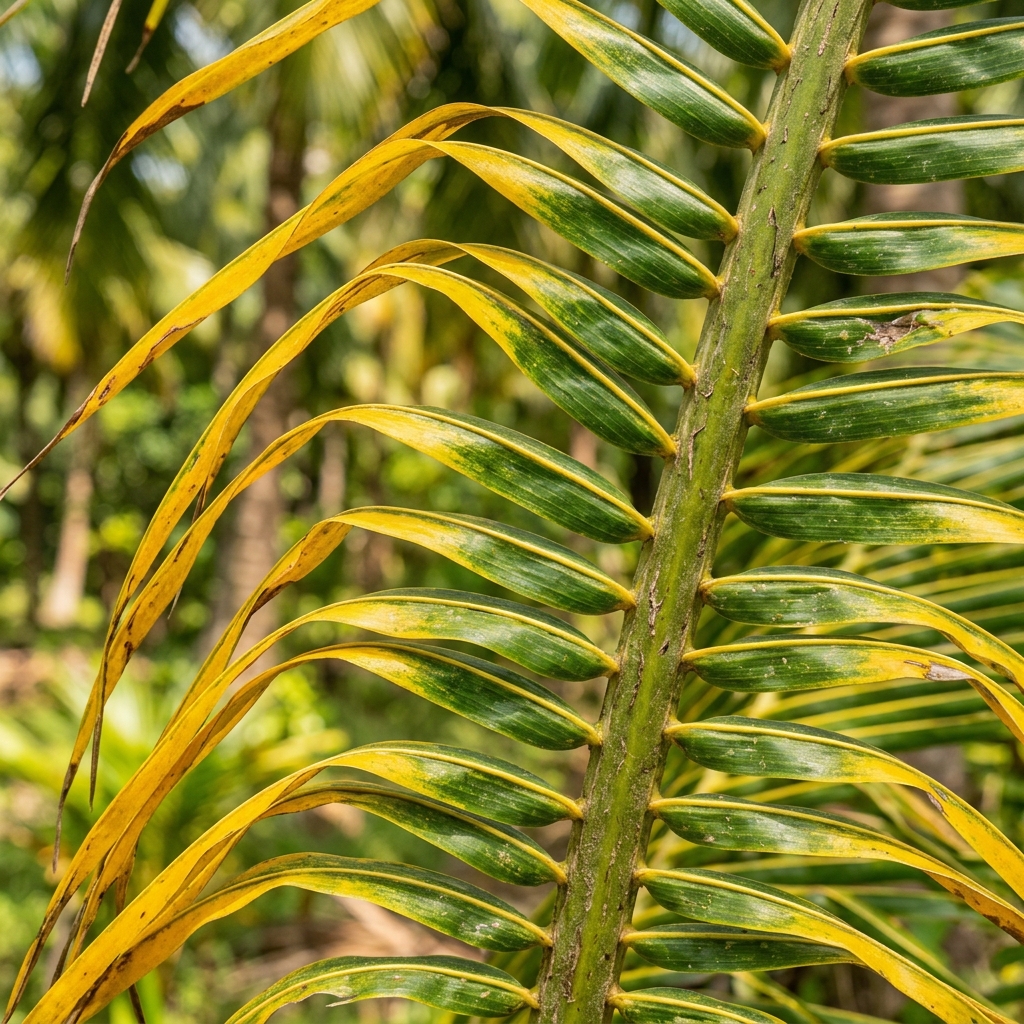
Older fronds show bright golden-yellow margins while the center of the leaflet and midrib remain green. This forms a prominent green 'V' pattern on the yellowing leaf blade. Leaves exposed to full sun show the most severe symptoms.
Organic Remedy
- In acid laterite and coastal sandy soils (pH < 5.8), broadcast 2.0 to 3.0 kg of agricultural dolomitic limestone per palm annually in May–June to replenish magnesium reserves.
- Maintain a 4-week gap between applying dolomite and applying nitrogenous fertilizers (Urea/DAP) to prevent ammonia gas volatilization.
- Add abundant organic matter (50 kg compost or green leaf manure) to sandy soil basins to increase cation exchange capacity and prevent magnesium from leaching with monsoon rains.
- Avoid over-application of potash fertilizers; maintain a balanced K:Mg ratio in fertilization schedules (roughly 3 parts K2O to 1 part MgO).
Chemical Correction
- Apply technical Magnesium Sulfate (Epsom salt, 9.6% Mg) at 500 g to 1.0 kg per palm annually, divided into pre-monsoon (May–June) and post-monsoon (September–October) split dressings.
- In high-rainfall coastal zones (>2500 mm rain), use Kieserite (MgSO4·H2O, 16% Mg) at 400–600 g/palm; its lower solubility ensures steady release through intense monsoon downpours.
- For nursery seedlings and young non-bearing palms showing bright yellowing, foliar spray 2% Magnesium Sulfate (20 g/L) with a non-ionic sticker every 15 days.
Boron Deficiency
Boron Deficientia
Key Visual Symptoms
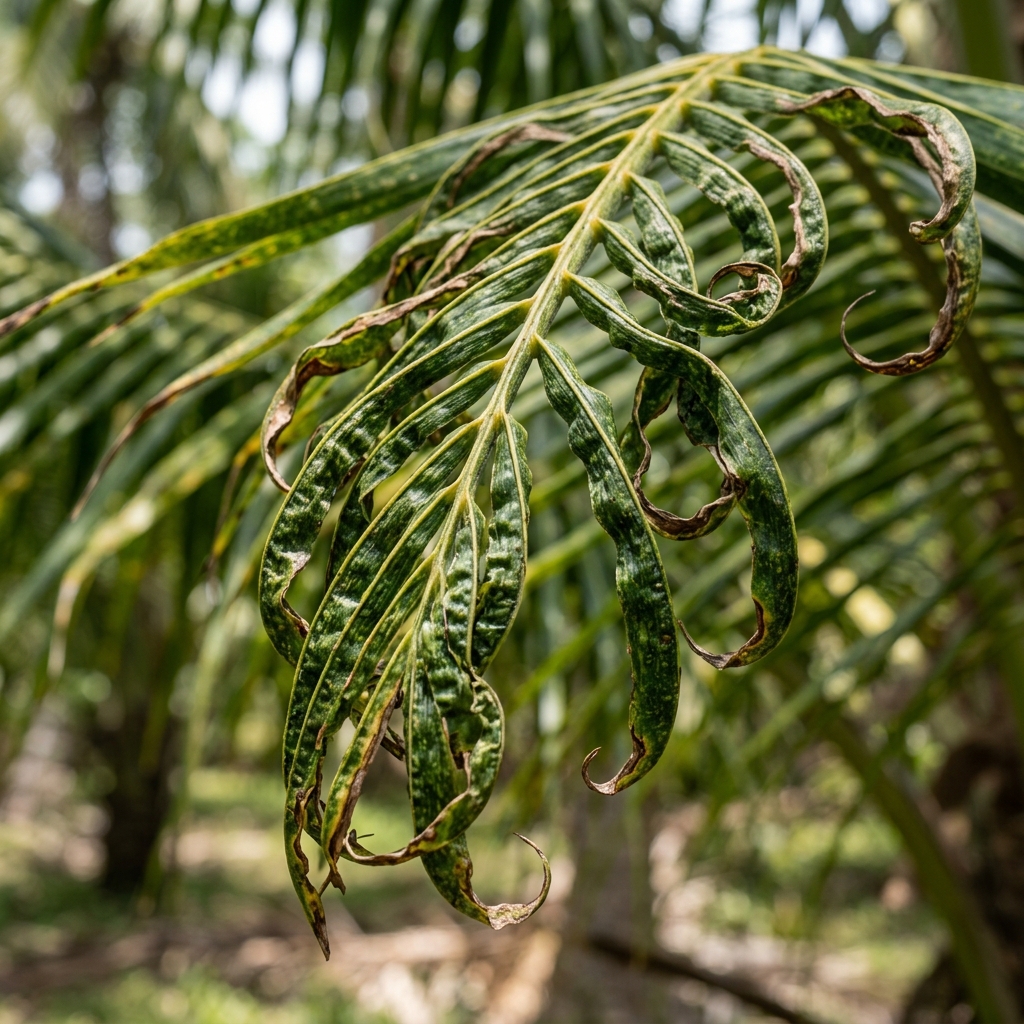
Leaflets fail to split normally, emerging fused and curled into a characteristic hook shape ('hook leaf' or 'bayonet deformity'). The crown becomes distorted and flat-topped. Developing nuts crack, secrete gum, and drop prematurely.
Organic Remedy
- Incorporate well-decomposed organic manure (25–30 kg/palm) in the basin; organic matter binds borate ions and releases them slowly, buffering against monsoon leaching.
- Maintain consistent soil moisture through the dry season with basin mulching and drip irrigation; severe summer drought precipitates boron into insoluble forms, inducing temporary deficiency.
- Avoid excessive liming; raising soil pH above 7.0 dramatically reduces boron availability by increasing borate adsorption to calcium carbonate and clay particles.
- Maintain cover crops in the plantation to encourage mycorrhizal fungi, which improve trace mineral transport to coconut roots.
Chemical Correction
- Apply Agricultural Borax (10.5% B) at 50 to 100 grams per adult palm annually in two equal splits (May–June and September–October) blended with compost or sand for even basin distribution.
- For acute deficiency showing hooked fronds, apply Solubor (20% B) at 25–30 g dissolved in 20 liters of water as a root drench around the 1.5-meter basin.
- Strictly adhere to recommended dosages: the safety margin between boron deficiency and boron toxicity in coconut palms is very narrow (never apply more than 150 g Borax per palm in a single year).
Coconut Diagnostic Guide: Diseases vs. Deficiencies
Palms turning orange-yellow can signal potassium starvation or destructive Bud Rot. Distinguish them early.
Coconut Bud Rot
Potassium Starvation
Key Indicators to Look For:
- Symptom Symmetry: Potassium deficiency causes symmetric orange-yellow spotting across older leaflets. Bud rot randomly attacks the central spear leaf first.
- Trunk Shape: Severe potassium deficiency results in a characteristic 'pencil-point' tapering of the trunk near the crown. Diseases like Bud Rot do not change trunk geometry.
- Nut Drop: Boron deficiency causes young nut drop with deformed, cracked nuts. Bud rot causes general premature nut fall as the entire crown decays.
Diagnose Your Coconut Crop Instantly
Take or upload a photo of your leaf or field damage to let our AI model scan for diseases, insect pests, or nutritional deficiencies.
Seasonal Outbreak Calendar
Track peak infestation and disease risk months by geographic region. Access the interactive dashboard to see what diseases are active this month.
Explore Disease CalendarFeatured Agronomy Guide
Read our comprehensive guide comparing plant nutrient deficiencies, infectious diseases, and pests.
Read Symptom Diagnosis GuideExplore Other Crop Hubs
Rice (Paddy) Hub
Grain health, blast management, and water guides.
Wheat Hub
Cereal growth guides, rust diagnosis, and soil prep.
Tomato Hub
Solanaceous care, fruit rots, and calcium fixes.
Mango Hub
Mango variety guides, zinc sprays, and leaf curl tips.
Onion Hub
Allium health, bulb expansions, and sulfur timing.