
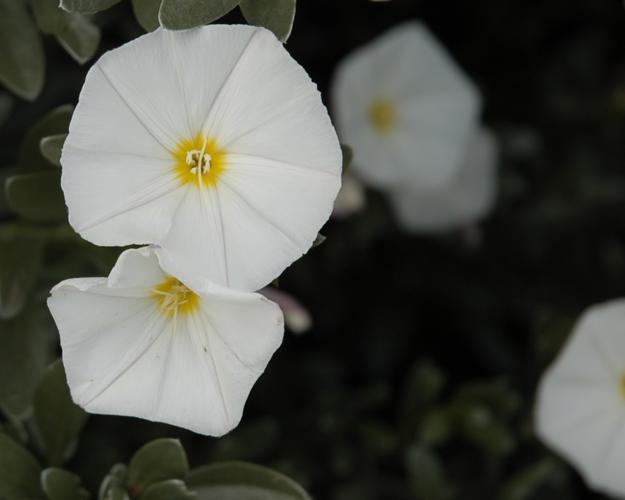
Silverbush
Convolvulus cneorum
Basic Details
Floral Formula & Features
Ebracteate, radially symmetrical (actinomorphic), bisexual, 5 fused sepals forming tube, 5 fused petals forming funnel-shaped corolla, 5 stamens attached to corolla tube, 2 fused carpels with superior ovary. Typical of Convolvulaceae family
- Name 'Silverbush' from distinctive silvery-green leaves covered in fine silky hairs. About 250 Convolvulus species. C. cneorum most popular ornamental. Related to morning glory but shrubby, not vining. Native to Mediterranean rocky coasts. Pronounced 'con-VOL-view-lus NEE-or-um'
- Flowers 1-1.5 inches (2.5-4 cm) across, funnel-shaped (like morning glory). White with pink-tinged buds. 5 fused petals forming trumpet. Yellow center. Blooms profusely spring-summer (April-August), sporadically year-round in mild climates. Each flower lasts 1 day, replaced by new blooms
- Compact evergreen shrub. Narrow lance-shaped leaves 1-2 inches long, covered in silky silver hairs giving metallic sheen. Leaves arranged alternately on stems. Mounding, rounded habit. Foliage provides year-round interest. Stems also silvery when young
- Grows 2-3 feet (60-90 cm) tall, 3-4 feet (90-120 cm) wide. Slow to moderate growth rate. Lifespan 5-10 years. Propagated from semi-hardwood cuttings (summer) or seeds. Cuttings root easily in 3-4 weeks. Prune to maintain compact shape
- Native to Mediterranean region - coastal areas of Spain, Italy, Croatia, Albania, Greece. Grows on rocky slopes, cliffs near sea. Now cultivated in Mediterranean climates worldwide. Thrives in coastal California, Australia, South Africa. Hardy zones 8-10
- Requires full sun (6-8 hours daily) - essential for silvery foliage. Needs excellent drainage - hates wet feet. Drought tolerant once established (deep watering every 2-3 weeks). Salt tolerant. Prefers poor to moderately fertile soil. Avoid overwatering and fertilizing. Hardy zones 8-10
- Excellent for rock gardens, Mediterranean gardens, coastal landscapes, containers. Perfect for hot, dry areas. Deer and rabbit resistant. Attracts bees and butterflies. Provides textural contrast with silvery foliage. Good for xeriscaping (water-wise gardening). Low maintenance once established
- Prune lightly after flowering to maintain shape and encourage bushiness. Cut back by one-third if leggy. Protect from hard frost (below 20°F) - mulch roots in cold zones. Avoid overhead watering (causes leaf spot). Very easy care - thrives on neglect. Symbolizes resilience and beauty in harsh conditions
Names in Different Languages
What is Floral Formula?
A floral formula is a symbolic representation of a flower's structure using letters, numbers, and special symbols. It provides a concise way to describe the arrangement and number of floral parts.
This formula describes the flower's symmetry, sepals, petals, stamens, and carpels in a standardized format.
Formula Sequence
- Bract: Br or Ebr
- Bracteole: Brl or Ebrl
- Symmetry: % (Radial) or ⊕ (Bilateral)
- Sex: ♀ (Female), ♂ (Male), or ⚥ (Bisexual)
- Calyx/Sepal: K<number> (Free or Fused)
- Corolla/Petal: C<number> (Free or Fused)
- Androecium: A<number> (Free or Fused)
- Gynaecium: G<number> (Superior or Inferior Ovary)
Symbol Meanings
- Numbers: Indicate quantity of parts
- Parentheses (): Parts are fused together
- Plus (+): Parts in different whorls
- Underline: Superior ovary position
- Overline: Inferior ovary position
- ∞: Numerous parts (too many to count)
Understanding floral formulas helps botanists quickly identify and classify flowers based on their structural characteristics.
Similar Flowers
Discover flowers that share botanical characteristics
Similar Colors
1
Similar Characteristics
4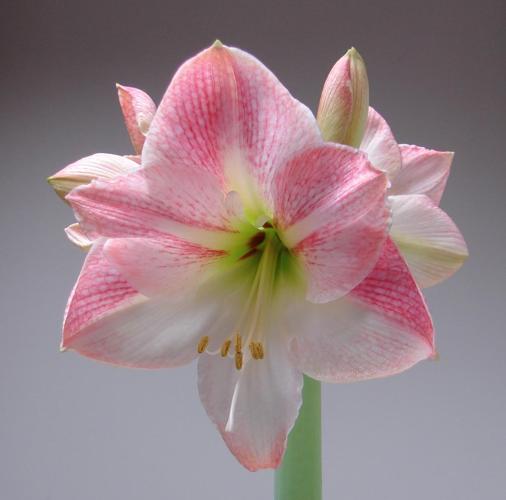
Amaryllis
Hippeastrum
Spectacular bulbous plant producing 2-6 large, trumpet-shaped flowers per stalk ...
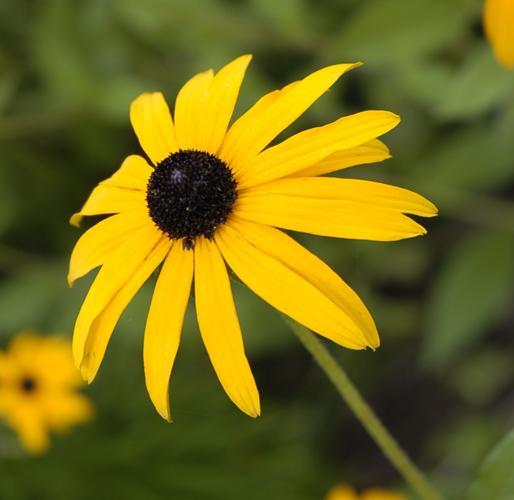
Black eyed Susan
Rudbeckia hirta
Cheerful native wildflower featuring bright golden-yellow ray petals surrounding...
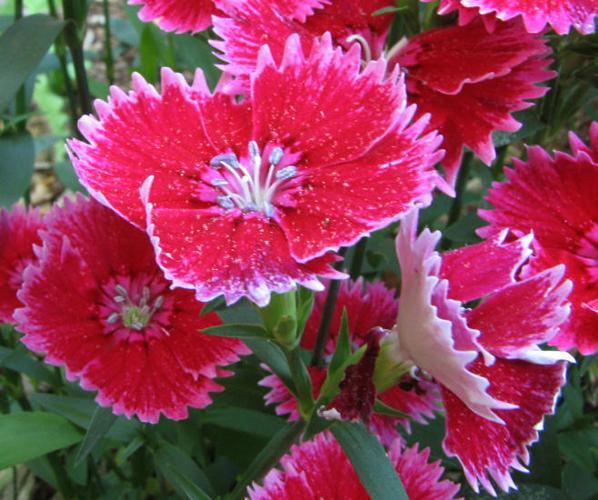
Sweet William (Dianthus barbatus)
Dianthus
Charming cottage garden biennial featuring dense, rounded clusters of small, fri...
Tree Poppy
Dendromecon
Rare California native evergreen shrub producing abundant satiny, golden-yellow ...