
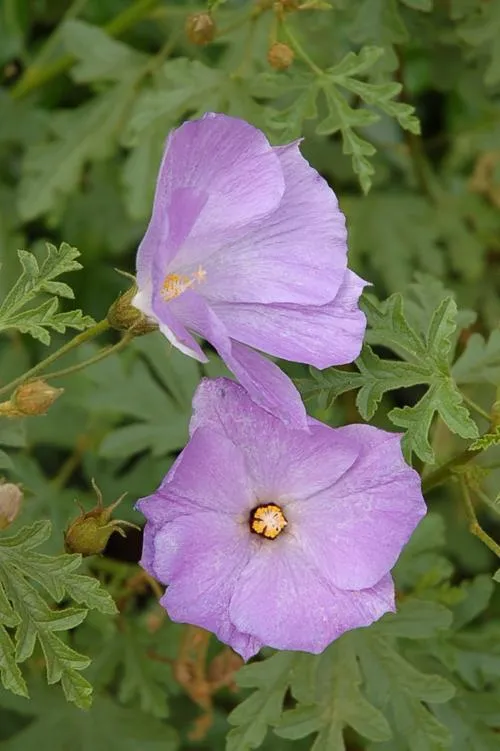
Pelargonium
Pelargonium
How to Identify Pelargonium
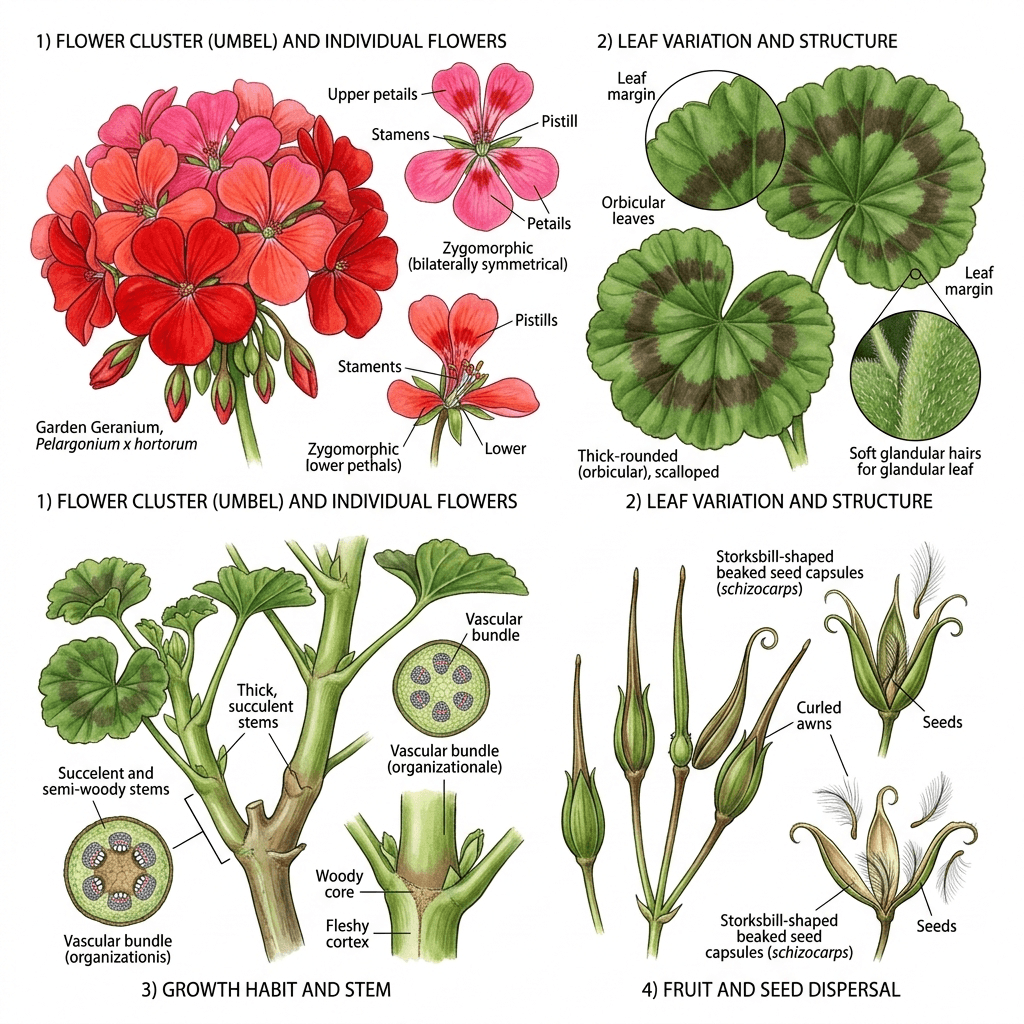
A detailed guide to identifying Pelargoniums / Garden Geraniums (Pelargonium spp.) by key botanical features:
- Rounded Flower Umbels with Bilateral Symmetry: Dense, spherical flower heads (umbels) borne on long stalks, consisting of individual zygomorphic flowers with 2 distinct upper petals and 3 lower petals in brilliant scarlet, orange, salmon, or hot pink.
- Orbicular Scalloped Leaves with Dark Zonal Rings: Thick, rounded, shallow-lobed foliage featuring a distinct concentric horseshoe-shaped darker band (zonal ring) on the upper surface, covered in soft glandular hairs.
- Succulent, Semi-Woody Branching Stems: Thick, fleshy, green stems that become semi-woody with age, storing moisture and exuding essential oils when bruised.
- Beaked Storksbill Fruit (Schizocarps): Distinctive elongated, beak-like seed capsules that split into 5 coiled, feathery-tailed awns at maturity to propel seeds into the wind.
Types & Sub-types of Pelargoniums
Pelargoniums belong to the Geraniaceae family and are classified into distinct horticultural groups based on growth habit, foliage scent, and flower morphology:
- By Horticultural Classification:
- Zonal Pelargoniums (Pelargonium × hortorum): The classic bedding and pot geranium with upright growth, dark leaf zonations, and large rounded umbels of single, semi-double, or double flowers.
- Ivy-Leaved Pelargoniums (Pelargonium peltatum): Trailing or cascading habit with smooth, leathery, 5-lobed ivy-like leaves and abundant clusters of slender-petaled flowers ideal for hanging baskets and window boxes.
- Regal / Martha Washington Pelargoniums (Pelargonium × domesticum): Compact, bushy plants with pleated, toothed leaves and large, ruffled, azalea-like flowers in bi-color patterns with dark velvet blotches.
- Scented-Leaved Pelargoniums (Pelargonium graveolens, crispum, etc.): Prized for fragrant essential oils in their leaves releasing aromas of rose, lemon, peppermint, nutmeg, or citronella when touched.
Care & Growing Guide
Seasonal Blooming & Hardiness
Seasonal Blooming Calendar:
- Peak Bloom: Late winter to early spring.
- Planting Time: Sow seeds directly outdoors in early spring after the last frost, or transplant nursery starts in late spring.
Bloom Timeline
About Pelargonium
Pelargoniums, widely but incorrectly referred to as 'Geraniums', are quintessential garden classics belonging to the Geraniaceae family. Native predominantly to the temperate and Mediterranean-like regions of South Africa, these resilient subshrubs were brought to Europe in the 17th century and have since become global staples for window boxes, patios, and garden borders. They offer a masterclass in reliable, long-lasting floral displays and striking, aromatic foliage.
Pelargoniums are easily identified by their large, rounded clusters (umbels) of five-petaled flowers, which bloom continuously in vivid shades of red, pink, white, and salmon. The foliage is thick, scalloped, or lobed, frequently marked with a distinctive dark horseshoe-shaped zone (in Zonal types). When rubbed, the leaves emit a strong, spicy, or citrusy scent. The stems are slightly succulent, aiding in water retention, and typically grow 1 to 3 feet tall depending on the variety.
The floral formula is EBr ⊕ ⚥ K5 C5 A(5+5) G(5). This indicates an ebracteate flower that is radially symmetrical (though slightly zygomorphic in some species), and bisexual. It features 5 free sepals, 5 petals (often unequal in size), 10 stamens arranged in two whorls, and a superior ovary formed by 5 fused carpels. This robust structure has made it a favorite for hybridizers worldwide.
These sun-lovers require 6 to 8 hours of direct sunlight for optimal blooming. They thrive in USDA zones 9-11 as perennials but are universally treated as summer annuals in cooler climates. They demand excellent soil drainage and prefer to dry out completely between waterings, making them highly drought-tolerant and perfect for low-maintenance container gardening.
Scented pelargoniums are heavily cultivated for their essential oils, particularly in the perfume industry as a substitute for rose oil. In the Victorian language of flowers, they symbolize friendship, comfort, and positive emotions. However, Pelargoniums contain essential oils (like linalool and geraniol) that are toxic to dogs, cats, and horses, causing gastrointestinal distress and lethargy if ingested.
They are frequently confused with True Geraniums (Cranesbills). True Geraniums are winter-hardy perennials with flat, saucer-shaped flowers and deeply cut, non-succulent foliage, whereas Pelargoniums are frost-tender with clustered blooms. Expand your garden palette in our Flower Identifier and pair these with other sun-worshippers like the African Daisy, Lantana Camara, or the dramatic Azalea.
Floral Formula & Features
Ebracteate, radially symmetrical (actinomorphic), bisexual, 5 free sepals, 5 free petals (often unequal), 10 stamens in two whorls, 5 fused carpels with superior ovary
- Scientific Name & Classification: Pelargonium spp. (Geraniaceae). Often misnamed as Geraniums.
- Identification Markers: Umbels of brightly colored 5-petaled flowers. Scalloped, thick foliage that is highly aromatic when crushed. Slightly succulent stems.
- Floral Formula (EBr ⊕ ⚥ K5 C5 A(5+5) G(5)): Ebracteate, radially symmetrical, bisexual, 5 free sepals, 5 petals, 10 stamens, 5 fused carpels.
- Growing Requirements: Full sun, excellent drainage. Let soil dry between waterings. Treated as a summer annual in cold climates, perennial in USDA 9-11.
- Cultural Significance: Scented varieties are heavily used in the perfume and essential oil industry as a rose substitute.
- Safety & Toxicity: TOXIC. Contains essential oils that can cause vomiting and lethargy in dogs and cats if ingested.
- Common Look-alikes: Often confused with True Geraniums (Cranesbills), which are cold-hardy perennials with flat, saucer-like flowers and no woody/succulent stems.
- Internal Links: For more container garden staples, see the Flower Identifier or pair with the African Daisy and Lantana Camara.
- Internal Links: Compare key differences in our Geranium vs Pelargonium comparison, or try our instant Flower Identifier.
Names in Different Languages
Botanical Classification: Pelargonium belongs to the Geraniaceae family. Learn how to identify its floral symmetry, stamen arrangement, and structural formulas in our Botanical Family Classification Guide.
Toxicity & Safety
Always keep toxic plants out of reach of children and pets. Consult a veterinarian or medical professional immediately if ingestion is suspected.
Frequently Asked Questions
What is Floral Formula?
A floral formula is a symbolic representation of a flower's structure using letters, numbers, and special symbols. It provides a concise way to describe the arrangement and number of floral parts.
This formula describes the flower's symmetry, sepals, petals, stamens, and carpels in a standardized format.
Formula Sequence
- Bract: Br or Ebr
- Bracteole: Brl or Ebrl
- Symmetry: % (Radial) or ⊕ (Bilateral)
- Sex: ♀ (Female), ♂ (Male), or ⚥ (Bisexual)
- Calyx/Sepal: K<number> (Free or Fused)
- Corolla/Petal: C<number> (Free or Fused)
- Androecium: A<number> (Free or Fused)
- Gynaecium: G<number> (Superior or Inferior Ovary)
Symbol Meanings
- Numbers: Indicate quantity of parts
- Parentheses (): Parts are fused together
- Plus (+): Parts in different whorls
- Underline: Superior ovary position
- Overline: Inferior ovary position
- ∞: Numerous parts (too many to count)
Understanding floral formulas helps botanists quickly identify and classify flowers based on their structural characteristics.
Similar Flowers
Discover flowers that share botanical characteristics
Same Family
2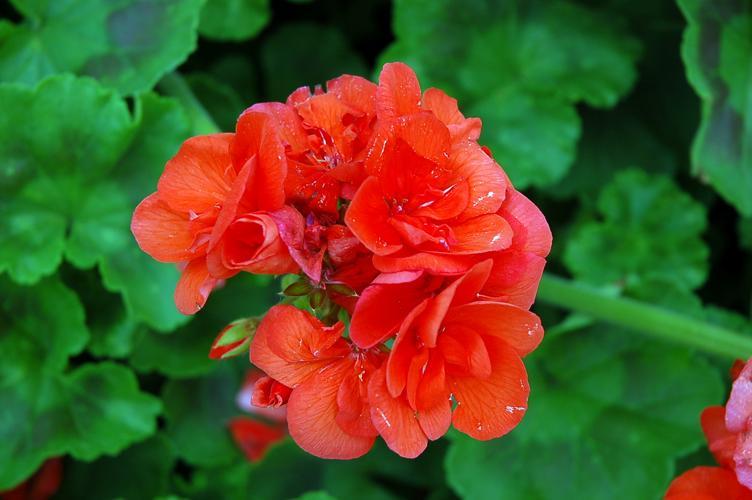
Geranium
Geranium, Pelargonium
The Geranium, belonging to the family Geraniaceae, is a highly diverse and extraordinarily popular group of flowering plants comprising two prominent genera: the true Geranium (commonly called Cranesbills) and the Pelargonium (popularly referred to as garden geraniums). While true cranesbills are...
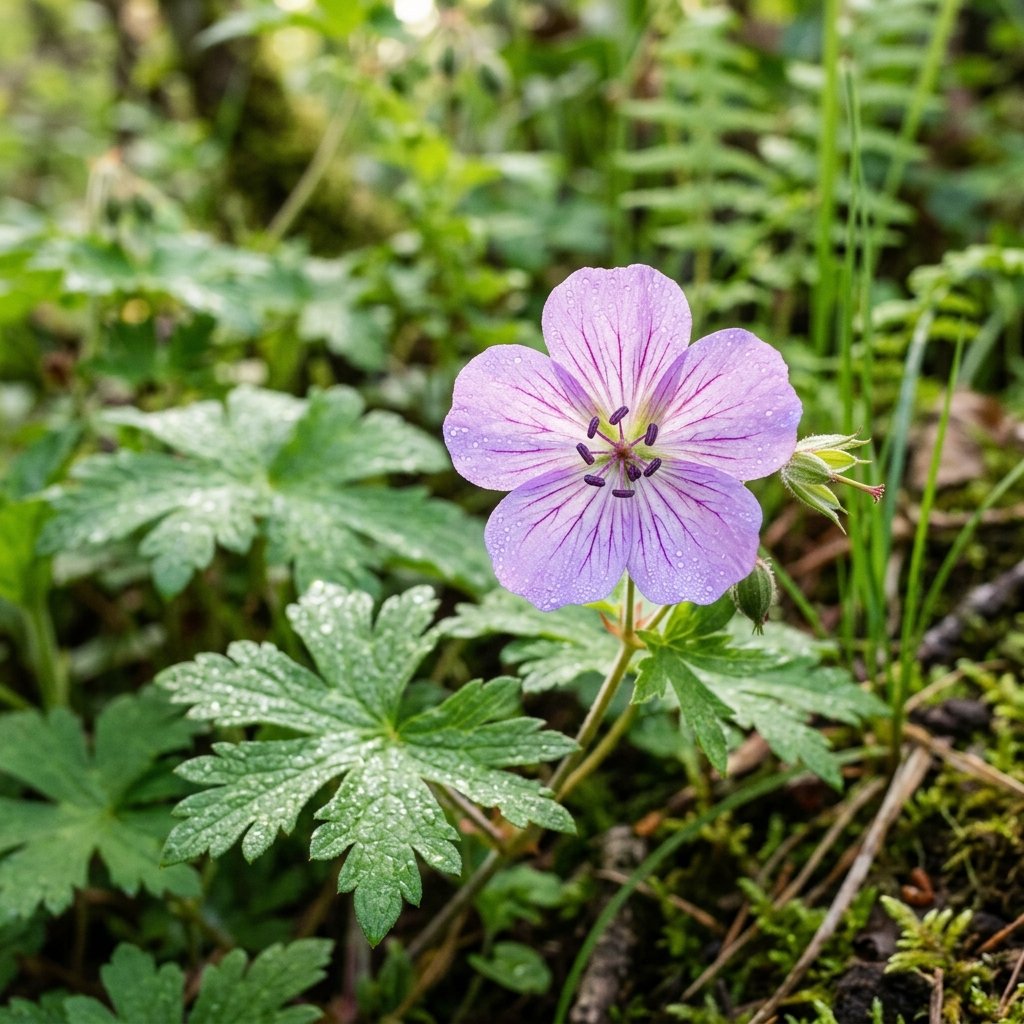
Wild Geranium
Geranium maculatum
Wild Geranium (*Geranium maculatum*), also known as Spotted Cranesbill, is one of the most graceful and widely appreciated native wildflowers of eastern North American woodlands, producing clusters of delicate rosy-lavender to pale pink flowers with five rounded petals above a mound of deeply lob...