
Mountain Laurel
Kalmia latifolia
How to Identify Mountain Laurel
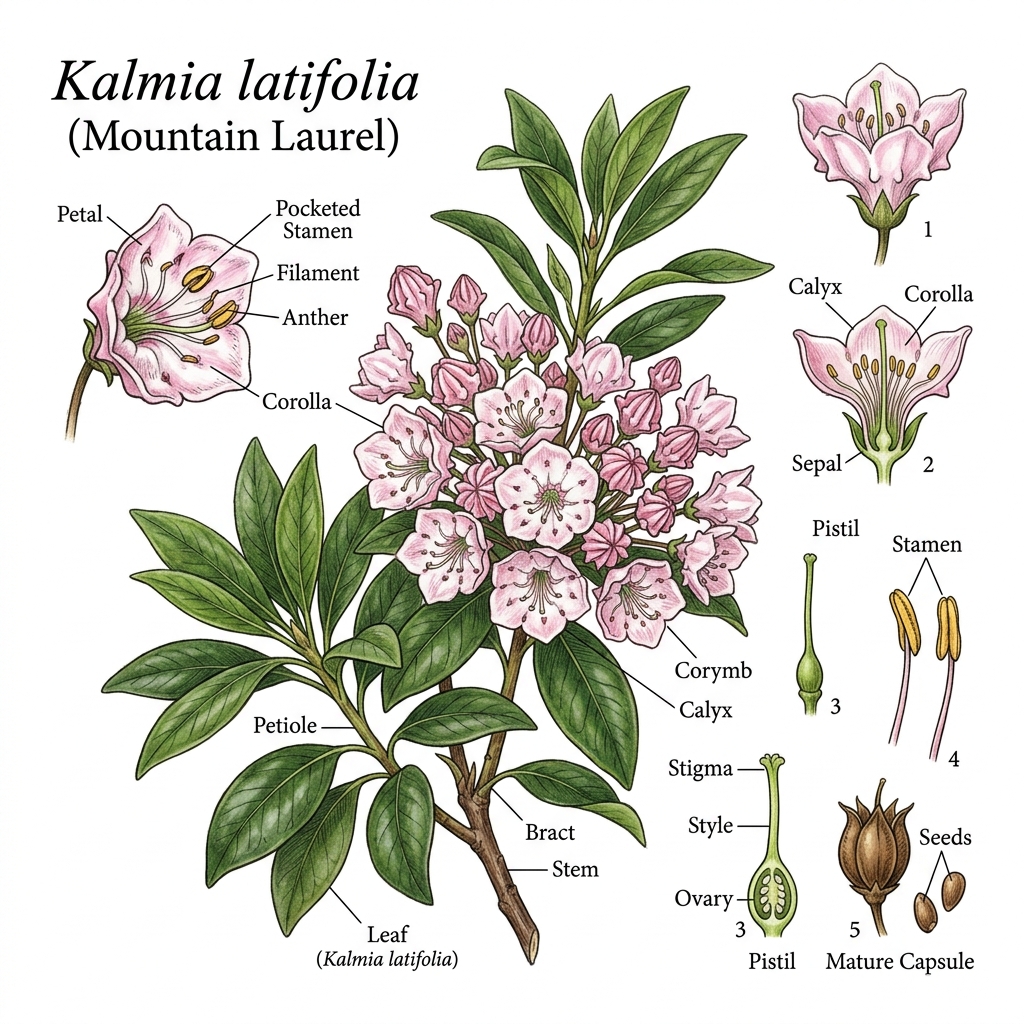
A detailed guide to identifying Mountain Laurels (Kalmia latifolia) by its key features:
- Pocketed Hexagonal Cups: Clusters of bowl-shaped, pink-and-white flowers with 10 pockets holding stamen tips under tension.
- Leathery Evergreen Leaves: Glossy, dark green, lance-shaped leaves resembling bay leaves.
- Gnarled Twisted Wood: Crooked, multi-branching woody shrub growing up to 5 to 15 feet tall.
- Sticky Flower Stems: Pedicels covered in sticky glandular hairs to deter crawling insects.
Care & Growing Guide
Mountain Laurel Care Guide:
- Light: Partial shade to morning sun; protect from afternoon sun
- Soil: Moist, acidic (pH 4.5–6.0), humus-rich, well-draining — same conditions as Rhododendron
- Fertilizer: Use acid-formulated fertilizer in early spring
- Pruning: Deadhead spent flower clusters to encourage new growth
Seasonal Blooming & Hardiness
Seasonal Blooming Calendar:
- Peak Bloom: May–June
- US Range: USDA Zones 4–9; native to Appalachian Mountains and eastern US acidic woodlands
Bloom Timeline
About Mountain Laurel
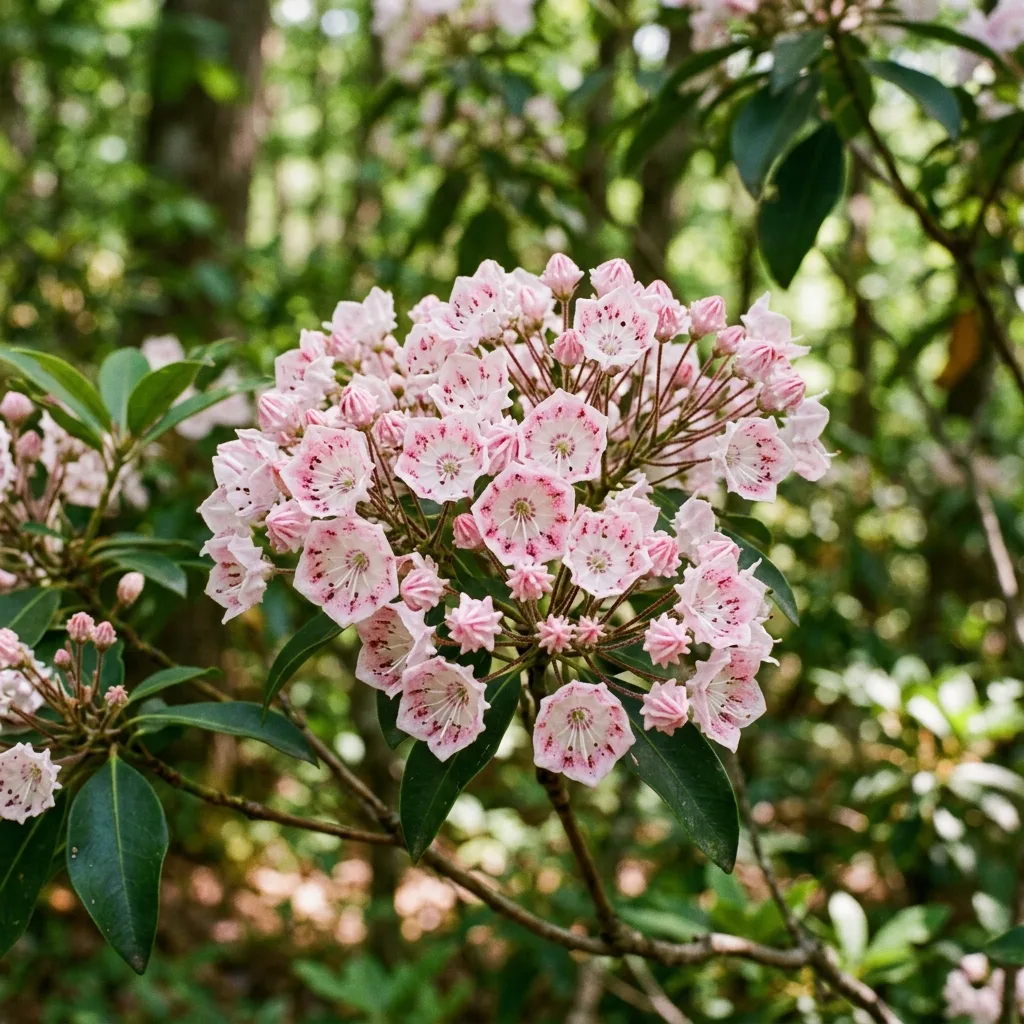
Mountain Laurel (Kalmia latifolia) is one of the most spectacular native flowering shrubs of the eastern United States, producing extraordinary clusters of cup-shaped flowers in shades of white, pink, and deep rose — each blossom decorated with a ring of ten maroon spots and a unique pentagonal (5-sided) structure that makes the buds look like tiny faceted jewels before they open. Belonging to the heath family (Ericaceae), it is native to the rocky, acidic woodlands of the Appalachian Mountains and surrounding foothills from Maine to Florida, and is the official state flower of both Connecticut and Pennsylvania.
The flower architecture of Mountain Laurel is one of the most elegantly engineered in the plant kingdom. Each flower begins as a 10-sided, star-shaped bud that opens into a cup with five lobes. The ten stamens are bent backward under tension, with their anthers tucked into ten small pouches in the flower's corolla. When a bee or bumblebee lands on the flower, it trips this tension mechanism, and the stamens spring upward like a catapult, flinging pollen onto the bee. This spring-loaded pollen delivery system is a sophisticated pollination adaptation unique to Kalmia and a few related genera.
Mountain Laurel is a broad-leaved evergreen shrub, typically growing 5 to 15 feet tall in the wild, with shiny, lance-shaped, dark green leaves that persist through winter, providing year-round structure and interest. In late May and June, the ends of every branch are capped with large, rounded clusters (corymbs) of 20–50 flowers, transforming the plant into a spectacular floral display that covers the entire Appalachian ridgeline each spring. In cultivation, it is a long-lived, reliable garden shrub for shaded or partially shaded acidic sites.
All parts of Mountain Laurel are highly toxic — the leaves, flowers, and especially the honey produced from its nectar can cause severe poisoning in humans, livestock, and pets. Indigenous peoples were aware of this toxicity and occasionally used it intentionally or as a medicine in highly diluted forms. In the landscape, it is an excellent choice for naturalized woodland gardens, foundation plantings on north or east exposures, and informal hedges in acidic soil areas. It is completely deer-resistant. Browse our Pet Guard for more plant safety guidance and our Flower Identifier for more native shrubs.
Floral Formula & Features
Actinomorphic, bisexual; 5 free sepals; 5 fused petals; 10 free stamens with spring-loaded, pouch-held anthers; 5 fused carpels with superior ovary
- Scientific Name & Classification: Kalmia latifolia (Ericaceae, tribe Phyllodoceae). A broad-leaved evergreen shrub — state flower of Connecticut and Pennsylvania.
- Identification Markers: Clusters of pentagonal, cup-shaped white to pink flowers with 10 maroon spots and a ring of 10 spring-loaded stamens. Shiny, lance-shaped evergreen leaves. Shrub 5–15 ft. Blooms May–June on acidic sites.
- Floral Formula (⊕ ☿ K5 C(5) A10 G(5)): Actinomorphic, bisexual; 5 free sepals; 5 fused petals (cup-shaped); 10 free stamens with spring-loaded anthers in petal pouches; 5 fused carpels with superior ovary.
- Growing Requirements: Partial shade to full sun; moist, acidic (pH 4.5–6.0), humus-rich, well-draining soil. Deer-resistant. USDA Zones 4–9. Requires acidic conditions — do not lime soil.
- Cultural Significance: State flower of Connecticut and Pennsylvania. Named after Pehr Kalm, a student of Linnaeus. Native to Appalachian Mountains — one of the signature plants of the eastern US ridge-and-valley landscape.
- Safety & Toxicity: ⚠️ HIGHLY TOXIC. All parts are toxic to humans, dogs, cats, horses, and livestock. Even honey made from Mountain Laurel nectar can cause poisoning. Keep children and pets away.
- Common Look-alikes: Often confused with Rhododendron and Azalea in the landscape. Mountain Laurel is distinguished by its unique pentagonal flower shape with spring-loaded stamens and smaller, narrower leaves than most Rhododendrons.
- Internal Links: Explore our Pet Guard for full toxicity details, and see companion plants in our Flower Identifier.
Names in Different Languages
Toxicity & Safety
Always keep toxic plants out of reach of children and pets. Consult a veterinarian or medical professional immediately if ingestion is suspected.
Pet Safety Guide: For detailed toxicity symptoms, first-aid measures, and safe garden alternatives, see our full Pet Guard Profile for Mountain Laurel.
Frequently Asked Questions
What is Floral Formula?
A floral formula is a symbolic representation of a flower's structure using letters, numbers, and special symbols. It provides a concise way to describe the arrangement and number of floral parts.
This formula describes the flower's symmetry, sepals, petals, stamens, and carpels in a standardized format.
Formula Sequence
- Bract: Br or Ebr
- Bracteole: Brl or Ebrl
- Symmetry: % (Radial) or ⊕ (Bilateral)
- Sex: ♀ (Female), ♂ (Male), or ⚥ (Bisexual)
- Calyx/Sepal: K<number> (Free or Fused)
- Corolla/Petal: C<number> (Free or Fused)
- Androecium: A<number> (Free or Fused)
- Gynaecium: G<number> (Superior or Inferior Ovary)
Symbol Meanings
- Numbers: Indicate quantity of parts
- Parentheses (): Parts are fused together
- Plus (+): Parts in different whorls
- Underline: Superior ovary position
- Overline: Inferior ovary position
- ∞: Numerous parts (too many to count)
Understanding floral formulas helps botanists quickly identify and classify flowers based on their structural characteristics.
Similar Flowers
Discover flowers that share botanical characteristics
Same Family
2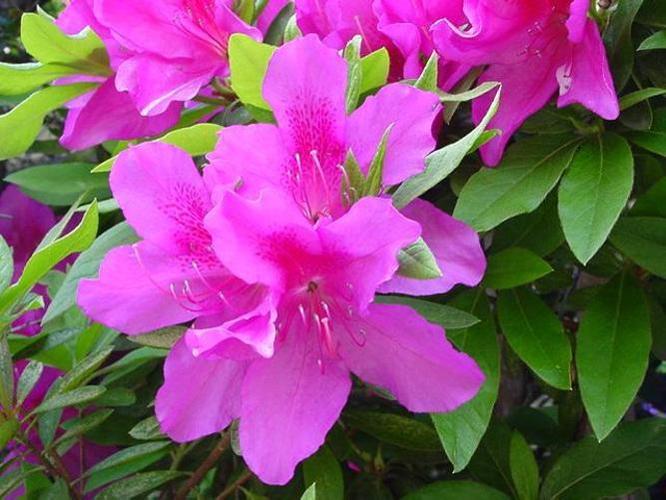
Azalea
Rhododendron (subgenus Tsutsusi)
The Azalea, botanically classified as Rhododendron (specifically under the subgenera Tsutsusi and Pentanthera) and belonging to the family Ericaceae (the heath family), is an exceptionally spectacular, heavy-blooming woody perennial shrub. Native primarily to the cool, damp woodlands, mountain sl...
Rhododendron (Burans)
Rhododendron arboreum
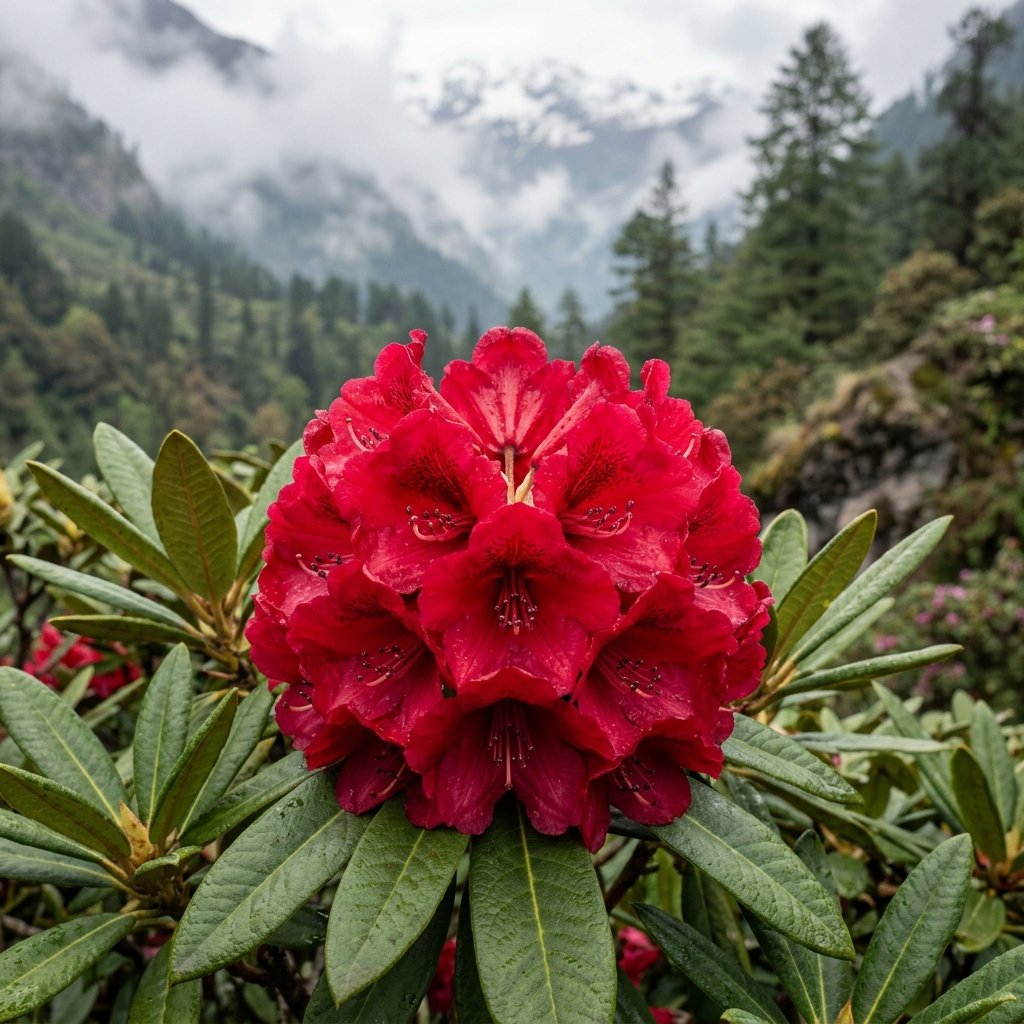
Rhododendron, botanically classified within the grand genus *Rhododendron* (exemplified by the majestic tree species *Rhododendron arboreum*) and celebrated across the Himalayas as Burans or the Rose Tree, is an exceptionally magnificent, woody evergreen flowering tree or large shrub. Belonging t...
Similar Characteristics
4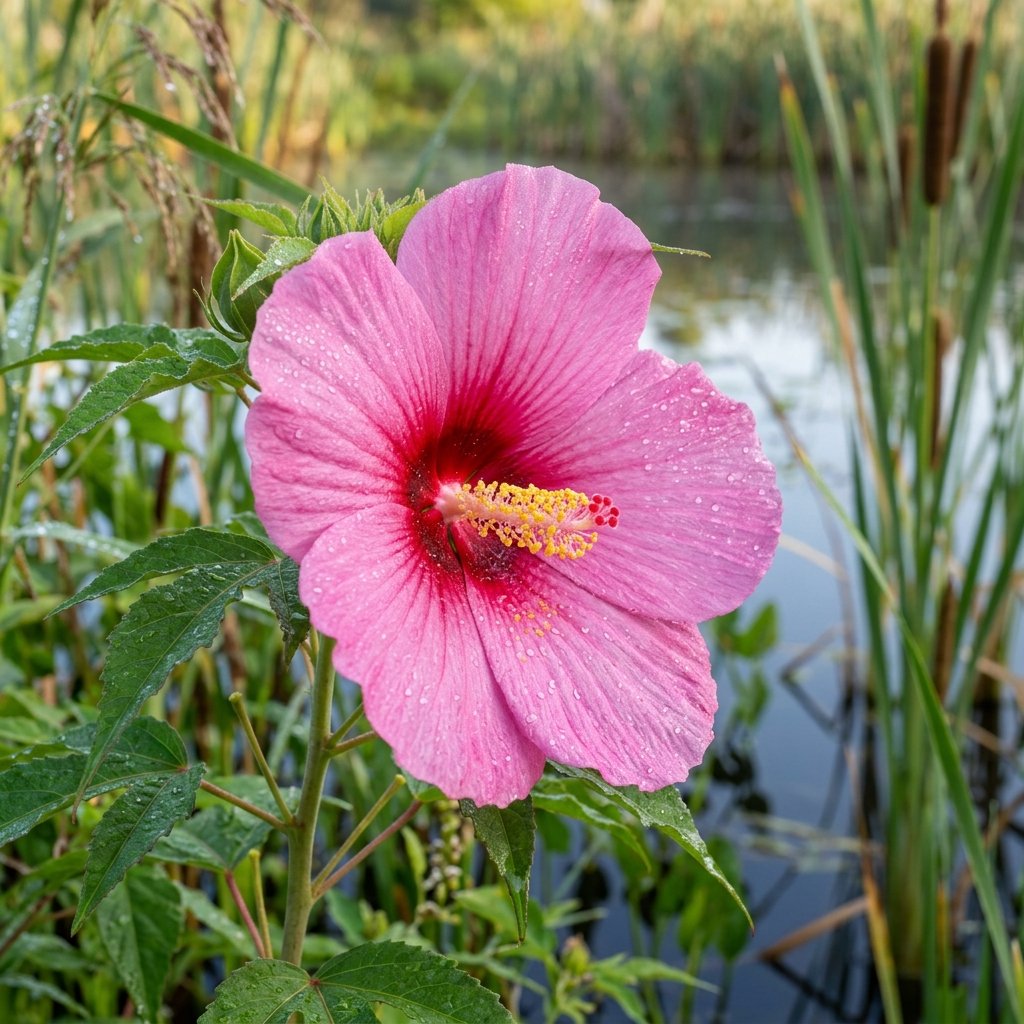
Swamp Rose Mallow
Hibiscus moscheutos
Swamp Rose Mallow (*Hibiscus moscheutos*) produces some of the largest flowers of any hardy perennial wildflower in North America — dinner-plate-sized blooms reaching 6 to 12 inches in diameter — in shades of white, pink, and rose, typically adorned with a dramatic deep crimson or rose-pink centr...
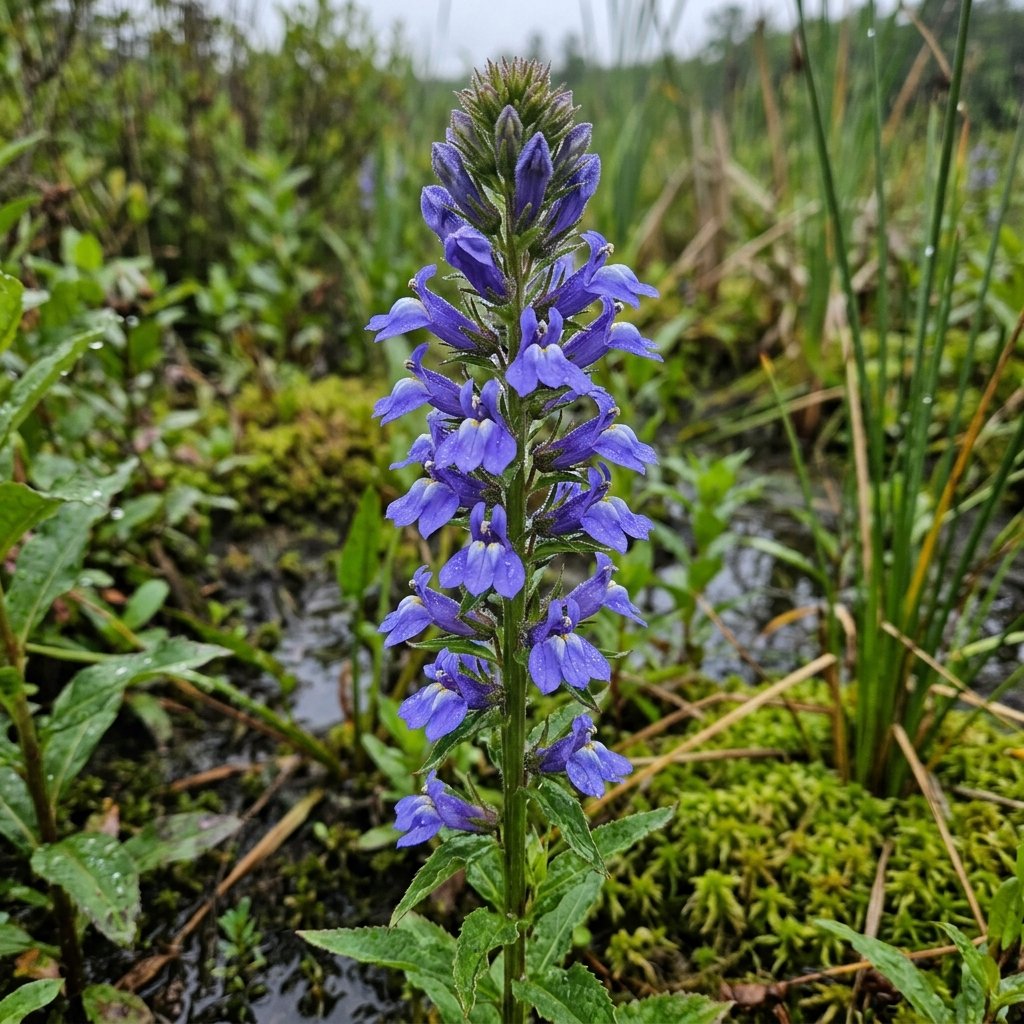
Great Blue Lobelia
Lobelia siphilitica
Great Blue Lobelia (*Lobelia siphilitica*) is a stunning native wildflower of eastern North America, producing tall spikes of vivid blue-violet to true blue flowers from late summer through fall in moist meadows, stream banks, and woodland edges. The blue-flowered counterpart to the scarlet Cardi...
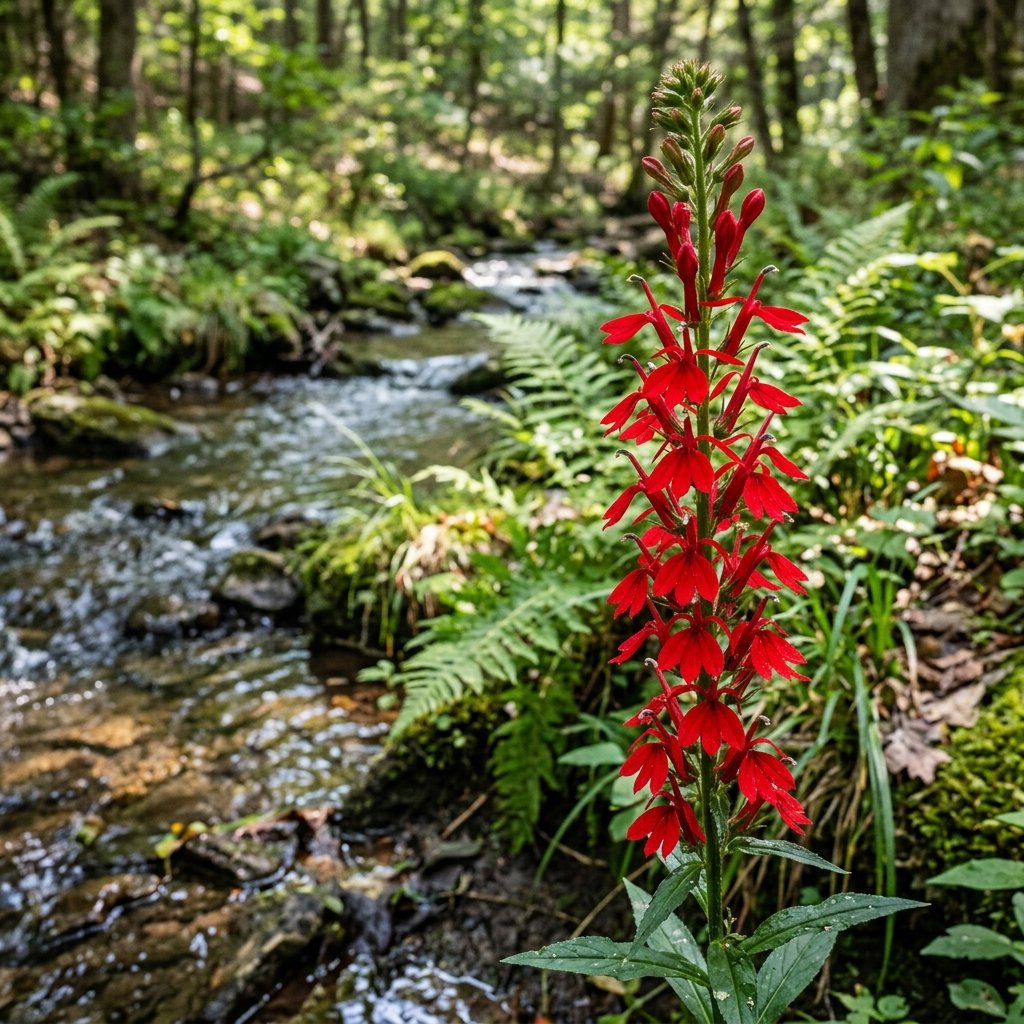
Cardinal Flower
Lobelia cardinalis
Cardinal Flower (*Lobelia cardinalis*) produces one of the most intensely saturated, brilliant scarlet-red flower spikes in all of North American horticulture, a vivid column of color that dominates moist meadows, stream banks, and woodland edges from July through September. Native throughout muc...
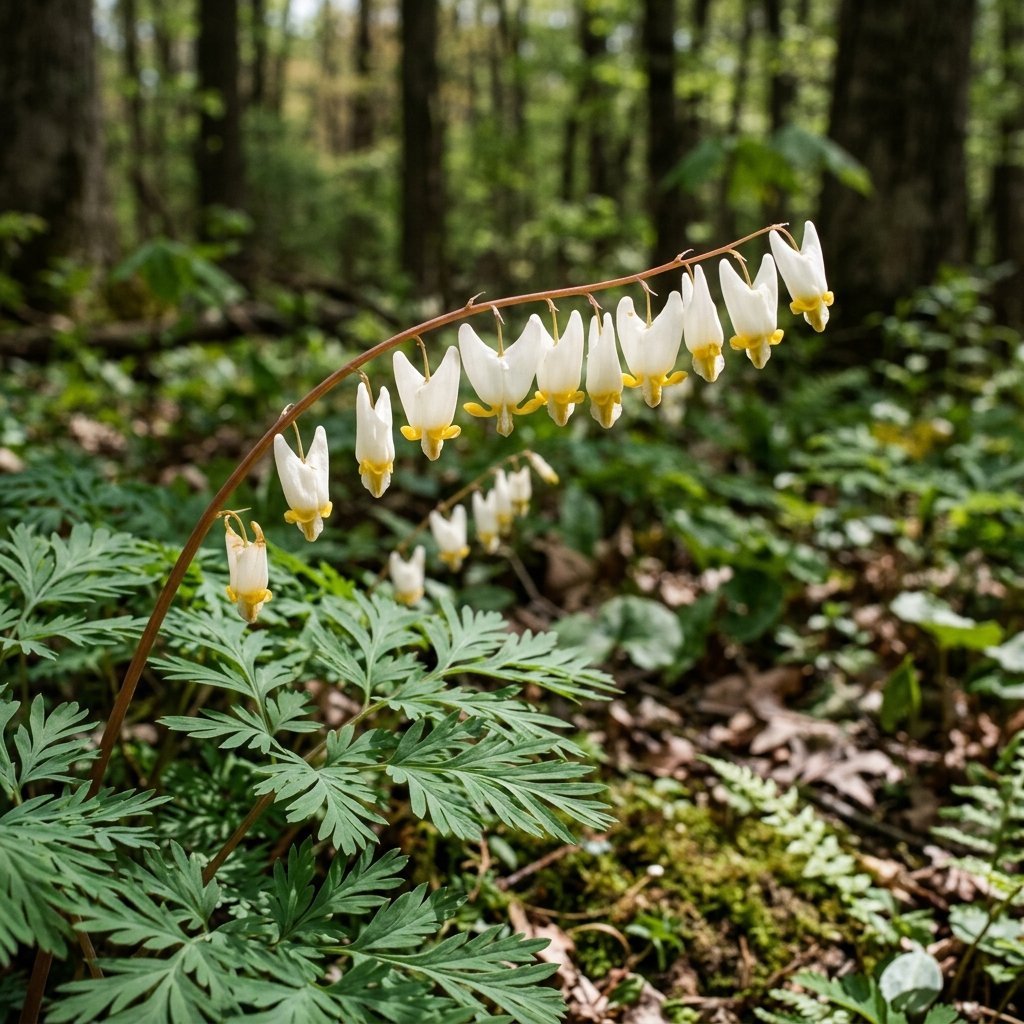
Dutchman's Breeches
Dicentra cucullaria
Dutchman's Breeches (*Dicentra cucullaria*) is one of the most whimsically charming and distinctively shaped wildflowers in the eastern North American spring flora, producing pendulous racemes of pure white flowers shaped precisely like pairs of miniature, upside-down pantaloons or 'breeches' — t...