Lotus
Nelumbo nucifera
How to Identify Lotus
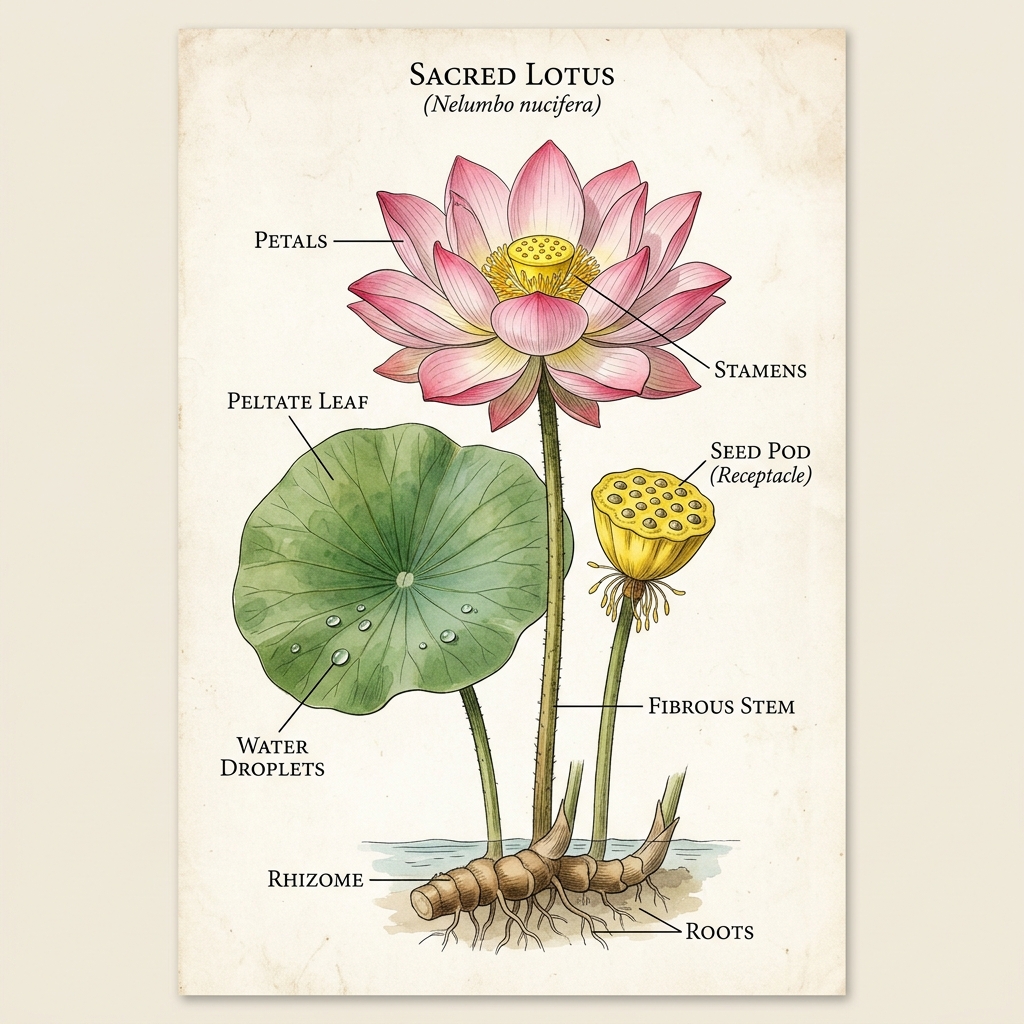
A detailed guide to identifying Lotus (Nelumbo nucifera) by its key features:
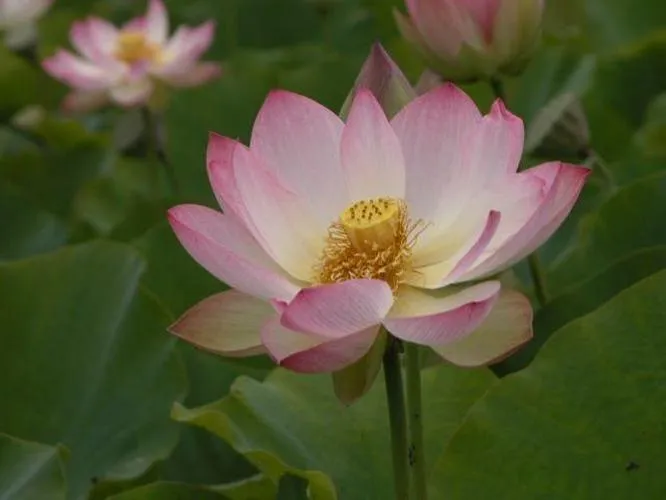
- Towering Blooms: Massive, cup-shaped pink or white blossoms that rise 2 to 5 feet high above the water surface on stiff, fibrous stalks.
- Notchless Circular Leaves: Giant circular leaves (peltate) that rise high above the water, lacking any V-notch, with a waxy surface that repels water droplets.
- Shower-Head Seed Pod: A prominent, flat-topped yellow or green central receptacle that resembles a shower head, housing developing seeds.
- Spiky Fibrous Stems: Thick stalks covered in tiny spikes/prickles that support the leaves and flowers high above water.
Types & Sub-types of Lotus
Lotus plants are categorized and distinguished based on flower color, plant size, and petal count:
- By Flower Color:
- Sacred Lotus (Nelumbo nucifera): The classic pink or white blooms native to Asia, deeply associated with spiritual symbolism.
- American Lotus (Nelumbo lutea): Native to North America, producing pale yellow or cream-colored blossoms.
- By Plant Size & Growing Scale:
- Large/Standard Lotus: Require large ponds or deep soil tubs, growing leaves up to 2 feet wide and heights up to 5 feet.
- Bowl/Dwarf Lotus: Compact varieties (1-2 feet tall) bred specifically for shallow container gardens and patio pots (e.g., 'Momo Botan').
- By Petal Form & Count:
- Single-Flowered Lotus: Classic blooms containing 20 or fewer petals, displaying the central seed pod clearly.
- Multi-Petaled (Double) Lotus: Heavily ruffled flowers containing 50 to 100+ petals, offering a dense pom-pom look (e.g., 'Thousand Petals').
Care & Growing Guide
Seasonal Blooming & Hardiness
Seasonal Blooming Calendar:
- Peak Bloom: Internal Links: Explore more symbolic blooms in the Flower Identifier or browse the Arum Lily and Anthurium.
- Planting Time: Plant container-grown starts in early spring or autumn.
Bloom Timeline
About Lotus
The Sacred Lotus (Nelumbo nucifera), the crown jewel of the Nelumbonaceae family, is an ancient aquatic perennial that holds profound spiritual significance across Asia. Originating in regions stretching from India to China and northern Australia, the Lotus has survived for over 135 million years, making it a living fossil. Renowned for its ability to emerge flawlessly clean from the murkiest of mud, it stands as a universal symbol of purity, rebirth, and spiritual enlightenment.
The Lotus produces massive, fragrant, multi-petaled blossoms (4 to 12 inches across) in ethereal shades of pink, white, or yellow. A distinctive, flat-topped yellow seed receptacle sits at the flower's center. Its large, circular, shield-like leaves can span up to 3 feet and are famous for the 'Lotus Effect'—a super-hydrophobic surface that causes water to bead up and roll off, naturally cleaning the leaf. Both the flowers and leaves rise majestically 2 to 6 feet above the water surface on sturdy stalks.
The floral formula is EBr ⊕ ⚥ K4-5 C15-25 A∞ G8-30. It is an ebracteate, radially symmetrical, bisexual flower featuring 4-5 free sepals, 15-25 free petals in multiple whorls, numerous stamens (over 100), and 8-30 distinct carpels embedded independently within the spongy, cone-like receptacle. This primitive yet highly efficient structure is a marvel of evolutionary biology.
Lotus plants require full, intense sun (6-8 hours) and must be grown in still or slow-moving water (6 to 24 inches deep) with a thick layer of rich, muddy soil at the bottom. They thrive in heat (USDA zones 4-11) and are surprisingly cold-hardy provided the submerged tuber sits below the winter freeze line.
It is the national flower of both India and Vietnam. In Hinduism and Buddhism, deities are frequently depicted seated upon a Lotus. Every part of the plant—from the starchy rhizome root to the seeds and petals—is widely consumed in Asian cuisine and utilized in traditional medicine. The plant is completely non-toxic and safe for water gardens frequented by pets.
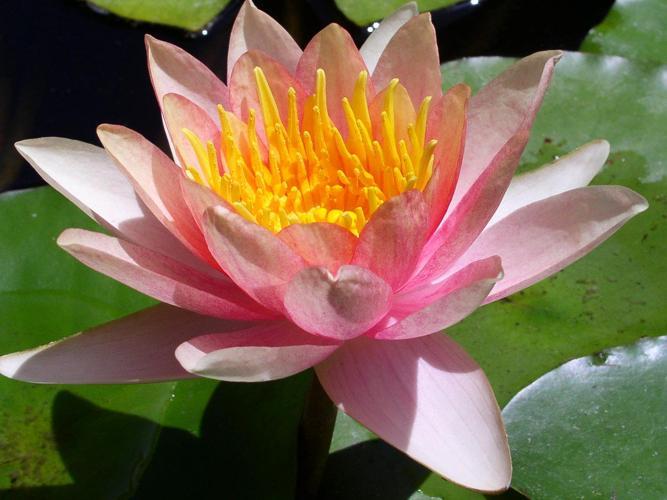
Often confused with Water Lilies (Nymphaea species), the key distinction is structural. Water Lily leaves and flowers typically float flat directly on the water's surface and have a distinct slit in the leaf, whereas Lotus leaves are perfectly circular without a slit, and both its leaves and massive flowers stand tall above the water. Discover more aquatic plants in our Flower Identifier or pair it with the beautiful Arum Lily, the intricate Passion Flower, or the bold Anthurium.
As India's national flower and the quintessential symbol of purity in Buddhism and Hinduism, the Lotus represents spiritual elevation above muddy waters. Across Sri Lanka and Southeast Asia, lotuses are strictly reverential offerings for temples and altars rather than casual gifts. Discover global flower symbolism in our Global Flower Etiquette Guide.
Floral Formula & Features
Ebracteate, radially symmetrical, bisexual, numerous free petals and stamens, independent carpels embedded in flat-topped receptacle
- Scientific Name & Classification: Nelumbo nucifera (Nelumbonaceae). Commonly known as the Sacred Lotus.
- Identification Markers: Massive pink or white blossoms with a distinctive yellow flat-topped seed pod in the center. Perfectly circular leaves that repel water (Lotus Effect).
- Floral Formula (EBr ⊕ ⚥ K4-5 C15-25 A∞ G8-30): Radially symmetrical, bisexual, numerous petals in multiple whorls, 100+ stamens, 8-30 carpels embedded in a spongy receptacle.
- Growing Requirements: Full sun, grown in still water (6-24 inches deep) over rich mud. Tubers are winter-hardy if submerged below the freeze line.
- Cultural Significance: National flower of India and Vietnam. A profound symbol of purity, rebirth, and enlightenment in Hinduism and Buddhism.
- Safety & Toxicity: NON-TOXIC. Completely safe for pets and ponds. Every part of the Lotus (roots, leaves, seeds) is edible and used in Asian cuisine.
- Common Look-alikes: Often confused with Water Lilies. However, Water Lilies float flat on the water and have a slit in the leaf, whereas Lotus leaves are full circles and stand tall above the water.
- Internal Links: Explore more symbolic blooms in the Flower Identifier or browse the Arum Lily and Anthurium.
- Internal Links: Compare key differences in our Lily vs Lotus comparison, or try our instant Flower Identifier.
Names in Different Languages
Tip: Need to buy or identify flowers in regional markets? Check our complete South Indian Flower Names Guide mapping 30+ flowers across Tamil, Telugu, Hindi, Kannada, and Malayalam.
Cultural Etiquette & Gifting: Planning to gift or decorate with Lotus? Discover its symbolic meanings, festival traditions, and crucial cultural faux pas across 20+ countries in our comprehensive Global Flower Etiquette Guide.
Botanical Classification: Lotus belongs to the Nelumbonaceae family. Learn how to identify its floral symmetry, stamen arrangement, and structural formulas in our Botanical Family Classification Guide.
Toxicity & Safety
Frequently Asked Questions
What is Floral Formula?
A floral formula is a symbolic representation of a flower's structure using letters, numbers, and special symbols. It provides a concise way to describe the arrangement and number of floral parts.
This formula describes the flower's symmetry, sepals, petals, stamens, and carpels in a standardized format.
Formula Sequence
- Bract: Br or Ebr
- Bracteole: Brl or Ebrl
- Symmetry: % (Radial) or ⊕ (Bilateral)
- Sex: ♀ (Female), ♂ (Male), or ⚥ (Bisexual)
- Calyx/Sepal: K<number> (Free or Fused)
- Corolla/Petal: C<number> (Free or Fused)
- Androecium: A<number> (Free or Fused)
- Gynaecium: G<number> (Superior or Inferior Ovary)
Symbol Meanings
- Numbers: Indicate quantity of parts
- Parentheses (): Parts are fused together
- Plus (+): Parts in different whorls
- Underline: Superior ovary position
- Overline: Inferior ovary position
- ∞: Numerous parts (too many to count)
Understanding floral formulas helps botanists quickly identify and classify flowers based on their structural characteristics.
Similar Flowers
Discover flowers that share botanical characteristics