
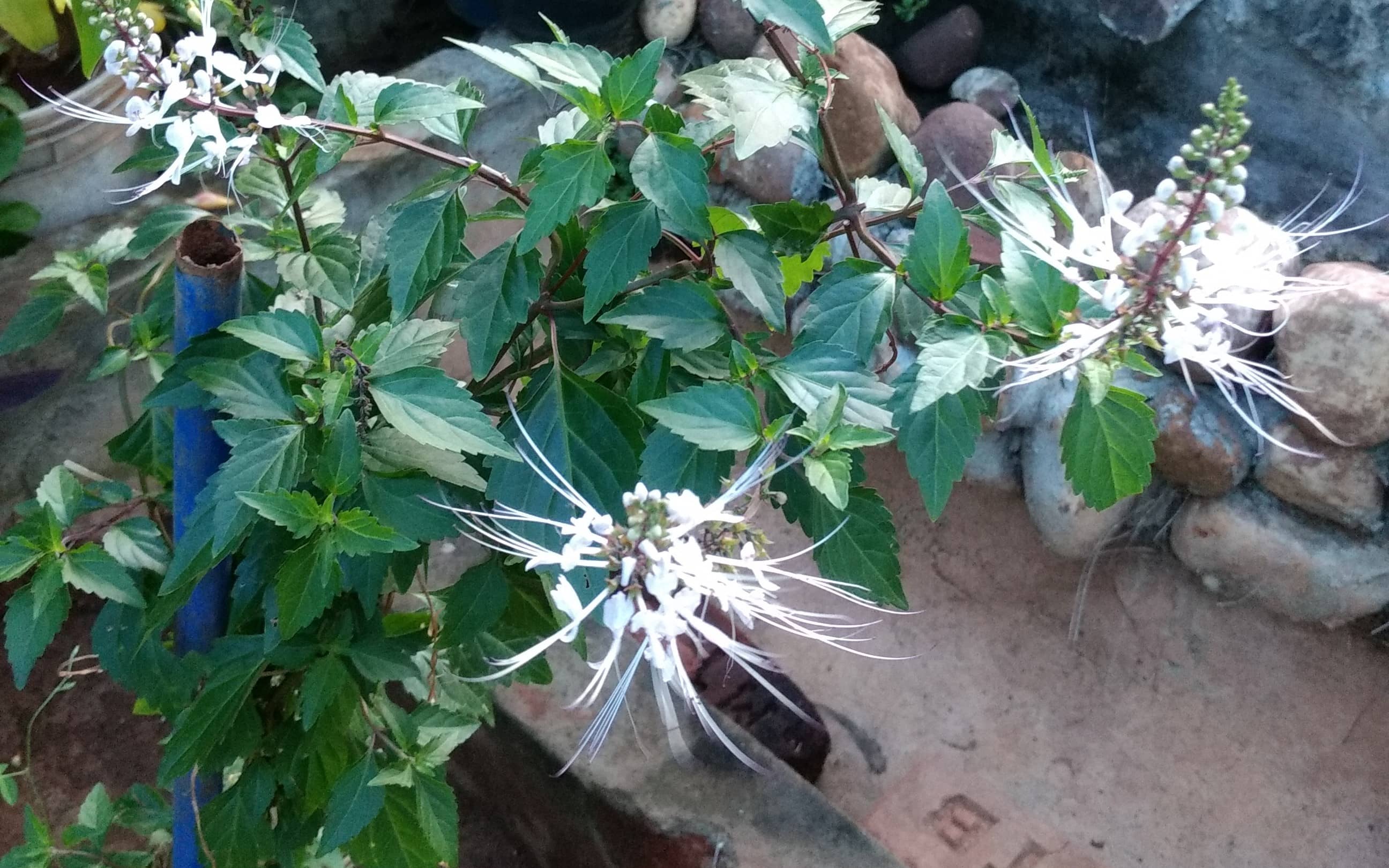
Cat's whiskers
Orthosiphon aristatus
Basic Details
Floral Formula & Features
Ebracteate (no bracts), bilaterally symmetrical (zygomorphic), bisexual, 5 fused sepals forming calyx tube, 5 fused petals forming two-lipped corolla, 4 stamens in 2 pairs (didynamous, 2 long + 2 short), 2 fused carpels with superior ovary deeply 4-lobed
- Name 'Orthosiphon' from Greek 'orthos' (straight) and 'siphon' (tube) referring to straight corolla tube. 'Aristatus' means 'bearded' or 'awned.' Common names 'Cat's Whiskers' and 'Kumis Kucing' (Malay) describe long, whisker-like stamens. 'Java Tea' refers to traditional use in Indonesia
- Small tubular flowers 0.5-1 inch (1-2 cm) long with two-lipped (bilabiate) corolla. Four stamens extend dramatically 1-2 inches (2.5-5 cm) beyond petals like whiskers. Flowers white, pale lavender, or purple, arranged in terminal racemes 4-8 inches long
- Herbaceous perennial shrub that blooms nearly year-round in tropical climates, primarily summer through fall (June-November) in subtropical areas. Fast-growing, reaching mature size in one season. Member of mint family with square stems and opposite leaves
- Grows 2-4 feet (60-120 cm) tall with 2-3 foot (60-90 cm) spread. Lifespan of 3-5 years. Propagated easily from softwood cuttings (root in 2-3 weeks) or seeds. Pinch growing tips to encourage bushiness
- Native to Southeast Asia including Indonesia, Malaysia, Thailand, Myanmar, Vietnam, and southern China. Found in moist, shaded areas along forest edges and stream banks. Widely cultivated throughout tropical Asia for medicinal use
- Adapts to full sun or partial shade (prefers afternoon shade in hot climates). Requires consistently moist, well-drained soil rich in organic matter. Thrives in heat and humidity. Water regularly; wilts dramatically if allowed to dry but recovers quickly. Frost tender
- Leaves used to make Java Tea (Teh Kumis Kucing), traditional remedy for kidney stones, urinary tract infections, and as diuretic. Contains rosmarinic acid and other bioactive compounds. Attracts butterflies and bees. Deer resistant. Popular ornamental in tropical gardens for unique flower form
Names in Different Languages
What is Floral Formula?
A floral formula is a symbolic representation of a flower's structure using letters, numbers, and special symbols. It provides a concise way to describe the arrangement and number of floral parts.
This formula describes the flower's symmetry, sepals, petals, stamens, and carpels in a standardized format.
Formula Sequence
- Bract: Br or Ebr
- Bracteole: Brl or Ebrl
- Symmetry: % (Radial) or ⊕ (Bilateral)
- Sex: ♀ (Female), ♂ (Male), or ⚥ (Bisexual)
- Calyx/Sepal: K<number> (Free or Fused)
- Corolla/Petal: C<number> (Free or Fused)
- Androecium: A<number> (Free or Fused)
- Gynaecium: G<number> (Superior or Inferior Ovary)
Symbol Meanings
- Numbers: Indicate quantity of parts
- Parentheses (): Parts are fused together
- Plus (+): Parts in different whorls
- Underline: Superior ovary position
- Overline: Inferior ovary position
- ∞: Numerous parts (too many to count)
Understanding floral formulas helps botanists quickly identify and classify flowers based on their structural characteristics.
Similar Flowers
Discover flowers that share botanical characteristics
Same Family
4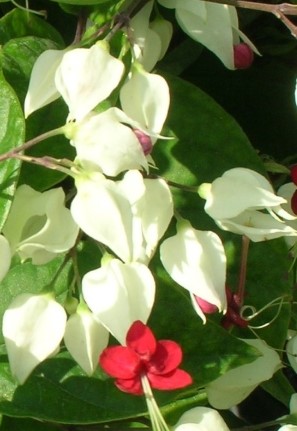
Bleeding Heart Vine
Clerodendrum thomsoniae
The plant is a creeper/climber and produces numerous clusters of flowers that a...
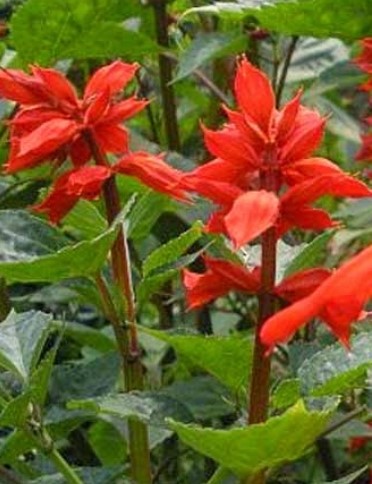
Salvia
Salvia
Diverse and valuable genus featuring tubular flowers in vibrant shades of blue, ...
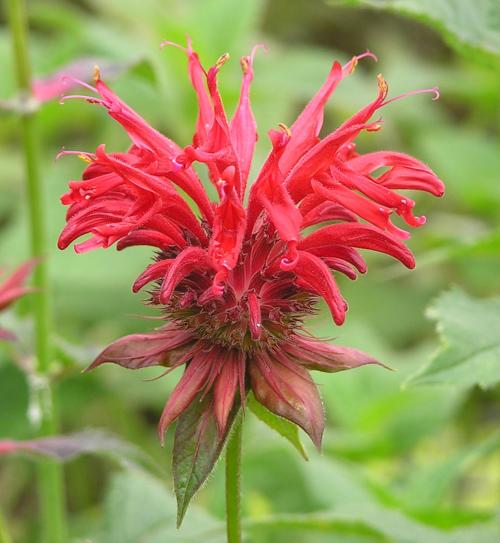
Beebalm
Monarda didyma, Mentha longifolia
Showy perennial herb featuring dense, pom-pom-like clusters of tubular flowers i...
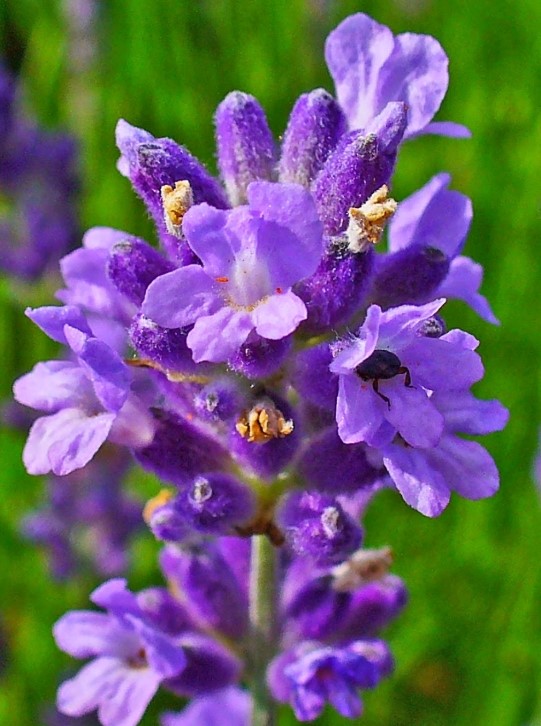
Lavender
Lavandula angustifolia
Iconic aromatic herb featuring slender spikes of small, intensely fragrant flowe...
Similar Characteristics
4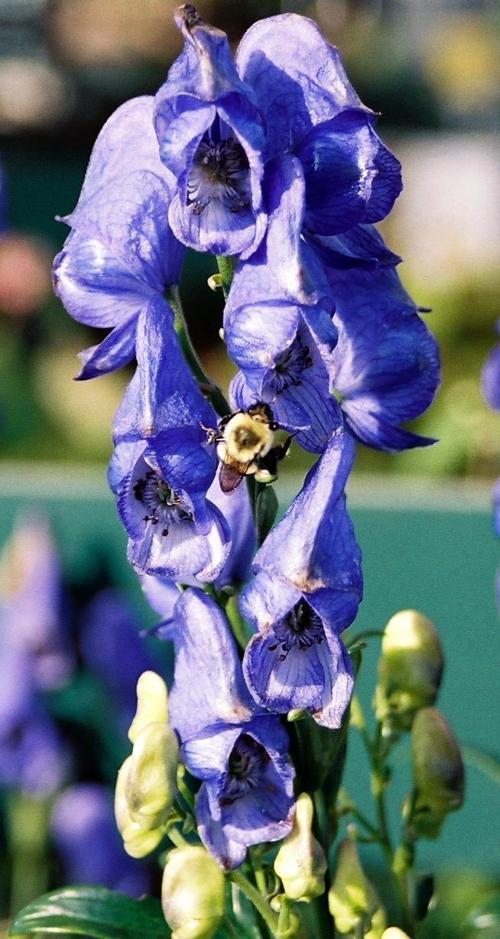
Monkshood
Aconitum napellus
Strikingly beautiful but DEADLY POISONOUS perennial with distinctive helmet or h...
Beebalm
Monarda didyma, Mentha longifolia
Showy perennial herb featuring dense, pom-pom-like clusters of tubular flowers i...
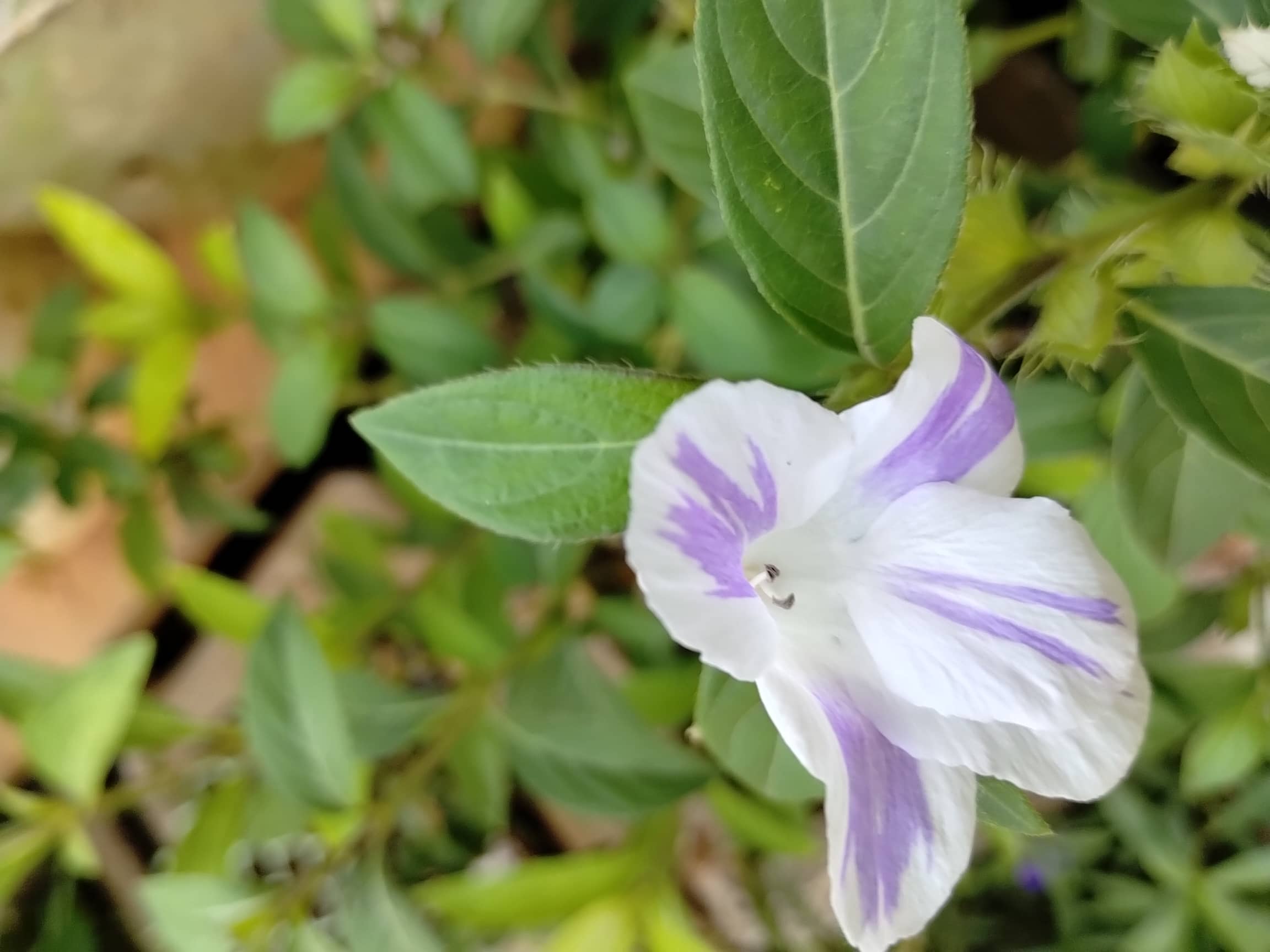
December
Barleria Cristata,Barleria prioniti
Attractive evergreen shrub featuring tubular flowers with distinctive crested or...
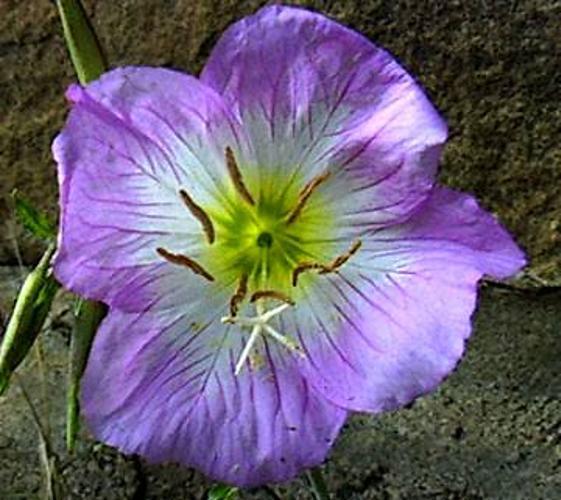
Primrose (Cowslip)
Primula veris
Cheerful spring wildflower with clusters of nodding yellow flowers on tall stems...