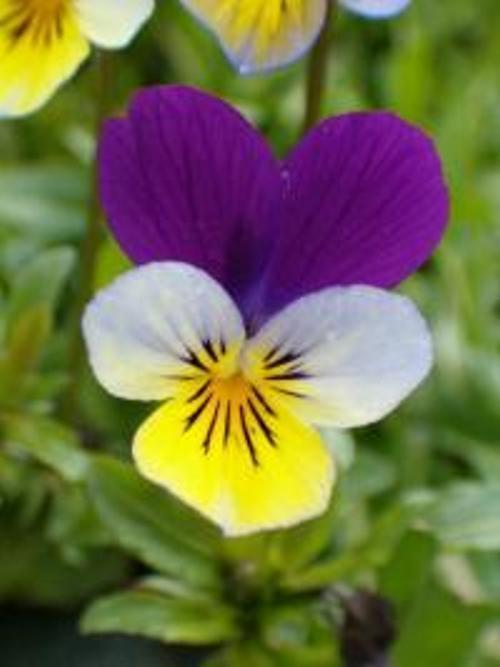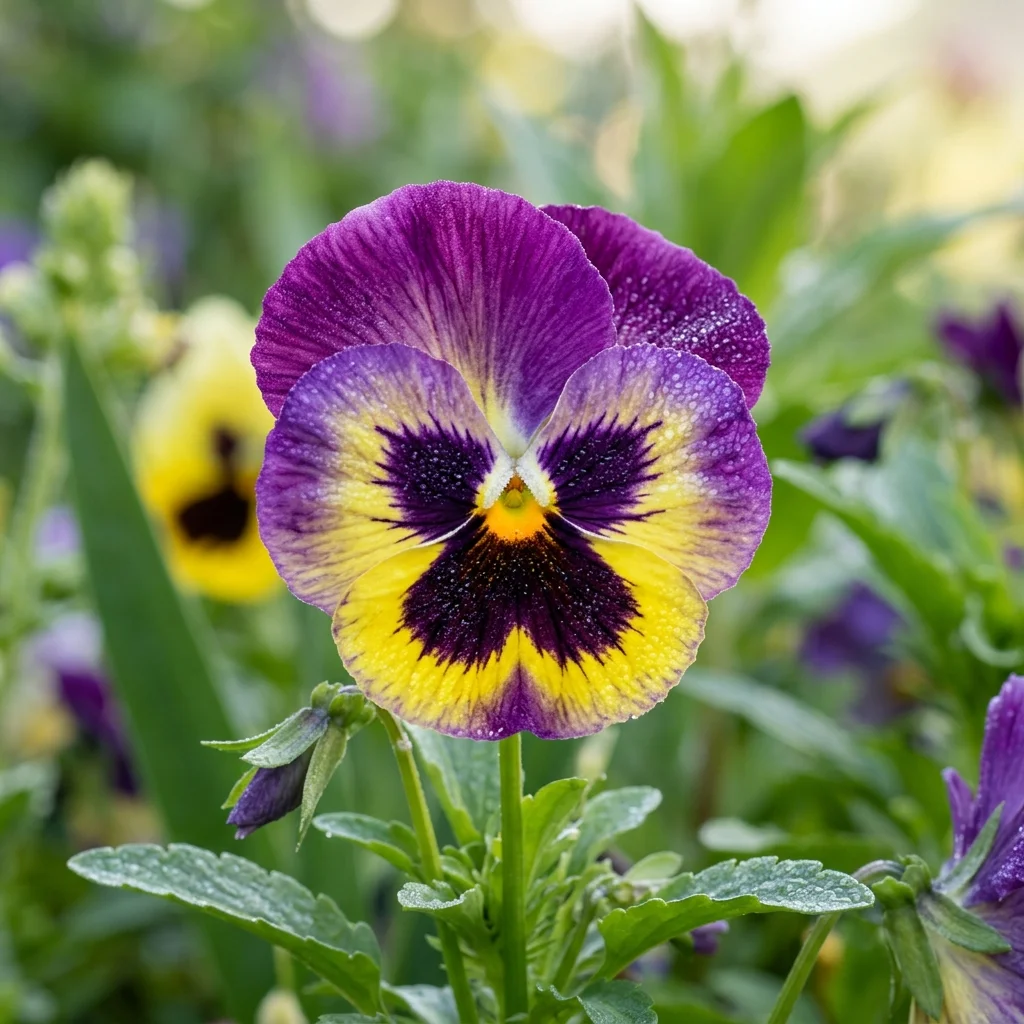
Pansy
Viola × wittrockiana
How to Identify Pansy
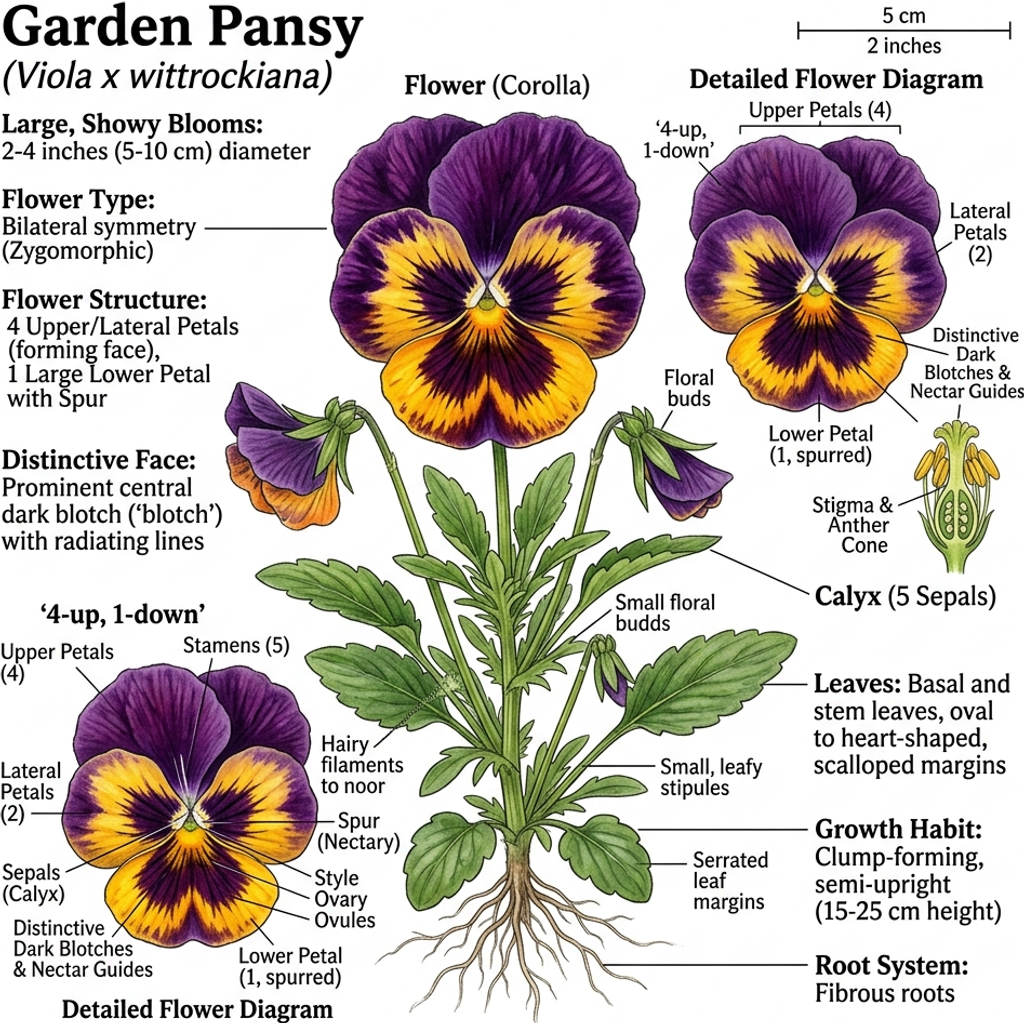
How to identify Garden Pansy (Viola × wittrockiana):
- Large Blooms: Flowers are large (2 to 4 inches wide) with broad, rounded, overlapping petals.
- Blotched Face: Most varieties feature a prominent, dark contrasting blotch in the center forming a 'face'.
- 4-Up, 1-Down Petals: Arrangement of petals has 4 petals pointing upward and only 1 pointing downward.
- Scalloped Foliage: Deep green heart-shaped to oval leaves with scalloped margins growing on low, bushy mounds.
Types & Sub-types of Pansies
Garden pansies are classified by flower size and coloration patterns:
- Standard Blotched Pansies: Classic varieties featuring the large dark central 'face' (e.g., 'Delta' series).
- Clear/Solid Pansies: Hybrid varieties with solid, uniform petal colors lacking any facial blotches.
- Trailing/Wave Pansies: Vigorous spreading varieties bred for hanging baskets and groundcover (e.g., 'Cool Wave').
Care & Growing Guide
Pansy Care & Growing Guide:
- Light: Full sun to partial afternoon shade. Avoid scorching afternoon sun in late spring.
- Soil: Moist, organic-rich, well-draining garden loam.
- Watering: Keep the soil consistently moist but not waterlogged. Water thoroughly during dry spells.
- Fertilization: Feed monthly with a balanced liquid fertilizer to support heavy blooming.
- Deadheading: Pinch off faded flowers regularly to prevent seed formation and promote fresh blooms.
Seasonal Blooming & Hardiness
Seasonal Blooming Calendar (US Hardiness Zones 4-9):
- Spring: Plant in early spring. Blooms heavily from early spring to early summer.
- Summer: Fades and dies back or becomes leggy when temperatures exceed 80°F.
- Autumn: Can be replanted in late summer/early autumn for a second bloom period through early winter.
Bloom Timeline
About Pansy
The Garden Pansy, botanically classified as Viola × wittrockiana, is a large-flowered hybrid plant cultivated extensively as a popular garden flower. It is a member of the Violaceae family and was hybridized in the 19th century in Northern Europe by crossing the wild Viola tricolor with other native alpine violet species. Celebrated for its cheerful, expressive central blotches that resemble 'faces', the garden pansy is a cool-season horticultural favorite.
Growing as a low, bushy mound reaching 6 to 9 inches in height, this plant is easily recognized by its massive, showy flowers measuring 2 to 4 inches in diameter. Each bloom consists of 5 broad, rounded, overlapping petals with a zygomorphic (bilaterally symmetrical) arrangement—usually with 4 petals pointing upward and only 1 pointing downward. Most cultivars display a contrasting dark blotch or 'face' in the center, although clear or solid-colored varieties are also widely grown.
The reproductive structures are represented by the floral formula EBr % ⚥ K5 C5 A5 G(3), sharing the Violaceae family layout. It features a bilaterally symmetrical, bisexual blossom with 5 green sepals, 5 overlapping petals where the lowermost is spurred to house nectar, 5 short stamens closely surrounding a single pistil, and a syncarpous ovary formed by 3 fused carpels with parietal placentation.
Thriving in cool, damp climates, Garden Pansies perform beautifully in USDA zones 4 through 9 during early spring and autumn. They prefer full sun to partial shade and organic-rich, moist, well-draining soil. Their primary horticultural limit is their low tolerance for summer heat, which causes the plants to become leggy, stop blooming, and eventually die out, making replanting necessary when hot weather arrives.
Steeped in symbolism, the name 'pansy' is derived from the French word 'pensée', meaning 'thought' or 'remembrance'. It has been a symbol of freethought, loving memories, and romantic contemplation in literature and art. The flowers are entirely non-toxic and edible, frequently used as a decorative garnish in gourmet cooking, baking, and salads.
Garden Pansies are easily distinguished from wild violas (Viola tricolor) by their much larger bloom size (2-4 inches wide compared to 0.5-1 inch) and their broad, overlapping petals with distinct contrasting central faces rather than thin whisker-like stripes. They pair beautifully with other early spring blooms; we suggest planting them in borders alongside Daffodil or Common Daisy.
Floral Formula & Features
Ebracteate (no bracts), Zygomorphic (bilateral symmetry), bisexual, 5 free sepals with appendages, 5 free petals (lower petal spurred), 5 free stamens with short filaments, 3 fused carpels with superior ovary typical of Violaceae
- Scientific Name & Classification: Viola × wittrockiana (Violaceae). Commonly referred to as Garden Pansy.
- Identification Markers: Large flowers (2-4 inches) with broad, overlapping petals, most varieties displaying a dark central face.
- Floral Formula (EBr % ⚥ K5 C5 A5 G(3)): Bilaterally symmetrical, bisexual flower featuring 5 sepals, 5 petals (lower spurred), 5 stamens, and 3 fused carpels.
- Growing Requirements: Cool weather; full sun to partial shade; prefers moist, fertile, organic-rich, and well-draining soil (Zones 4-9).
- Cultural Significance: Name derived from French 'pensée' (thought), representing remembrance and freethought. Edible blossoms.
- Safety & Toxicity: NON-TOXIC. Safe for dogs, cats, and horses, making them a safe choice for flower borders.
- Common Look-alikes: Confused with wild violas (Johnny Jump Ups), but distinguished by much larger blooms and distinct overlapping petals with central blotched faces.
- Internal Links: Search the Flower Identifier or pair them in spring borders with Daffodil or Common Daisy.
- Internal Links: Compare key differences in our Pansy vs Viola comparison, or try our instant Flower Identifier.
Names in Different Languages
Toxicity & Safety
Frequently Asked Questions
What is Floral Formula?
A floral formula is a symbolic representation of a flower's structure using letters, numbers, and special symbols. It provides a concise way to describe the arrangement and number of floral parts.
This formula describes the flower's symmetry, sepals, petals, stamens, and carpels in a standardized format.
Formula Sequence
- Bract: Br or Ebr
- Bracteole: Brl or Ebrl
- Symmetry: % (Radial) or ⊕ (Bilateral)
- Sex: ♀ (Female), ♂ (Male), or ⚥ (Bisexual)
- Calyx/Sepal: K<number> (Free or Fused)
- Corolla/Petal: C<number> (Free or Fused)
- Androecium: A<number> (Free or Fused)
- Gynaecium: G<number> (Superior or Inferior Ovary)
Symbol Meanings
- Numbers: Indicate quantity of parts
- Parentheses (): Parts are fused together
- Plus (+): Parts in different whorls
- Underline: Superior ovary position
- Overline: Inferior ovary position
- ∞: Numerous parts (too many to count)
Understanding floral formulas helps botanists quickly identify and classify flowers based on their structural characteristics.
Similar Flowers
Discover flowers that share botanical characteristics