
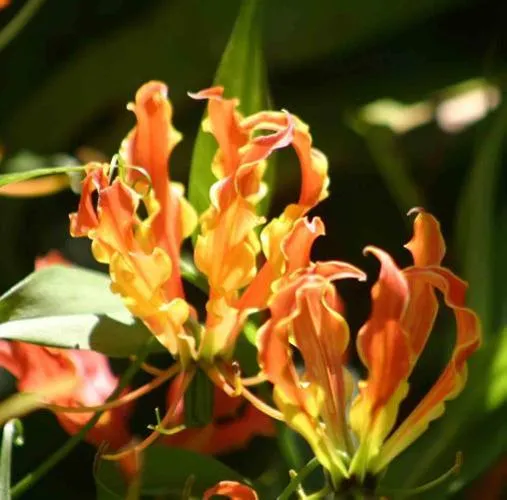
Fire Lily
Gloriosa superba
How to Identify Fire Lily
Care & Growing Guide
Seasonal Blooming & Hardiness
Seasonal Blooming Calendar:
- Peak Bloom: Late winter to early spring.
- Planting Time: Sow seeds directly outdoors in early spring after the last frost, or transplant nursery starts in late spring.
Bloom Timeline
About Fire Lily
The Fire Lily (Gloriosa superba), a breathtaking member of the Colchicaceae family, is a climbing tuberous plant native to the tropical and southern regions of Africa and Asia. True to its name, this spectacular plant produces dramatic, flame-like blossoms that seemingly ignite the garden with their fiery hues. It stands out as a true botanical rarity, being one of the only climbing lilies in existence, utilizing specialized leaf tips to scale surrounding vegetation.
Unmistakable in bloom, the flowers feature six dramatically reflexed (backward-curving) tepals with heavily wavy, crimped margins. These petals transition from a bright yellow base to an intense, fiery red-orange tip. The prominent stamens splay outward dramatically, giving the flower a tiger-claw appearance. The glossy, lance-shaped leaves end in coiling tendrils that allow the vine to climb up to 8 feet.
The floral formula is EBr % ⚥ P3+3 A3+3 G(3). This denotes an ebracteate, bilaterally symmetrical (due to the reflexed tepals), and bisexual flower. It has 6 tepals arranged in two whorls of 3, 6 prominent stamens, and 3 fused carpels forming a superior ovary. This unique floral structure makes it a highly searched subject for botany enthusiasts.
Fire Lilies thrive in full to partial sun in rich, well-draining soil. As a tropical plant (USDA zones 8-11), the brittle tubers must be lifted and stored indoors during winter in colder climates. They require a trellis or fence for support and need regular watering during their active summer growth phase.
Deeply revered, it is the national flower of Zimbabwe and the state flower of Tamil Nadu, India (where it is known as Karthigaipoo). However, it is an endangered species in many native habitats due to over-harvesting for medicinal use. Caution is paramount: all parts of the plant, especially the tuber, contain highly toxic, lethal levels of colchicine. Ingestion can cause fatal organ failure in both humans and pets. Always handle the tubers with gloves.
Its reflexed petals might cause confusion with the Turk's Cap Lily (Lilium superbum). However, the Turk's Cap Lily grows on a rigid, upright stalk and does not possess the climbing tendrils on its leaf tips, which are the absolute defining hallmark of the Fire Lily. Dive into exotic blooms in the Flower Identifier and complement it with the dramatic Passion Flower, the towering Amaranthus, or the stunning Amaryllis.
Floral Formula & Features
Ebracteate, bilaterally symmetrical, bisexual, 6 tepals in 2 whorls, 6 stamens, 3 fused carpels with superior ovary
- Scientific Name & Classification: Gloriosa superba (Colchicaceae). Also known as Flame Lily and Glory Lily.
- Identification Markers: Bright red/yellow reflexed petals that look like flames. Climbing vine utilizing tendrils on the tips of its leaves to scale structures.
- Floral Formula (EBr % ⚥ P3+3 A3+3 G(3)): Ebracteate, bilaterally symmetrical, bisexual, 6 tepals, 6 stamens, 3 fused carpels forming a superior ovary.
- Growing Requirements: Full to partial sun, rich draining soil. Provide a trellis. Tubers must be dug up and stored in winter if grown outside USDA zones 8-11.
- Cultural Significance: National flower of Zimbabwe and state flower of Tamil Nadu, India (Karthigaipoo).
- Safety & Toxicity: LETHAL. All parts contain colchicine, a highly toxic alkaloid that causes fatal organ failure in humans and pets if ingested.
- Common Look-alikes: Turk's Cap Lily also has reflexed petals but grows upright on a single stalk without the leaf-tip tendrils of the climbing Fire Lily.
- Internal Links: Discover more striking beauties in our Flower Identifier or pair with the Amaryllis and Passion Flower.
Names in Different Languages
Toxicity & Safety
Always keep toxic plants out of reach of children and pets. Consult a veterinarian or medical professional immediately if ingestion is suspected.
Pet Safety Guide: For detailed toxicity symptoms, first-aid measures, and safe garden alternatives, see our full Pet Guard Profile for Fire Lily.
Frequently Asked Questions
What is Floral Formula?
A floral formula is a symbolic representation of a flower's structure using letters, numbers, and special symbols. It provides a concise way to describe the arrangement and number of floral parts.
This formula describes the flower's symmetry, sepals, petals, stamens, and carpels in a standardized format.
Formula Sequence
- Bract: Br or Ebr
- Bracteole: Brl or Ebrl
- Symmetry: % (Radial) or ⊕ (Bilateral)
- Sex: ♀ (Female), ♂ (Male), or ⚥ (Bisexual)
- Calyx/Sepal: K<number> (Free or Fused)
- Corolla/Petal: C<number> (Free or Fused)
- Androecium: A<number> (Free or Fused)
- Gynaecium: G<number> (Superior or Inferior Ovary)
Symbol Meanings
- Numbers: Indicate quantity of parts
- Parentheses (): Parts are fused together
- Plus (+): Parts in different whorls
- Underline: Superior ovary position
- Overline: Inferior ovary position
- ∞: Numerous parts (too many to count)
Understanding floral formulas helps botanists quickly identify and classify flowers based on their structural characteristics.