Bindweed
Convolvulus arvensis
How to Identify Bindweed
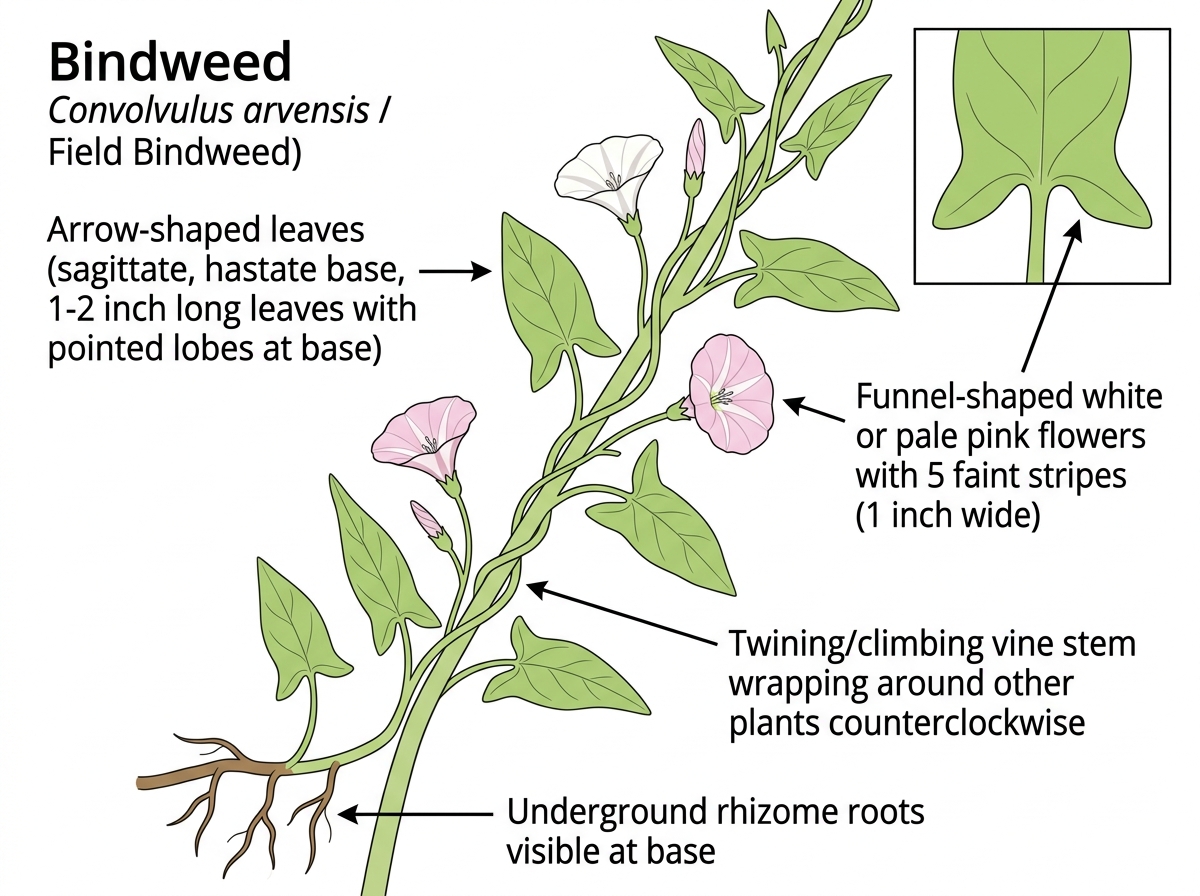
A guide to identifying Field Bindweed (Convolvulus arvensis):
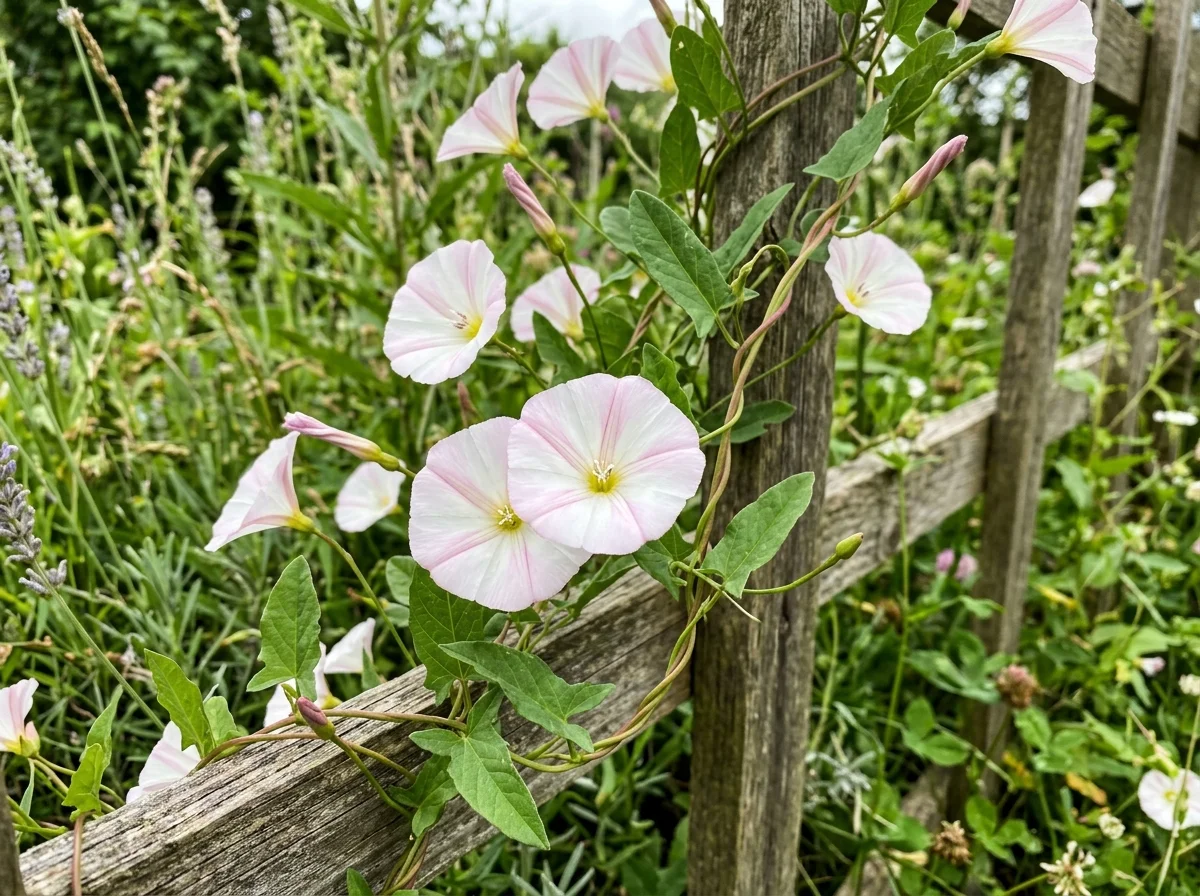
- Arrow-shaped (Sagittate) Leaves: The most reliable identification feature. Leaves are 1–2 inches long with two distinct pointed lobes at the base projecting backward like a double arrowhead. This is different from the heart-shaped (cordate) leaves of Morning Glory.
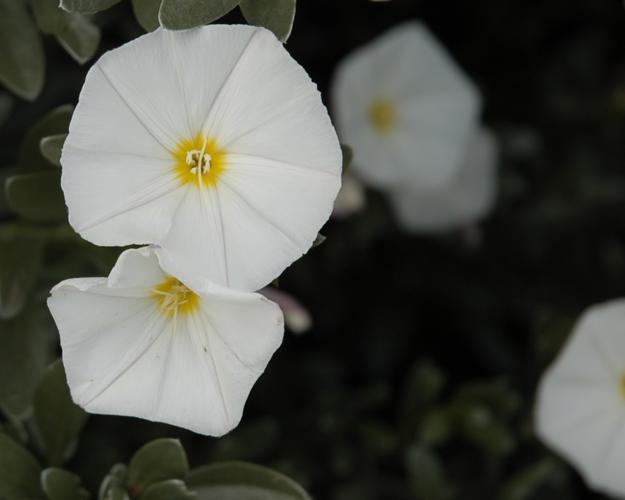
- Small Funnel-shaped Flowers: White to pale pink funnel-shaped flowers measuring only ½ to 1 inch across — significantly smaller than Morning Glory. Five faint pink stripes radiate from the center.
- Counterclockwise Twining Stem: Bindweed wraps around supports in a counterclockwise direction (when viewed from above), unlike Morning Glory which twines clockwise.
- Extensive Underground Rhizomes: The plant spreads by deep white fleshy rhizome roots that can penetrate 20 feet into the soil, making it extremely difficult to pull out fully.
Care & Growing Guide
Bindweed Control & Management:
- Prevention: Bindweed spreads by both seed and root fragments. Never compost bindweed roots. Avoid disturbing the soil where it grows as root fragments regenerate.
- Hand Removal: Only effective when very young. Pull vines repeatedly throughout the season to deplete root energy. Takes 2–3 full seasons of persistent removal.
- Mulching: Heavy black plastic or thick cardboard mulch (3–4 inches) starves established plants of light. Must remain in place for a full growing season.
- Herbicides: Systemic herbicides (glyphosate, triclopyr) applied during active flowering for maximum root translocation. Multiple applications in successive seasons required.
Seasonal Blooming & Hardiness
Seasonal Blooming Calendar:
- Blooming Season: Late spring through early autumn (May through September/October).
- Flower Habit: Flowers open in morning sunlight and close by evening or on overcast days.
- Seed Production: Each plant can produce 25–300 seeds annually, which remain viable in the soil for 20–30 years.
Bloom Timeline
About Bindweed
Bindweed (Convolvulus arvensis), commonly called Field Bindweed or Wild Morning Glory, is a perennial twining vine native to Europe and Asia that has become one of the most widespread and persistent weeds across North America, Australia, and South Asia. Despite its invasive nature, the plant produces surprisingly attractive funnel-shaped flowers that closely resemble those of the ornamental Morning Glory, leading to frequent misidentification. The plant spreads aggressively both by seed and by an extensive underground rhizome system that can penetrate the soil to depths of 20 feet or more, making it exceptionally difficult to eradicate once established. A single bindweed plant can spread to cover a 10-foot-wide patch in a single growing season.
Bindweed has been documented climbing up and smothering crop plants, fence posts, telephone poles, and ornamental garden plants with equal determination. The vine wraps counterclockwise (unlike Morning Glory, which wraps clockwise) around any available support. Its arrow-shaped leaves are a key visual diagnostic feature: they are sagittate at the base with two pointed basal lobes that project backward like a double arrowhead. This distinctive leaf shape — combined with the small, pale funnel flower — is the simplest way to distinguish it from the ornamental Morning Glory.
From a botanical standpoint, Convolvulus arvensis is classified within the family Convolvulaceae alongside its popular ornamental relatives: Morning Glory (Ipomoea purpurea), Sweet Potato (Ipomoea batatas), and the Moonflower (Ipomoea alba). Its flowers open only during daylight hours and close on overcast days or in the evening — a behavior shared with all members of the genus. Though classified as a noxious weed in most agricultural contexts, bindweed flowers attract several specialist pollinators, including solitary bees and hoverflies that feed on its abundant pollen.
In traditional and folk medicine across its native Eurasian range, Convolvulus arvensis has a long history of use. The roots were used as a purgative laxative in European herbalism, and leaf preparations were used topically in parts of the Middle East and India for wound healing and anti-inflammatory purposes. However, ingestion of the plant can cause gastrointestinal irritation, and the plant contains resin glycosides that can be mildly toxic to pets, making it important to keep it out of reach of cats and dogs.
Floral Formula & Features
Radial symmetry, bisexual, 5 free sepals, 5 petals fused into a funnel (sympetalous), 5 stamens, 2 fused carpels forming a superior ovary.
- Scientific Name & Classification: Convolvulus arvensis (Convolvulaceae). Globally known as Field Bindweed, Wild Morning Glory, and Creeping Jenny.
- Identification Markers: Small ½–1 inch white or pale pink funnel-shaped flowers with 5 faint pink stripes, sagittate arrow-shaped leaves with 2 backward-pointing basal lobes, and counterclockwise twining stems.
- Floral Formula (⊕ ☿ K5 C(5) A5 G(2)): Sympetalous funnel flower with 5 sepals, 5 fused petals, 5 stamens, and superior ovary of 2 fused carpels.
- Growing Requirements: Full Sun to Part Shade; highly adaptable to poor, dry, disturbed soils. Extensive underground rhizomes penetrate 20 feet deep.
- Cultural & Agricultural Impact: Native to Eurasia, widely naturalized as an aggressive, noxious weed. Competes heavily with garden crops and ornamental plants.
- Safety & Toxicity: MILDLY TOXIC TO PETS. Contains resin glycosides (convolvulins) that can cause drooling, vomiting, and diarrhea in cats and dogs.
- Common Look-alikes: Frequently confused with ornamental Morning Glory, but distinguished by its much smaller flowers, arrow-shaped leaves (not heart-shaped), counterclockwise twining, and perennial weed habit.
- Internal Links: Compare key differences in our Morning Glory vs Bindweed comparison, or try our instant Flower Identifier.
Names in Different Languages
Botanical Classification: Bindweed belongs to the Convolvulaceae family. Learn how to identify its floral symmetry, stamen arrangement, and structural formulas in our Botanical Family Classification Guide.
Toxicity & Safety
Always keep toxic plants out of reach of children and pets. Consult a veterinarian or medical professional immediately if ingestion is suspected.
Pet Safety Guide: For detailed toxicity symptoms, first-aid measures, and safe garden alternatives, see our full Pet Guard Profile for Bindweed.
Frequently Asked Questions
What is Floral Formula?
A floral formula is a symbolic representation of a flower's structure using letters, numbers, and special symbols. It provides a concise way to describe the arrangement and number of floral parts.
This formula describes the flower's symmetry, sepals, petals, stamens, and carpels in a standardized format.
Formula Sequence
- Bract: Br or Ebr
- Bracteole: Brl or Ebrl
- Symmetry: % (Radial) or ⊕ (Bilateral)
- Sex: ♀ (Female), ♂ (Male), or ⚥ (Bisexual)
- Calyx/Sepal: K<number> (Free or Fused)
- Corolla/Petal: C<number> (Free or Fused)
- Androecium: A<number> (Free or Fused)
- Gynaecium: G<number> (Superior or Inferior Ovary)
Symbol Meanings
- Numbers: Indicate quantity of parts
- Parentheses (): Parts are fused together
- Plus (+): Parts in different whorls
- Underline: Superior ovary position
- Overline: Inferior ovary position
- ∞: Numerous parts (too many to count)
Understanding floral formulas helps botanists quickly identify and classify flowers based on their structural characteristics.
Similar Flowers
Discover flowers that share botanical characteristics