Crop Health Directory

Mango

Mango is a major tropical fruit tree. It is highly susceptible to micronutrient deficiencies like Zinc (Little Leaf) and Boron (Internal Necrosis/Fruit cracking), which affect fruit yield and quality.

Soil & Foliar Nutrition

Mango Nutrient Deficiencies (2)

Confused about plant symptoms? Nutrient starvation can mimic aggressive fungal blights. Check our Symptom Disambiguation Guide to tell them apart.
Zinc Deficiency
Moderate Severity

Zinc Deficiency

Zincum Deficientia

Key Visual Symptoms

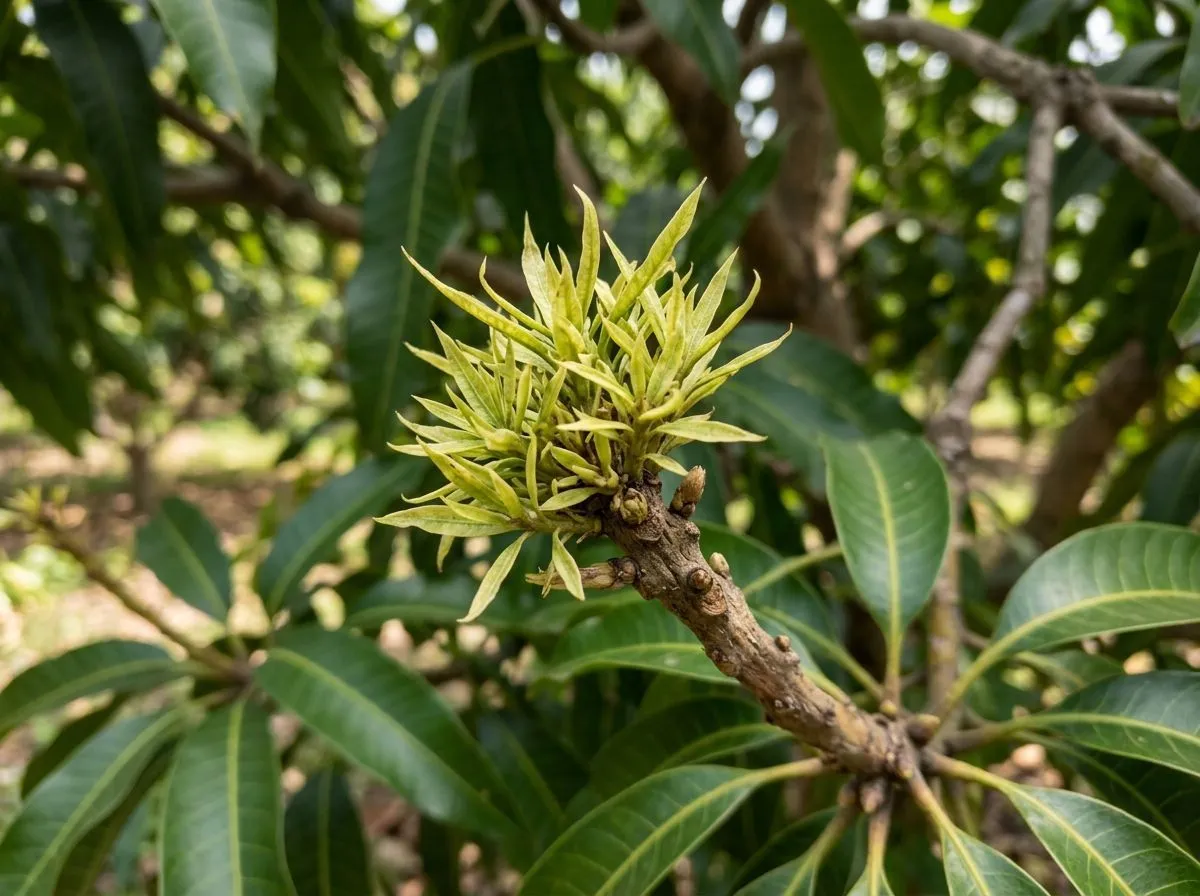
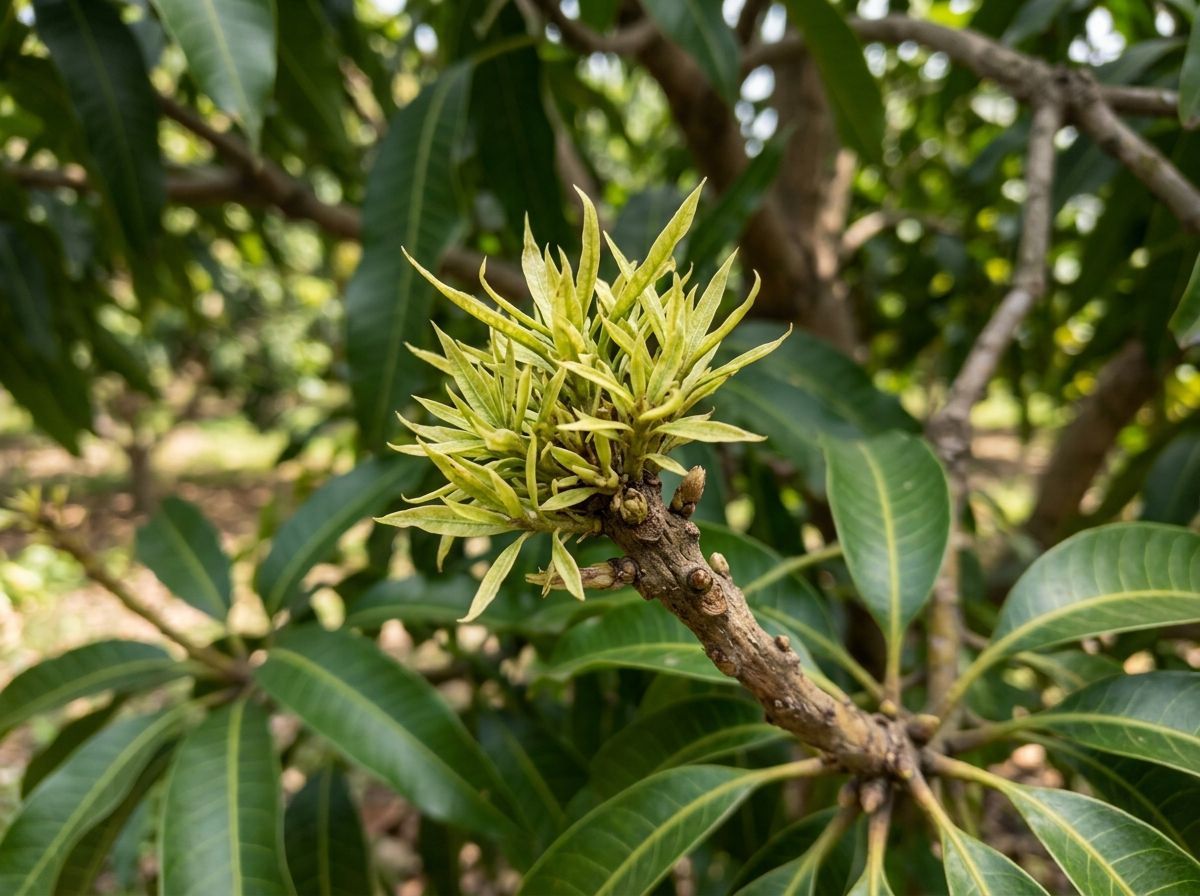
Leaves emerge extremely small, narrow, and clustered in a tight, rosette-like bundle at shoot tips (hence 'Little Leaf'). Leaves are thin and display interveinal chlorosis.

Organic Remedy
  • Apply 40–50 kg of well-rotted cattle manure pre-incubated with zinc sulfate around the tree drip line (active root zone 2–3 meters from the trunk) during post-harvest orchard maintenance.
  • Maintain a thick 4-inch organic mulch of leaf litter in the tree basin to encourage mycorrhizal fungi, which significantly improve zinc transport to deep mango roots.
  • Avoid over-liming orchard soils; keeping soil pH between 6.0 and 7.2 maintains zinc in a soluble, bioavailable form.
  • Prune and dispose of severely affected 'little leaf' terminal rosettes before the onset of new vegetative flushes to redirect sap flow to healthy lateral buds.
Chemical Correction
  • Foliar spray 0.5% Zinc Sulfate heptahydrate (5 g/L) neutralized with 0.25% slaked lime (2.5 g/L) to prevent leaf burning; apply two sprays: first on new vegetative shoots (July–August) and second before panicle emergence (October–November).
  • Alternatively, use technical-grade Chelated Zinc (Zn-EDTA 12% at 1.0–1.5 g/L) for precision orchard spraying, ensuring complete coverage of both upper and lower leaf surfaces.
  • In sandy or neutral soils (pH < 7.2), apply 200–250 g Zinc Sulfate per mature tree in circular trenches along the drip line followed by light irrigation.
Boron Deficiency
Severe Severity

Boron Deficiency

Boron Deficientia

Key Visual Symptoms

Developing mango fruits crack open, secrete gummy ooze, and drop prematurely. Cutting the fruit reveals dark brown, corky, dead necrotic patches in the pulp near the seed.

Organic Remedy
  • Apply 40–50 kg of well-cured farmyard manure amended with 150–200 g Borax per mature tree in the canopy drip line during post-harvest tillage (July–August).
  • Maintain consistent soil moisture via drip irrigation from fruit set through harvest; summer drought precipitates boron into unabsorbable forms, triggering catastrophic internal fruit breakdown.
  • Avoid excessive application of nitrogen or calcium fertilizers during flowering, which competitively inhibit boron transport to expanding fruitlets.
  • Maintain organic mulch around the root zone to protect shallow surface feeder roots from high summer soil temperatures.
Chemical Correction
  • Foliar spray Solubor (20% B) at 1.0–1.5 g/L (0.1–0.15%) or Borax (2.0 g/L) at two critical stages: first at panicle emergence before flower opening, and second at pea-sized fruitlet stage.
  • STRICT RULE: Never spray boron or any chemicals during 100% full bloom, as sprays damage delicate stigmatic surfaces and kill pollinating bees and houseflies.
  • For orchard soil application, broadcast 150–250 g Agricultural Borax per adult tree along the drip line once a year during monsoon rains; never exceed 300 g/tree to avoid boron toxicity.
Plant Pathology & Entomology

Mango Pathogens & Pests (5)

Insect

Ash Weevil

Myllocerus subfasciatus

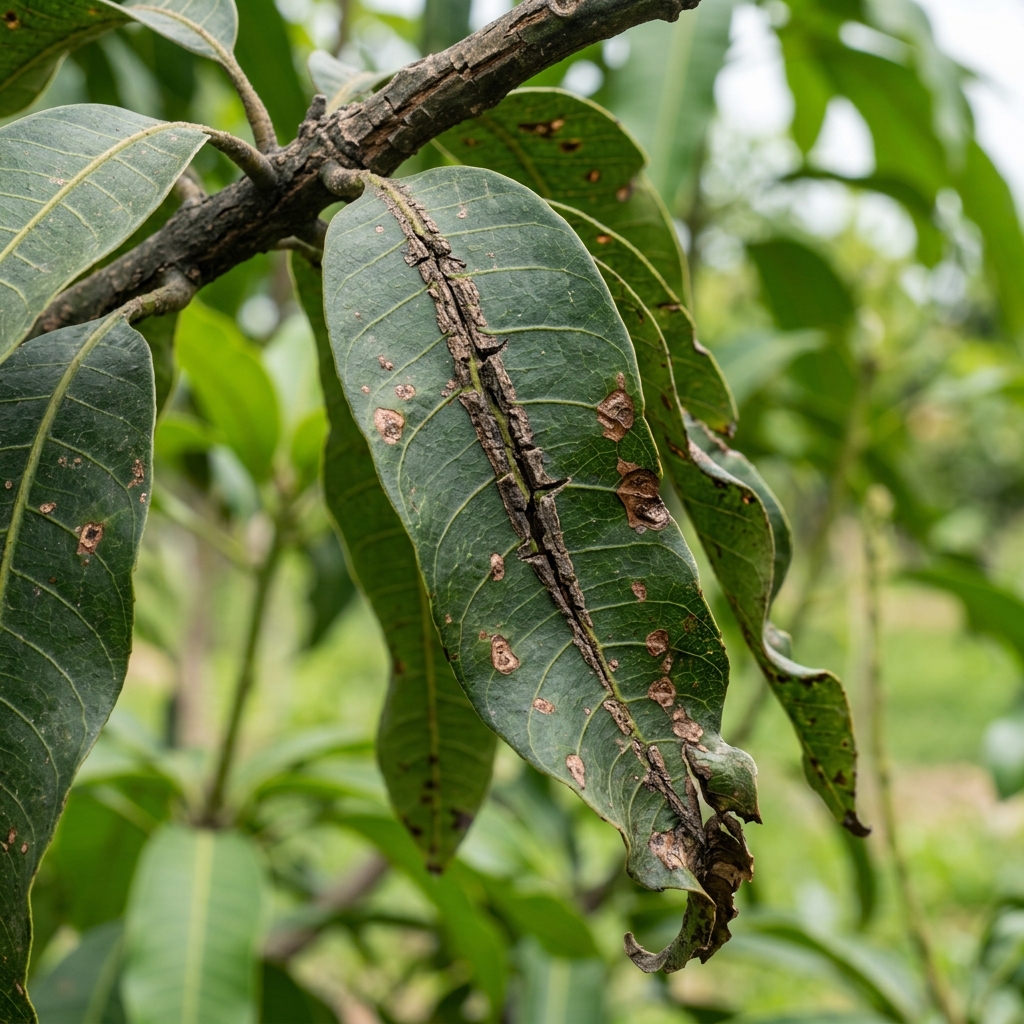
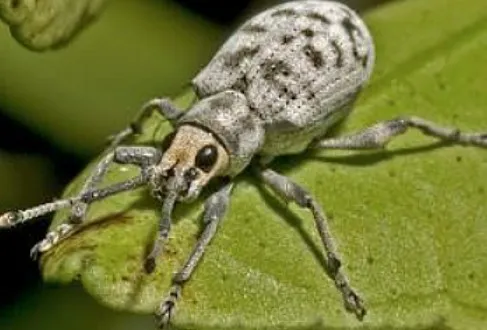
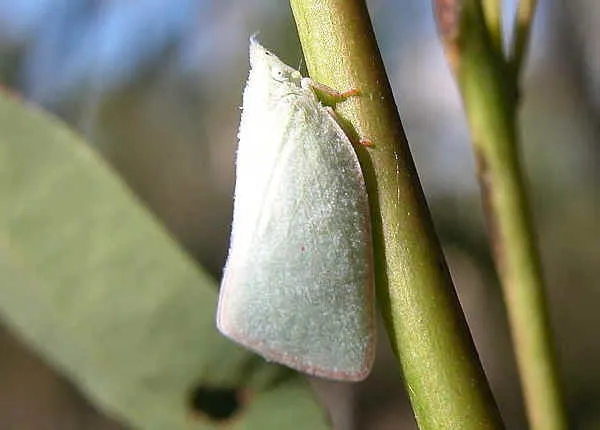
The Ash Weevil (*Myllocerus subfasciatus* and *Myllocerus undecimpustulatus*, family Curculionidae, order Coleoptera) is a destructive, highly polyphagous chewing snout beetle native to Southern Asia that has established invasive populations in tropical and subtropical agricultural regions worldwide. This broad-spectrum pest infests over 150 host plants, with severe economic damage reported in Solanaceous crops (especially brinjal/eggplant, tomatoes, and chilies), okra, cotton, and major fruit orchards (pomegranate, guava, mango, and citrus).,The dual-stage life cycle of the Ash Weevil makes it doubly destructive. Adult weevils are compact (3 to 6 mm long), pearlescent ash-grey to greyish-white beetles with a broad, short snout and faint dark or yellowish-brown maculae on their elytra. Adults feed on above-ground foliage, while their subterranean larvae (grubs)—which are creamy white, legless, C-shaped grubs with light brown head capsules—feed aggressively on root hairs, taproots, and root crowns in the soil.,Diagnosing an Ash Weevil infestation is straightforward due to its signature marginal leaf feeding pattern. Adult beetles chew inwards from the leaf edges, carving out highly distinctive, jagged, semi-circular scalloped notches along the margins. In severe infestations, leaves are skeletonized down to their midribs. Below ground, root grazing by grubs starves the plant of water and nutrients, resulting in generalized chlorosis (yellowing), sudden midday wilting, stunted shoot growth, and complete seedling collapse.,Post-harvest and storage considerations: While primarily a field and orchard pest, adult Ash Weevils frequently hitchhike into produce storage crates, hiding beneath the calyx caps of harvested eggplants, pomegranates, and guavas. In warm, poorly ventilated packing sheds, surviving adults contaminate produce and continue feeding on green calyx tissue, accelerating fungal decay and rendering fruits unmarketable.,Ash Weevils exhibit strong seasonal population spikes during the warm, pre-monsoon and summer months (March to June). A single mated female deposits 300 to 500 tiny, oval, light-yellow eggs in the soil around the root zone. Hatching grubs tunnel through soil for 30 to 50 days before constructing oval earthen pupal chambers. Adult beetles emerge with a lifespan of up to 4 months. <table class='severity-table' style='width:100%; border-collapse:collapse; margin:15px 0; font-size:14px; text-align:left; background-color:#fff; border:1px solid #ddd;'><thead style='background-color:#790a4a; color:white;'><tr><th style='padding:10px; border:1px solid #ddd;'>Target Crops / Plant Hosts</th><th style='padding:10px; border:1px solid #ddd;'>Severity Rating</th><th style='padding:10px; border:1px solid #ddd;'>Key Symptoms & Damage Mode</th></tr></thead><tbody><tr><td style='padding:8px; border:1px solid #ddd;'>Brinjal / Eggplant (Solanum melongena)</td><td style='padding:8px; border:1px solid #ddd; color:#e0115f; font-weight:bold;'>Extreme (⭐⭐⭐)</td><td style='padding:8px; border:1px solid #ddd;'>Severe leaf scalloping, root severance, total plant wilting & collapse</td></tr><tr><td style='padding:8px; border:1px solid #ddd;'>Okra, Chili Pepper & Tomato</td><td style='padding:8px; border:1px solid #ddd; color:#ff8c00; font-weight:bold;'>High (⭐⭐)</td><td style='padding:8px; border:1px solid #ddd;'>Marginal notches, seedling damping, blossom & bud drop</td></tr><tr><td style='padding:8px; border:1px solid #ddd;'>Pomegranate, Guava & Citrus</td><td style='padding:8px; border:1px solid #ddd; color:#ff8c00; font-weight:bold;'>High (⭐⭐)</td><td style='padding:8px; border:1px solid #ddd;'>New shoot defoliation, fruit calyx contamination in crates</td></tr><tr><td style='padding:8px; border:1px solid #ddd;'>Ornamental Hibiscus & Roses</td><td style='padding:8px; border:1px solid #ddd; color:#ffbf00; font-weight:bold;'>Medium (⭐)</td><td style='padding:8px; border:1px solid #ddd;'>Aesthetic leaf margin notches, reduced flowering vigor</td></tr></tbody></table>,Sustainable Integrated Pest Management (IPM) incorporates cultural, biological, and organic methods. Shaking plant branches in the early morning over a white cloth exploits the weevil's natural thanatosis (playing dead) behavior to collect and destroy adults. Subterranean grubs are effectively controlled using entomopathogenic nematodes (*Heterorhabditis bacteriophora*) and soil-incorporated neem cake. For companion diagnostic guides, consult our <a href='/plant-disease-identifier/'>Plant Disease Identifier Hub</a>, or view profiles on <a href='/plant-disease/root_knot_nematode/'>Root-Knot Nematodes</a>, <a href='/plant-disease/cutworm/'>Cutworms</a>, and <a href='/plant-disease/stem_borer/'>Stem Borers</a>.

View Detailed Diagnosis
Insect

Mango Gall Midge

Erosomyia mangiferae

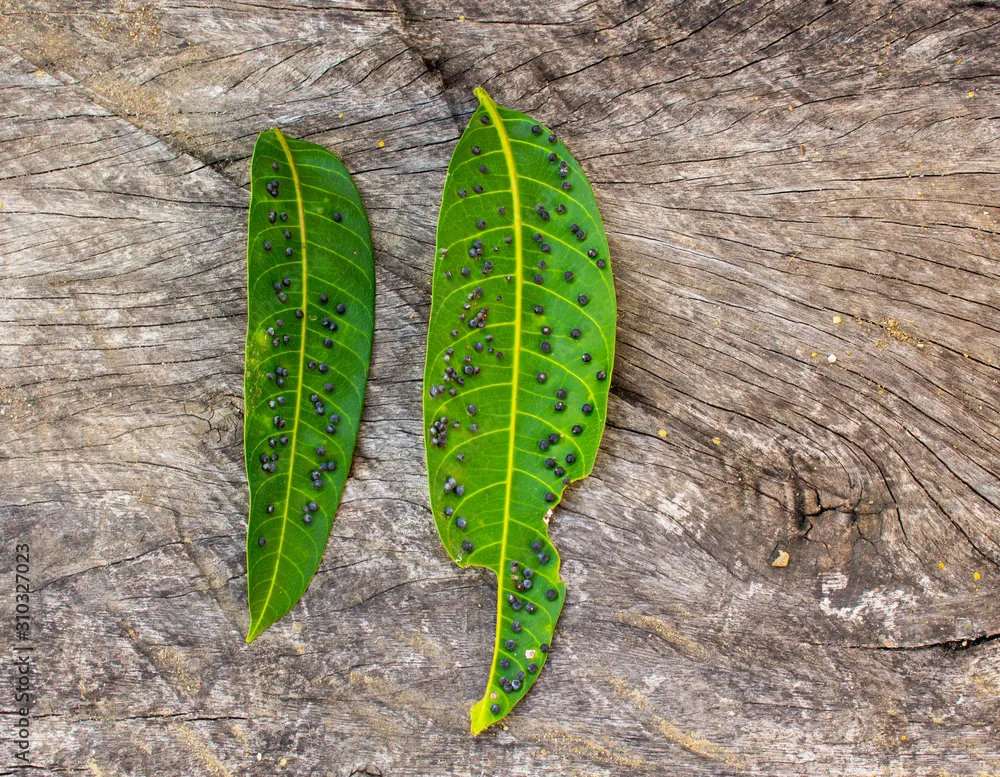
The Mango Gall Midge (*Erosomyia mangiferae*, family Cecidomyiidae) is a highly destructive insect pest that targets commercial mango (*Mangifera indica*) cultivation. This tiny, mosquito-like fly specifically attacks the reproductive structures of the mango tree, targeting young inflorescence buds, emerging floral axes, and newly set fruitlets. The adult midges are minute (1–2 mm long) and relatively short-lived, but their larvae (maggots) are voracious feeding parasites. By tunneling into the succulent tissue of flower stems, flower buds, and tiny mustard-sized mangoes, the larvae disrupt nutrient flow, causing flowers to blacken, die, and fruit to drop prematurely, leading to devastating yield losses up to 80%.,Identifying a Mango Gall Midge infestation is crucial during the flowering season to prevent fruit loss. Early symptoms manifest as small, dark brown or black necrotic spots on the flower stems (peduncles) and inflorescence axes. As larvae feed internally, the flower stalks bend abnormally and dry up. Emerging flower buds remain unopened, turn dry, and drop. Affected newly set fruitlets exhibit tiny exit holes and turn black, shriveling before falling from the tree. Breaking open a blackened inflorescence stem or young fruitlet will reveal tiny, legless, translucent-to-orange maggots (1.5–2.5 mm long) wriggling inside.,Mango Gall Midge is highly host-specific, primarily targeting commercial mango cultivars. The adult midge active phase matches cool, cloudy, and humid spring weather during mango bud swell. Females lay eggs inside flower buds or stem tissue. Upon hatching, larvae feed internally for 10–12 days before jumping out to drop to the soil, where they pupate in the top 2 inches. <table class='severity-table' style='width:100%; border-collapse:collapse; margin:15px 0; font-size:14px; text-align:left; background-color:#fff; border:1px solid #ddd;'><thead style='background-color:#790a4a; color:white;'><tr><th style='padding:10px; border:1px solid #ddd;'>Mango Cultivar</th><th style='padding:10px; border:1px solid #ddd;'>Severity Rating</th><th style='padding:10px; border:1px solid #ddd;'>Inflorescence Impact</th></tr></thead><tbody><tr><td style='padding:8px; border:1px solid #ddd;'>Alphonso & Kesar</td><td style='padding:8px; border:1px solid #ddd; color:#e0115f; font-weight:bold;'>Extreme (⭐⭐⭐)</td><td style='padding:8px; border:1px solid #ddd;'>Heavy blackening of floral stalks, total inflorescence drying</td></tr><tr><td style='padding:8px; border:1px solid #ddd;'>Amrapali & Mallika</td><td style='padding:8px; border:1px solid #ddd; color:#ff8c00; font-weight:bold;'>High (⭐⭐)</td><td style='padding:8px; border:1px solid #ddd;'>Bud rot, shriveled flower clusters, reduced fruitlet set</td></tr><tr><td style='padding:8px; border:1px solid #ddd;'>Dasheri & Langra</td><td style='padding:8px; border:1px solid #ddd; color:#ffbf00; font-weight:bold;'>Medium (⭐)</td><td style='padding:8px; border:1px solid #ddd;'>Moderate fruitlet drop, mild twig scarring</td></tr></tbody></table>,Effective control of Mango Gall Midge requires managing both the soil-dwelling pupae and the foliar adult midges. Cultural control involves deep plowing of the orchard soil basin under the tree canopy in late autumn to expose pupae to winter cold and bird predators. Applying organic neem cake or a drench of Beauveria bassiana to the soil basin destroys pupating larvae. For foliage protection, apply neem oil or spinosad sprays during early inflorescence emergence. Chemical control requires targeted systemic insecticide sprays like dimethoate, imidacloprid, or lambda-cyhalothrin applied at early bud swell and mustard-sized fruit set. For advanced orchard health guidelines, consult our <a href='/plant-disease-identifier/'>Plant Disease Identifier Hub</a>, or explore our guides on <a href='/plant-disease/thrips/'>Thrips</a>, <a href='/plant-disease/powdery_mildew/'>Powdery Mildew</a>, and <a href='/plant-disease/citrus_canker/'>Citrus Canker</a>.

View Detailed Diagnosis
Insect

Mango Hopper

Idioscopus clypealis

The Mango Hopper (*Idioscopus clypealis* and *Amritodus atkinsoni*), belonging to the leafhopper family *Cicadellidae* under the order *Hemiptera*, is one of the most critical and yield-limiting sucking insect pests of mango trees (*Anacardiaceae* family) across Asia. These small, wedge-shaped insects congregate in massive numbers on flower panicles, young shoots, and tender leaves. They use their piercing-sucking mouthparts to aggressively drain phloem sap, which stunts inflorescence development and directly prevents commercial fruit set.,Identifying a mango hopper infestation involves observing active hopping insects and sticky leaf surfaces. The adults are tiny (4–5 mm), wedge-shaped, and dull brown or greyish-green, with a broad head and tapering body. When disturbed, they fly or hop erratically in clouds around the branches. Foliage symptoms include leaf curling, browning of flower panicles (inflorescence blight), and premature dropping of flowers. The tree canopy becomes coated with sticky, clear 'honeydew' excretion, which turns into a thick layer of black sooty mold.,The mango hopper primarily damages mango orchards during the spring bloom. <table class='severity-table' style='width:100%; border-collapse:collapse; margin:15px 0; font-size:14px; text-align:left; background-color:#fff; border:1px solid #ddd;'><thead style='background-color:#790a4a; color:white;'><tr><th style='padding:10px; border:1px solid #ddd;'>Affected Crops / Plants</th><th style='padding:10px; border:1px solid #ddd;'>Severity Rating</th><th style='padding:10px; border:1px solid #ddd;'>Damage Symptoms</th></tr></thead><tbody><tr><td style='padding:8px; border:1px solid #ddd;'>Mango (Alfonso, Dasheri, Langra)</td><td style='padding:8px; border:1px solid #ddd; color:#e0115f; font-weight:bold;'>Extreme (⭐⭐⭐)</td><td style='padding:8px; border:1px solid #ddd;'>Browning of flower panicles, total loss of fruit set, and severe black sooty mold</td></tr><tr><td style='padding:8px; border:1px solid #ddd;'>Cashews & Pistachios</td><td style='padding:8px; border:1px solid #ddd; color:#ff8c00; font-weight:bold;'>High (⭐⭐)</td><td style='padding:8px; border:1px solid #ddd;'>Chewed shoots, minor blossom drop, and weakened vegetative twigs</td></tr><tr><td style='padding:8px; border:1px solid #ddd;'>Ornamental Garden Shrubs</td><td style='padding:8px; border:1px solid #ddd; color:#ffbf00; font-weight:bold;'>Medium (⭐)</td><td style='padding:8px; border:1px solid #ddd;'>Sticky leaves, cosmetic mold accumulations, and minor foliar spotting</td></tr></tbody></table>,Mango hoppers are active year-round but explode in population during the spring flowering season (February to March). Females insert up to 200 eggs individually into flower buds and leaves. The eggs hatch into wingless nymphs that feed on tender stems, completing their life cycle in just 2 to 3 weeks. Organic management focuses on foliar sprays of neem formulations (NSKE 5%), tilling orchard basins, and releasing predatory lacewings. Chemical control includes spraying imidacloprid, thiamethoxam, or cypermethrin directly onto inflorescences before flower opening. For complete orchard support, check our <a href='/plant-disease-identifier/'>Plant Disease Identifier Hub</a>, or read related profiles like <a href='/plant-disease/mango_mealybug/'>Mango Mealybug</a>, <a href='/plant-disease/scale_insect/'>Scale Insect</a>, and <a href='/plant-disease/thrips/'>Thrips</a>. For specialized diagnosis of related crop threats, see our guide on <a href='/mango/laxman-bhog/'>Laxman Bhog Mango</a>.

View Detailed Diagnosis
Insect

Mango Mealybug

Drosicha mangiferae

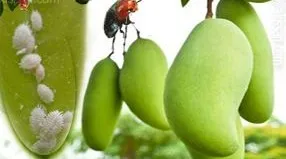
The Mango Mealybug (*Drosicha mangiferae*), a giant scale insect belonging to the family *Monophlebidae* under the order *Hemiptera*, is one of the most destructive and economically damaging sucking pests in mango-growing regions, particularly across South Asia. Unlike smaller mealybugs, this species is exceptionally large, with mature females reaching up to 1.5 cm. These pests aggregate in dense colonies on twigs, branches, flower panicles, and young fruits, using their piercing-sucking mouthparts to aggressively drain host phloem sap. This feeding behavior severely robs mango trees of water and essential nutrients, causing massive yield losses.,Identifying a mango mealybug infestation is simple due to their highly distinct visual cues. The wingless mature females are large, oval, and covered in a thick, powdery, flour-like white wax coating, making them look like moving cotton balls on tree trunks. Nymphs are smaller, brown, and highly active, crawling up the tree trunk in early spring. Foliage symptoms include severe wilting of young shoots, drying of flower panicles, and premature drop of developing fruits. Infested areas are heavily coated in sticky, sugary 'honeydew' excretion, which fuels the rapid growth of black sooty mold on leaf surfaces.,Mango mealybugs are primary pests of mango orchards, but they also attack several other high-value fruit trees and ornamental crops. <table class='severity-table' style='width:100%; border-collapse:collapse; margin:15px 0; font-size:14px; text-align:left; background-color:#fff; border:1px solid #ddd;'><thead style='background-color:#790a4a; color:white;'><tr><th style='padding:10px; border:1px solid #ddd;'>Affected Crops / Plants</th><th style='padding:10px; border:1px solid #ddd;'>Severity Rating</th><th style='padding:10px; border:1px solid #ddd;'>Damage Symptoms</th></tr></thead><tbody><tr><td style='padding:8px; border:1px solid #ddd;'>Mango (Alfonso, Dasheri, Kesar)</td><td style='padding:8px; border:1px solid #ddd; color:#e0115f; font-weight:bold;'>Extreme (⭐⭐⭐)</td><td style='padding:8px; border:1px solid #ddd;'>Drying panicles, fruit drop, severe honeydew & black sooty mold</td></tr><tr><td style='padding:8px; border:1px solid #ddd;'>Guava, Peach, Plum</td><td style='padding:8px; border:1px solid #ddd; color:#ff8c00; font-weight:bold;'>High (⭐⭐)</td><td style='padding:8px; border:1px solid #ddd;'>Twig dieback, weakened shoots, reduced fruit quality</td></tr><tr><td style='padding:8px; border:1px solid #ddd;'>Citrus, Papaya, Hibiscus</td><td style='padding:8px; border:1px solid #ddd; color:#ffbf00; font-weight:bold;'>Medium (⭐)</td><td style='padding:8px; border:1px solid #ddd;'>Cosmetic foliar damage, minor shoot wilting</td></tr></tbody></table>,The life cycle of the mango mealybug is closely synchronized with seasonal temperatures. Females lay hundreds of eggs in soil cracks around the tree base during summer. The eggs overwinter in the soil and hatch as tiny, highly active crawlers in late winter or early spring (January to February). These crawlers migrate up the tree trunk to feed on tender shoots and blooms. Natural and organic management is highly effective: wrapping a 30-cm wide, smooth plastic band around the tree trunk 4 feet above the ground in December blocks the crawlers from climbing up. Dusting the soil base with diatomaceous earth or applying neem-based soil drenches targets emerging nymphs. Chemical control relies on foliar sprays of contact insecticides like imidacloprid or chlorpyrifos on tree bases before they climb. For more agricultural support, check our <a href='/plant-disease-identifier/'>Plant Disease Identifier Hub</a>, or explore similar sucking pest profiles like <a href='/plant-disease/scale_insect/'>Scale Insects</a>, <a href='/plant-disease/aphid/'>Aphids</a>, and <a href='/plant-disease/thrips/'>Thrips</a>. For specialized diagnosis of related crop threats, see our guide on <a href='/mango/laxman-bhog/'>Laxman Bhog Mango</a>.

View Detailed Diagnosis
Fungus

Sooty Mold

Capnodium spp.

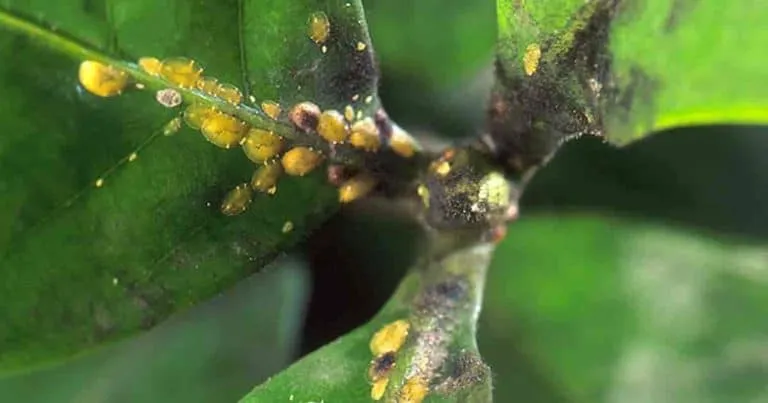
Sooty Mold, caused by a group of dark-colored saprophytic ascomycete fungi (most notably species within the genus *Capnodium*), is a highly common and conspicuous foliar condition that targets a vast array of ornamental, fruit, and vegetable crops. Classed under the family *Capnodiaceae* in the order *Capnodiales*, the fungus is not a plant pathogen; it does not infect or feed on plant tissues directly. Instead, it behaves as an opportunist, growing exclusively on the sticky, sugar-rich 'honeydew' excreted by sap-sucking insect pests (such as aphids, scale insects, whiteflies, and psyllids) that colonize the host plant canopy.,Identifying sooty mold is simple due to its highly diagnostic black, velvety appearance on plant parts. The foliage, stems, and fruits become coated in a dry, powdery, or sticky black layer that resembles a heavy coating of charcoal soot or chimney ash. Unlike true leaf spot pathogens, this black layer can be easily rubbed or washed off the leaf surface using water, exposing healthy green leaf tissue underneath. Foliage symptoms underneath the black mold include generalized leaf yellowing (chlorosis) and early leaf drop because the dense black fungal layer physically blocks sunlight, preventing vital photosynthesis.,Because Sooty Mold relies entirely on insect honeydew, review this insect vector and host severity breakdown: <table class='severity-table' style='width:100%; border-collapse:collapse; margin:15px 0; font-size:14px; text-align:left; background-color:#fff; border:1px solid #ddd;'><thead style='background-color:#790a4a; color:white;'><tr><th style='padding:10px; border:1px solid #ddd;'>Primary Honeydew Vector</th><th style='padding:10px; border:1px solid #ddd;'>High-Risk Crop Hosts</th><th style='padding:10px; border:1px solid #ddd;'>Mold Impact & Vector Link</th></tr></thead><tbody><tr><td style='padding:8px; border:1px solid #ddd; font-weight:bold;'>Asian Citrus Psyllid (Diaphorina citri)</td><td style='padding:8px; border:1px solid #ddd;'>Sweet Orange, Lemon, Lime, Orange Jasmine</td><td style='padding:8px; border:1px solid #ddd; color:#e0115f; font-weight:bold;'>Heavy black soot on leaves & fruit (see our <a href='/plant-disease/asian_citrus_psyllid/'>Asian Citrus Psyllid Guide</a>)</td></tr><tr><td style='padding:8px; border:1px solid #ddd; font-weight:bold;'>Aphids (Aphididae)</td><td style='padding:8px; border:1px solid #ddd;'>Roses, Cucumbers, Beans, Leafy Greens</td><td style='padding:8px; border:1px solid #ddd; color:#ff8c00; font-weight:bold;'>Dense sticky honeydew film (see our <a href='/plant-disease/aphid/'>Aphid Guide</a>)</td></tr><tr><td style='padding:8px; border:1px solid #ddd; font-weight:bold;'>Scale Insects & Mealybugs</td><td style='padding:8px; border:1px solid #ddd;'>Mango, Guava, Gardenia, Crape Myrtle</td><td style='padding:8px; border:1px solid #ddd; color:#ff8c00; font-weight:bold;'>Thick crusty soot on woody stems (see our <a href='/plant-disease/scale_insect/'>Scale Insect Guide</a>)</td></tr><tr><td style='padding:8px; border:1px solid #ddd; font-weight:bold;'>General Psyllids (Psylloidea)</td><td style='padding:8px; border:1px solid #ddd;'>Pears, Apples, Potatoes, Tomatoes</td><td style='padding:8px; border:1px solid #ddd;'>Waxy tubules & sugary deposits (see our <a href='/plant-disease/psyllid/'>General Psyllid Guide</a>)</td></tr></tbody></table>,The life cycle of sooty mold is entirely dependent on the presence of honeydew-producing sucking insects. The fungal spores (conidia) are spread by wind, splashing rain, and crawling ants. When conidia land on honeydew-coated leaves, they germinate and form a dark network of microscopic threads (mycelium) that feeds exclusively on the sugary insect waste, multiplying rapidly in warm, humid weather. Organic management focuses on controlling the underlying sucking insect pests using organic neem oil, horticultural oils, or insecticidal soaps. Blasting foliage with soapy water washes off both honeydew and the black mold. Chemical insecticides are used to eradicate the insect vectors. For complete pest and mold guides, visit our <a href='/plant-disease-identifier/'>Plant Disease Identifier Hub</a>, or explore related threat profiles like <a href='/plant-disease/asian_citrus_psyllid/'>Asian Citrus Psyllid</a>, <a href='/plant-disease/psyllid/'>Psyllids</a>, <a href='/plant-disease/aphid/'>Aphids</a>, <a href='/plant-disease/scale_insect/'>Scale Insects</a>, and <a href='/plant-disease/whitefly/'>Whiteflies</a>.

View Detailed Diagnosis

Spot the Threat: Anthracnose vs. Zinc Deficiency

Differentiate between fungal Anthracnose spots and Zinc starvation:

🍄 Mango Anthracnose (Fungal)
  • Sunken Black Spots: Dark, sunken lesions on leaves, twigs, and developing fruits that coalesce under wet monsoon conditions.
  • Wet Weather Spread: Spreads rapidly during rain and high humidity, spoiling fruit skins and flesh post-harvest.
🥭 Zinc Deficiency (Little Leaf)
  • Rosetted Shoots: Leaves grow tiny, narrow, and clustered together due to failure of inter-nodal stem elongation.
  • Foliar Spray Solution: Corrected by spraying Zinc Sulfate mixed with lime during new vegetative flushes.
Agronomic Lifecycle & Produce Calendar

Mango Harvest & Seasonal Produce Calendar

Track peak harvest windows across US domestic groves, primary US import corridors (Mexico, Peru, Brazil), and India's premier mango belts for year-round fresh availability.

🌿 Botanical Cycle: Perennial Tropical & Subtropical Fruit Tree (Mangifera indica) 🌡️ Optimal Temp: 75°F – 86°F (24°C – 30°C); frost-intolerant; requires a distinct 2–3 month dry spell to induce flower bud differentiation 🌧️ Rainfall: 30 – 100 inches (750 – 2500 mm) annually; completely dry weather is critical during blossoming and fruit ripening 🌱 Soil: Deep, well-drained sandy loam or alluvial soil with pH 5.5 – 7.5; water table below 6–8 feet

12-Month Harvest & Market Supply Heatmap

Monthly field status progression across primary growing zones.

Peak Harvest Moderate / Regional Sowing / Growing Off-Season / Rest
Jan
peak harvest

US Winter Import Peak (Peru Piura Valley & Brazil counter-season)

Feb
peak harvest

South American Import Peak (Peru Kent, Brazil Palmer to US mandis)

Mar
moderate harvest

Early Spring Harvest (Mexico Chiapas/Oaxaca, South India Banganapalli)

Apr
peak harvest

North American Inflow (Mexico Ataulfo/Honey, India Konkan Alphonso)

May
peak harvest

Peak US Import & India Season (Mexico Tommy Atkins, India Kesar/Banganapalli)

Jun
peak harvest

US Domestic Harvest Begins (Florida Haden, India Dasheri/Langra, Mexico Sinaloa)

Jul
peak harvest

US Domestic & Late Summer Peak (Florida Keitt, Mexico Kent, India Chausa)

Aug
moderate harvest

Late Summer Crop (Florida Keitt, Southern California Coachella, Egypt)

Sep
moderate harvest

California Desert Harvest & Puerto Rico / Spanish Subtropical Season

Oct
sowing growing

Off-Season Transition: Tree Pruning in North America & India

Nov
moderate harvest

Early Southern Hemisphere Harvest (Brazil Bahia, Ecuador to US)

Dec
peak harvest

Holiday Counter-Season Peak (Peru & Brazil winter harvest for US/Europe)

Crop Lifecycle & Phenological Milestones

Key physiological growth stages from seed/planting through harvest maturity.

1 Post-Harvest Rest (Fall / Winter)
Vegetative Shoot Rest & Terminal Dormancy

Post-harvest canopy rest followed by terminal bud dormancy triggered by cool night temperatures (<60°F / 15°C) and cessation of vegetative flushes.

2 December – February (US/India) / June – August (Peru/Brazil)
Panicle Emergence & Inflorescence

Pyramidal flower panicles blossom with thousands of small flowers. Requires dry, frost-free weather; rains induce destructive powdery mildew and anthracnose blights.

3 February – March (US/India) / August – September (Southern Hemisphere)
Fruit Set & Pea/Marble Development

Pollination by syrphid flies and honeybees followed by rapid fruitlet swelling. Critical stage for fruitlet drop management and controlled irrigation.

4 March – April (US/India) / September – October (Southern Hemisphere)
Fruit Maturation & Shoulder Fill

Starch accumulation, shoulder elevation, and depression around the stem cavity. Specific gravity reaches 1.01–1.02 at commercial maturity.

5 May – August (US/India/Mexico) / Nov – March (Peru/Brazil)
Peak Harvest & Controlled Desapping

Careful manual harvest with 1–2 cm stem attached in the cool morning hours; inverted field racks prevent caustic acidic latex from blistering the skin.

Major Regional Growing Belts

Key harvest windows and commercial production zones across the United States, India, and primary import corridors.

United States (Florida, Southern California, Hawaii)
May – August (Florida); August – October (California Coachella Valley)

Varieties / Agro-Notes: South Florida (Homestead, Pine Island) produces iconic heritage varieties: Haden, Keitt, Tommy Atkins, Kent, and Glenn; Southern California desert microclimates harvest late-season Keitt; Hawaii produces year-round tropical backyard crops (Rapoza, Pirie).

India (South, Western Konkan & Northern Belts)
March – May (South India); April – June (Konkan & Gujarat); June – August (North India)

Varieties / Agro-Notes: World's largest producer (>50% global harvest); South (Banganapalli, Totapuri, Alphonso); Maharashtra Konkan (Ratnagiri & Devgad Alphonso / Hapus); Gujarat (Kesar); North India (Malihabad Dasheri, Varanasi Langra, Chausa); West Bengal (Himsagar).

Key US Import Corridors (Mexico, Peru, Brazil, Ecuador)
March – September (Mexico); November – March (Peru & Brazil Counter-Season)

Varieties / Agro-Notes: Supplies 95%+ of fresh mangoes consumed in the US; Mexico is the #1 US supplier (Ataulfo/Honey, Tommy Atkins, Kent, Keitt); Peru (Piura valley hot-water-treated Kent) and Brazil (São Francisco valley) fill the US winter grocery window.

Post-Harvest Cold Chain & Storage Telemetry

Science-backed temperature, humidity, and curing parameters to maximize commercial shelf life.

Optimal Temperature
54°F – 55°F (12°C – 13°C) for mature green; 50°F – 54°F (10°C – 12°C) for ripe fruit
Relative Humidity
85% – 90% Relative Humidity
Commercial Shelf Life
2–3 weeks (mature green in marine refrigerated containers under Controlled Atmosphere: 3–5% O2, 5–10% CO2); 5–8 days (fully ripe at room temp)
Curing & Field Handling:

Desapping within 2 hours; USDA APHIS certified hot water immersion at 115°F–118°F (46°C–48°C) for 65–90 minutes for fruit fly quarantine compliance before entry into US markets.

Critical Storage Risk: Never refrigerate unripe mangoes below 50°F (10°C); severe chilling injury causes greyish-brown peel scald, pitted lenticels, uneven mottled ripening, and irreversible loss of natural sweetness and floral aroma.
Consumer Food Safety & Quality Testing

Purchasing Mango From Market or Mandi?

Protect yourself from artificial chemical ripening, prohibited coal-tar dyes, and adulterants. Check official 60-second home detection tests and FSSAI/FDA statutory legal limits in the Food Guard dossier.
Mango Diagnostic Guide: Diseases vs. Deficiencies

Rosette-like bunched leaves or dry margins on mango trees can represent disease or nutrient hunger. Diagnose correctly.

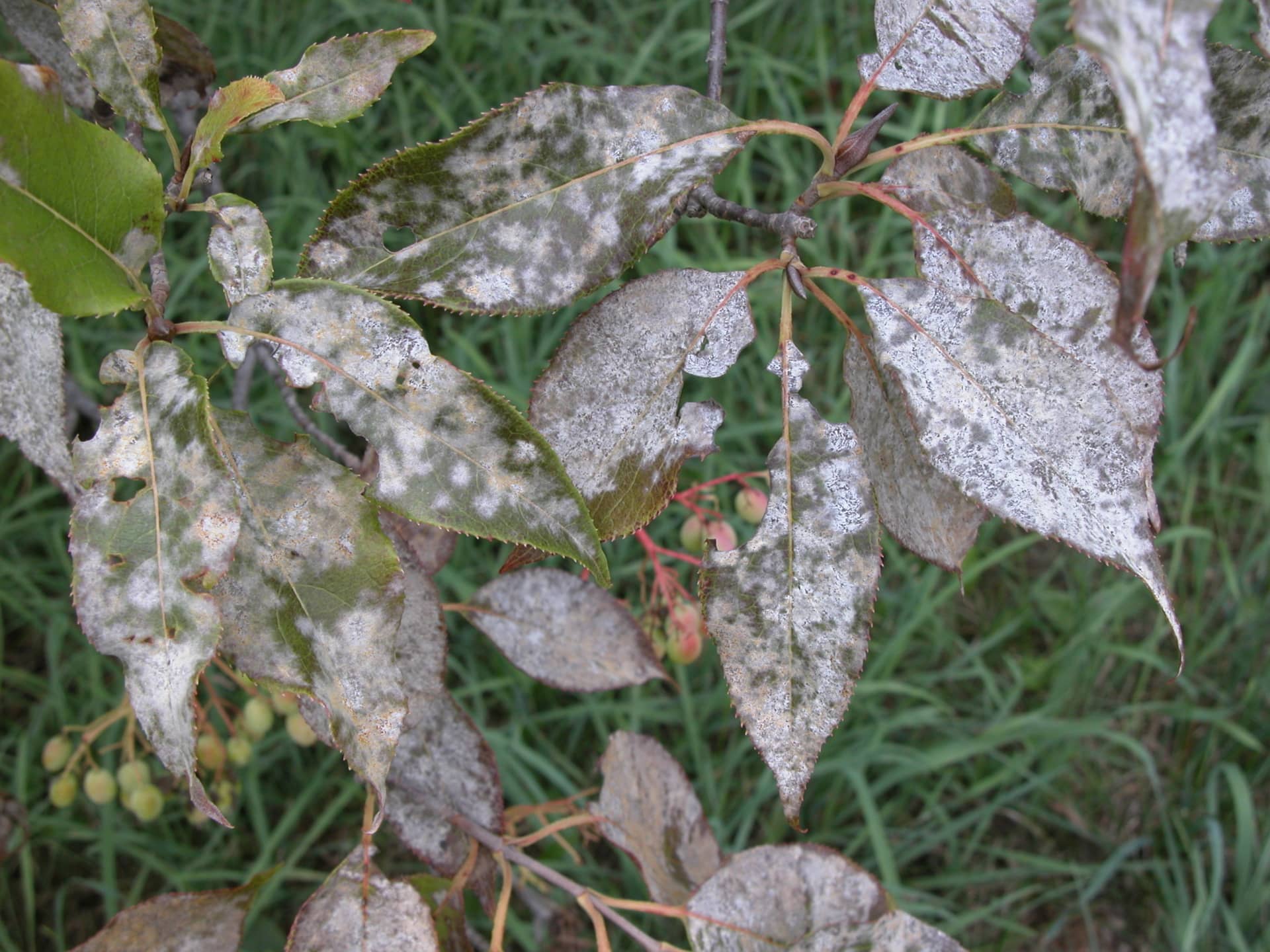
Mango Powdery Mildew
Pathogen Spotting
Mango Powdery Mildew
Zinc (Little Leaf) Rosetting
Nutrient Starvation
Zinc (Little Leaf) Rosetting
Key Indicators to Look For:
  • Leaf Size: Zinc deficiency causes 'Little Leaf' rosetting where leaves are severely reduced in size. Fungal powdery mildew covers normal-sized leaves in white spores.
  • Fruit Damage: Boron deficiency causes internal necrosis (brown corky centers) and fruit splitting. Diseases like Anthracnose cause black, sunken lesions on the fruit surface.

Diagnose Your Mango Crop Instantly

Take or upload a photo of your leaf or field damage to let our AI model scan for diseases, insect pests, or nutritional deficiencies.

🛡️ Comprehensive Diagnostic & Safety Dossier

Mango Fruit Diseases & Tree Pests: Complete Field & Consumer Safety Guide

Learn how to diagnose and treat major mango orchard threats—including Anthracnose, Powdery Mildew, Stem-End Rot, Bacterial Black Spot, Mango Hoppers, and Fruit Flies—plus how consumers can tell superficial skin blemishes apart from internal rot.

👑 Terroir & Purity Dossier

Alphonso Mango (Hapus): The King's Complete Guide

Compare Devgad vs. Ratnagiri GI terroir, spot Karnataka Badami lookalikes, master the 4-point ready-to-cut ripeness test, and run water float checks for Spongy Tissue and Calcium Carbide.

Read Complete Alphonso Guide
🗺️ Cultivar Nomenclature

Mango Names Across India: State-by-State Variety Map

Why is the same cultivar called Alphonso in Maharashtra, Badami in Karnataka, and Gundu in Tamil Nadu? Explore our regional synonym matrix across 15+ Indian states to avoid market confusion.

Read Regional Names Guide
📅 Harvest & Terroir Calendar

Mango Season Calendar 2027: Eat by the Calendar & Terroir

Follow the month-by-month harvest progression from March early arrivals to August late-season Chausa, understand how GI-tagged terroir shapes aroma, and spot carbide-ripened fruit.

Read 2027 Season Calendar Guide

Seasonal Outbreak Calendar

Track peak infestation and disease risk months by geographic region. Access the interactive dashboard to see what diseases are active this month.

Explore Disease Calendar

Featured Agronomy Guide

Read our comprehensive guide comparing plant nutrient deficiencies, infectious diseases, and pests.

Read Symptom Diagnosis Guide

Explore Other Crop Hubs