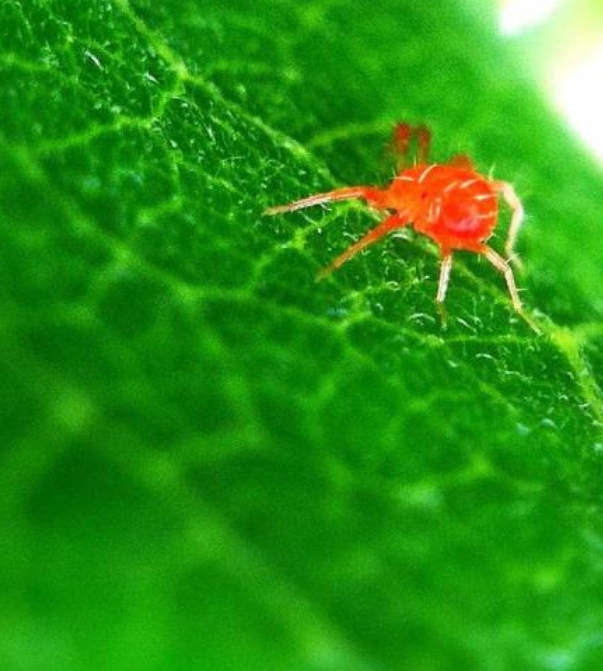
Spider Mite
Tetranychus urticae
Basic Details
Description
Taxonomy
Features
Translations
Basic Details
NameSpider Mite
DescriptionSpider mites are tiny pests that cause stippled leaves and fine webbing. Our guide offers AI-powered diagnosis and effective organic removal techniques.
TypeArachnid
FamilyTetranychidae
GenusTetranychus
TribeTetranychini
Taxonomy & Features
PhylumArthropoda
SubphylumChelicerata
ClassArachnida
OrderTrombidiformes
SubfamilyTetranychinae
Features
- Named 'spider' mites because they belong to the arachnid family like spiders, have 8 legs, and spin fine silk webs on infested plants
- Extremely small (0.5 mm) and often look like moving dots. Colors vary from translucent white or yellow to green, orange, and reddish-brown
- Pierce plant cells on leaf undersides and suck out the chlorophyll. They thrive in dry conditions where their natural predators are absent
- Causes fine, pale yellow stippling (dots) on leaf surfaces. In heavy infestations, leaves turn yellow or bronze and fall off. Fine webbing is visible
- Reproduce rapidly in hot, dry conditions. A single female can produce hundreds of offspring, and the lifecycle can be completed in only 5-7 days
- Adults are about the size of a grain of salt. Nymphs and eggs are microscopic. Webbing becomes prominent only after populations are high
- Most active during hot, dry summer months and in low-humidity indoor environments. Do not survive well in wet or rainy conditions
- Attack hundreds of species including beans, tomatoes, strawberries, melons, roses, marigolds, and many houseplants like ivies
- Keep plants well-watered and increase humidity. Use a strong stream of water to blast mites and webbing off plants regularly. Prevent dusty conditions
- Introduce predatory mites (Phytoseiulus persimilis) or ladybugs. Treat with insecticidal soap, neem oil, or horticultural oil on leaf undersides
Names in Different Languages
Latin / ScientificTetranychus urticae
English (Alternate)Two-spotted spider mite, Webspinning mite
Hindiमकड़ी कीट (makdi keet), मकड़ी घुण (makdi ghun)
Tamilசிலந்திப் பேன் (silandhip pen), சிவப்புச் சிலந்தி (sivappuch silandhi)
Teluguఎర్ర నల్లి (erra nalli)
Malayalamಚುವನ್ನ ಚಿಲಂತಿ (chuvanna chilanthi)
Kannadaಜೇಡರ ಹೂಳು (jedara hooulu)
Sanskritಲೂತಾಕೀಟ (lūtākīṭa), ಸೂಕ್ಷ್ಮಮಕ್ಷಿಕಾ (sūkṣmamakṣikā)
Bengaliಮಕಡಸಾ ಕೃಮಿ (makorsha krimi), ಲಾಲ್ ಮಕಡಸಾ (lal makorsha)
Frenchacarien tisserand, tétranyque
Russianпаутинный клещ (pautinnyy kleshch)
Spanisharaña roja, ácaro tejedor
GermanSpinnmilbe