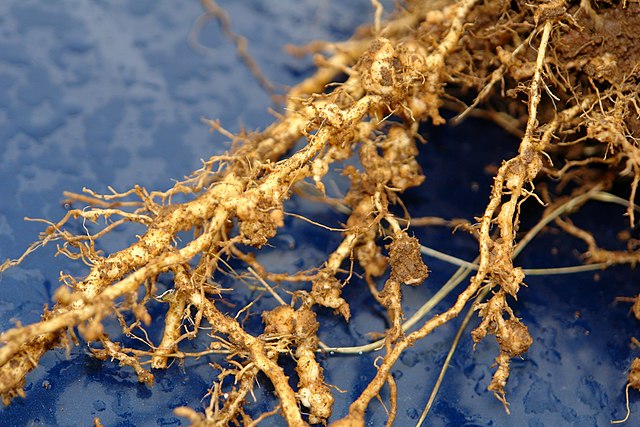
Root Nematode
Meloidogyne spp.
Basic Details
Description
Taxonomy
Features
Translations
Basic Details
NameRoot Nematode
DescriptionRoot knot nematodes cause swollen galls on plant roots, blocking nutrient flow and stunting growth. Discover organic soil treatments and resistant varieties.
TypeNematode
FamilyHeteroderidae
GenusMeloidogyne
Taxonomy & Features
PhylumNematoda
ClassSecernentea
OrderTylenchida
SubfamilyMeloidogyninae
Features
- Named for the distinctive knots or galls they create on plant roots. Microscopic roundworms that are among the most economically damaging plant parasites worldwide
- Microscopic worm-like organisms, typically 0.4-1.3 mm long. Females are pear-shaped and sedentary. Males are vermiform and mobile. Second-stage juveniles (J2) are the only infective stage
- Infective juveniles penetrate roots near tips and migrate to vascular tissue. Establish permanent feeding sites called giant cells. Inject secretions that cause rapid cell division and enlargement, forming visible galls
- Above-ground: stunting, yellowing leaves, wilting in hot weather despite adequate moisture. Below-ground: characteristic swollen knots or galls on roots ranging from tiny bumps to large lumps. Shallow, excessively branched root systems
- Eggs laid in gelatinous matrix on root surface. Juveniles hatch and molt once inside egg to become infective J2. Complete lifecycle in 2-5 weeks depending on temperature. Multiple generations per year. Many species reproduce without males
- Adults are 0.4-1.3 mm long. Eggs are microscopic. Galls range from 0.02 to 20 cm in diameter depending on host and infestation severity
- Thrive in warm climates and sandy soils. Most active at temperatures between 25-30°C (77-86°F). Can survive in soil for extended periods. Populations build up with continuous susceptible crops
- Attack tomatoes, potatoes, peppers, eggplants, cucumbers, melons, carrots, lettuce, beans, okra, roses, and over 2000 other plant species
- Prevent by rotating with non-host crops (grasses, marigolds), using resistant varieties, soil solarization in summer, removing infected plants, maintaining plant health, and using nematode-free transplants
- Add organic matter and compost to encourage beneficial organisms. Plant biofumigant cover crops (mustards, marigolds). Use beneficial nematodes. Apply neem products or microbial inoculants. No chemical cure for organic systems
Names in Different Languages
Latin / ScientificMeloidogyne spp.
English (Alternate)Root gall nematode, Root knot eelworm
Hindiಜಡ ಗಾಂಠ್ ಸೂತ್ರಕೃಮಿ (Jad Ganth Sutrakrmi)
Tamilವೇರ್ ಮುಡಿಚ್ಚು ನೂಱ್ಪುಳು (Vēr muṭiccu nūṟpuḻu)
Teluguವೇರು ಮುಡಿ ನೆಮಟೋಡ್ (Vēru muḍi nemaṭōḍ)
Malayalamವೇರുകെಟ್ಟು ನೆಮಟೋಡ್ (Vērukkeṭṭ nemaṟṟōḍ)
Kannadaಬೇರು ಗಂಟು ನೆಮಟೋಡ್ (Bēru gaṇṭu nemaṭōḍ)
Sanskritಮೂಲ-ಗ್ರಂಥಿ-ಕೃಮಿಃ (Mūla-granthi-kṛmiḥ)
Bengaliಮೂಲ್ ಗಿಂಠ್ ನೆಮಾಟೋಡ್ (Mūl gim̐ṭa nēmāṭōḍa)
Frenchnématode à galles
Russianಗಲ್ಲೋವಾಯ ನೆಮಟೋಡಾ (gallovaya nematoda)
Spanishnematodo agallador, nematodo de los nódulos
GermanWurzelgallennematode