
Honey Safety Inspection
Detect sugar syrup, HFCS, and starch adulteration in honey
Inspection Guide
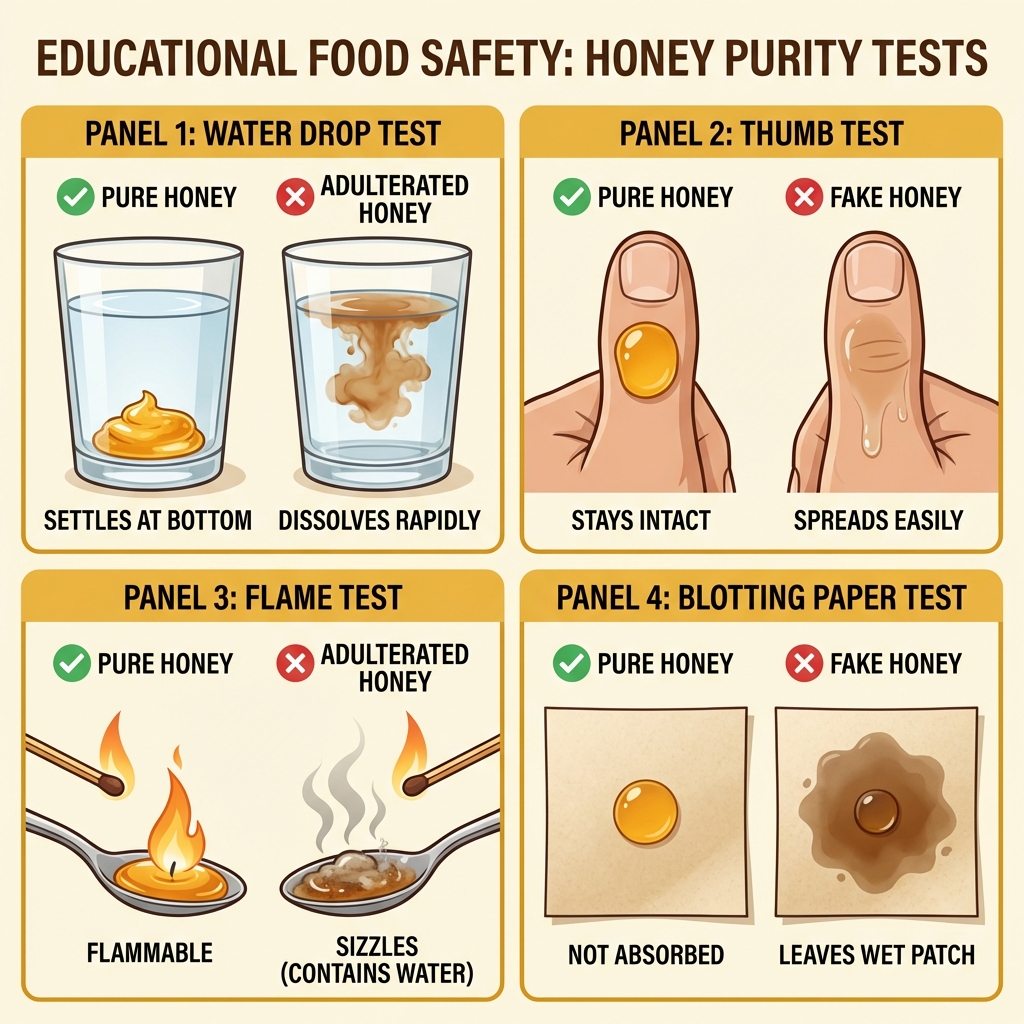
Click to enlarge
Honey Purity Testing Methods
Honey is one of the most adulterated foods globally, mixed with sugar syrup, high fructose corn syrup, jaggery, molasses, and starch to increase volume and reduce cost.
1. The Water Drop Test:
Fill a glass with water and drop a spoonful of honey into it without stirring. Pure honey will settle at the bottom as a lump and dissolve very slowly. Adulterated honey (with sugar syrup) will dissolve quickly and disperse in water, creating cloudiness.
2. The Thumb Test:
Put a small drop of honey on your thumb. Pure honey will stay intact in a bead shape and won't spread or drip. Adulterated honey with added water/syrup will spread easily and may drip from your thumb. This tests viscosity.
3. The Flame Test:
Dip a dry matchstick or cotton wick in honey and try to light it. Pure honey is flammable because it has low moisture content - the match will light and honey will burn steadily. Adulterated honey with water/sugar syrup will sizzle, produce moisture, and won't catch fire easily.
4. The Blotting Paper Test:
Put a drop of honey on blotting paper or newspaper. Pure honey is very thick and won't get absorbed - it will stay on the surface as a bead. Fake honey with added water/syrup will get absorbed into the paper, leaving a wet patch or ring around it.
5. The Refrigerator Test:
Put honey in the refrigerator. Pure honey will crystallize over time (forming sugar crystals) and become thick/granular. Adulterated honey remains liquid or develops layers because of different sugar compositions. Pure honey never separates into layers.
Quick Safety Tips
- Water test - pure honey settles, fake dissolves
- Thumb test - pure stays intact, fake spreads
- Flame test - pure honey is flammable
- Buy from certified sources with lab test reports
Chemical Concerns
Step 1: AI Visual Scan
New to BioLens? Try a sample test