
Dragon Fruit Safety Inspection
Check for growth tonics, artificial coloring, and ripening anomalies in Dragon Fruit
Inspection Guide
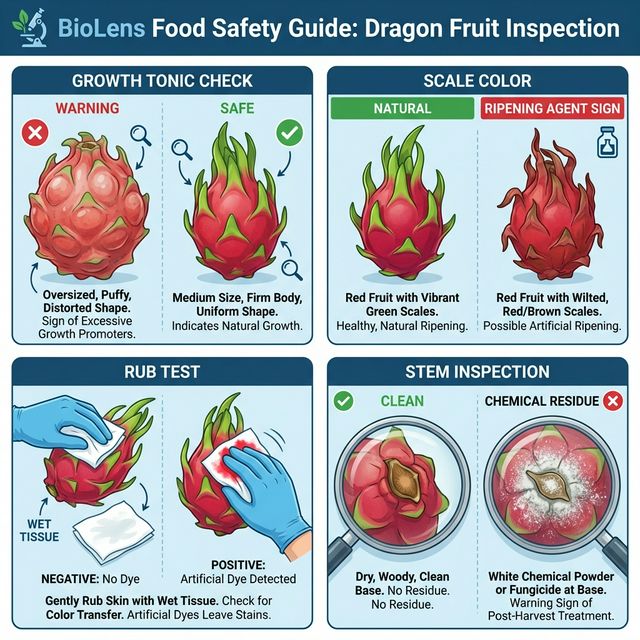
Click to enlarge
Dragon Fruit Safety Inspection Guide
Dragon fruits are sometimes treated with growth chemicals or dyes to appear larger and riper.
1. Size & Growth Check: Be wary of unusually bloated or "puffy" fruits that are green on one side but red on the other. Growth tonics can cause unnatural swelling.
2. Dye Rub Test: Rub the magenta scales with a damp cloth. Natural color does not easily transfer. If magenta dye wipes off, it has been surface-colored.
3. Stem & Scale Integrity: A fresh-looking green stem on a fruit with withered or dying scales is a sign of artificial ripening using carbide gases.
4. Internal Contrast: Naturally ripe dragon fruit has vibrant flesh (white or red). Artificially forced fruits often have pale, dull, or tasteless flesh.
Quick Safety Tips
- Avoid unusually bloated or asymmetric fruits
- Check if the stem is unnaturally green compared to the body
- Rub skin with wet cotton to detect surface colorants
- Prefer medium-sized, organically grown looking fruits
What CANNOT be Verified (Lab-Only)
Invisible Risks (Lab-Only):
* Growth Retardants: Synthetic plant hormones and growth tonics can only be identified through LC-MS laboratory screening.
* Residual Carbides: Arsenic and Phosphorus traces from illegal Calcium Carbide require high-sensitivity spectrometry.
Chemical Concerns
Step 1: AI Visual Scan
New to BioLens? Try a sample test