
Custard Apple (Sitaphal) Safety Inspection
Detect carbide ripening and quality in custard apples
Inspection Guide
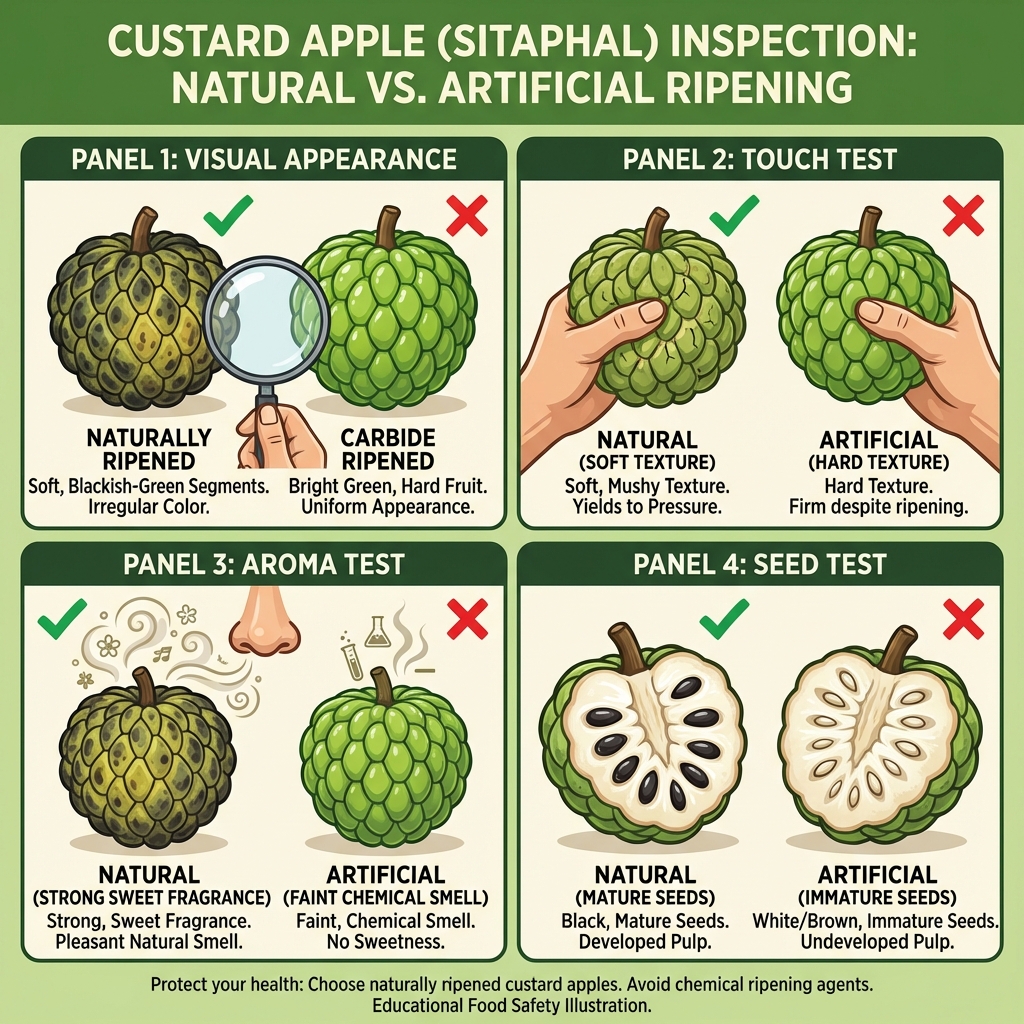
Click to enlarge
Custard Apple (Sitaphal) Ripening Check
Custard apples are delicate and often forced to ripen with calcium carbide to survive transport.
1. The Touch Test (Firmness):
Naturally ripened custard apples are soft and "give" evenly when pressed. If the fruit feels hard despite looking ripe (blackish-green segments), it has likely been carbide-ripened.
2. Segment Appearance:
Natural ripening causes segments to spread slightly and turn yellowish/blackish with a soft look. Carbide-ripened fruits often look uniformly bright green and the segments remain tight and hard.
3. The Aroma Test:
Ripe natural Sitaphal has a very strong, sweet, and unique fragrance. Chemically ripened ones have very little to no aroma, or a faint chemical smell.
4. Seed Check (Mature Seeds):
Cut open the fruit. Natural ripe fruit has large, hard, shiny black seeds. Artificially ripened fruit often has brown or whitish immature seeds because the fruit was harvested too early.
Quick Safety Tips
- Choose fruit that is soft and yields to gentle pressure
- Strong sweet fragrance is a key sign of natural ripening
- Mature black seeds indicate a naturally ripened fruit
- Avoid fruits with uniform bright green, hard segments
Chemical Concerns
Step 1: AI Visual Scan
New to BioLens? Try a sample test