
Cumin Seeds (Jeera) Safety Inspection
Detect charcoal-colored grass seeds in cumin seeds
Inspection Guide
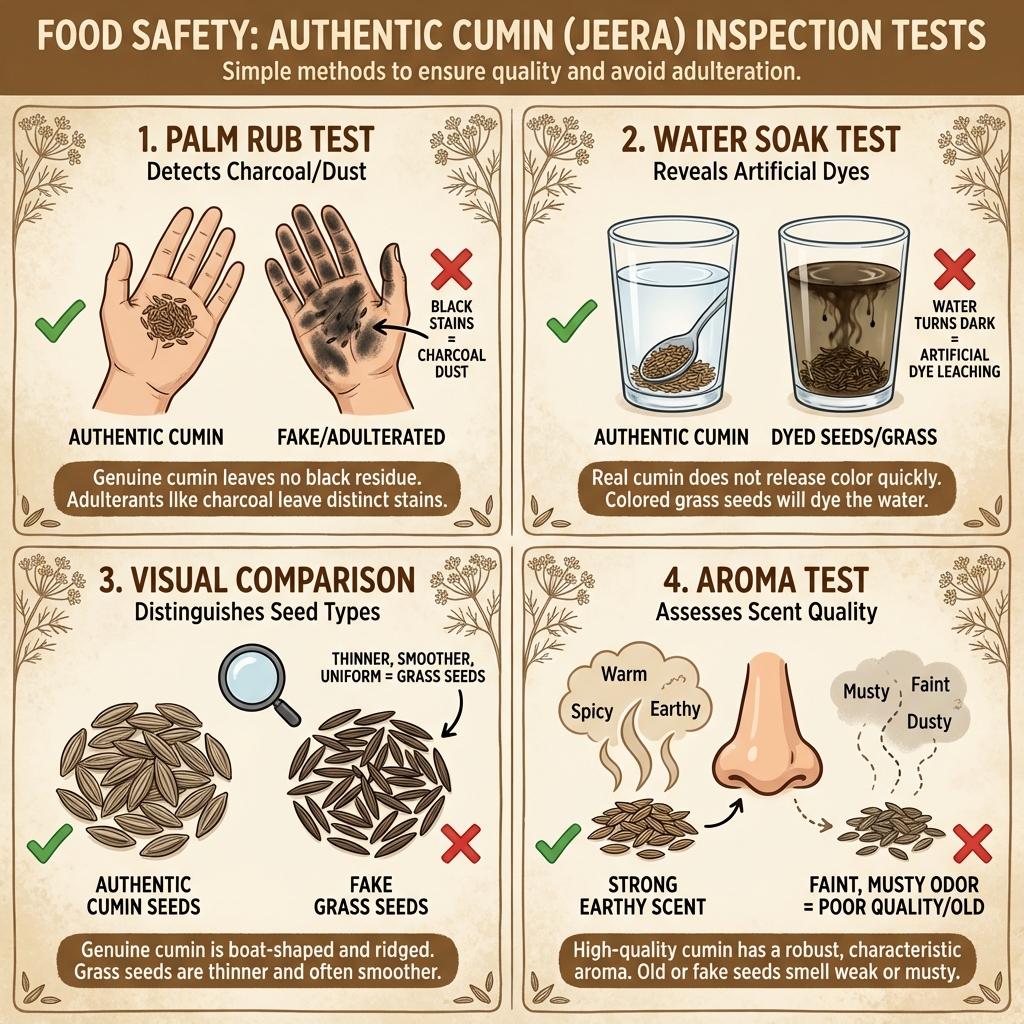
Click to enlarge
Cumin Seeds Authenticity Detection
Cumin seeds (Jeera) are often adulterated with grass seeds that have been colored with charcoal dust or lead-based dyes to mimic the appearance of genuine cumin.
1. The Palm Rub Test (Primary Test):
Take a small quantity of cumin seeds on your palm and rub them vigorously with your other hand. If the seeds are colored with charcoal, your palm will turn black or gray. Pure cumin seeds will leave a slightly oily, earthy residue with no black staining.
2. The Water Soak Test:
Add a spoonful of cumin seeds to a glass of water and stir. If the seeds are artificially colored, the water will turn blackish or dark gray as the charcoal/dye leached out. Pure cumin water remains relatively clear with a slight brownish tint.
3. The Visual Examination:
Look closely at the seed shape. Cumin seeds are slightly elongated with fine ridges. Grass seeds are usually thinner, longer, and look different when studied under a magnifying glass. If all seeds look "too black" or "too uniform," be suspicious.
4. The Aroma Test:
Crush a few seeds. Pure cumin (Jeera) has a very strong, distinct, earthy, and warm aroma. Adulterated seeds with grass and charcoal will have a weak aroma or may smell dusty/burnt.
Quick Safety Tips
- Rub on palm - charcoal/dye will leave black stains
- Soak in water - check for black color leaching
- Crush test - check for strong earthy cumin aroma
- Avoid seeds that look unnaturally black or uniform
Chemical Concerns
Step 1: AI Visual Scan
New to BioLens? Try a sample test