
Cinnamon (Dalchini) Safety Inspection
Detect Cassia bark adulteration in cinnamon
Inspection Guide
Click to enlarge
Cinnamon vs. Cassia Detection
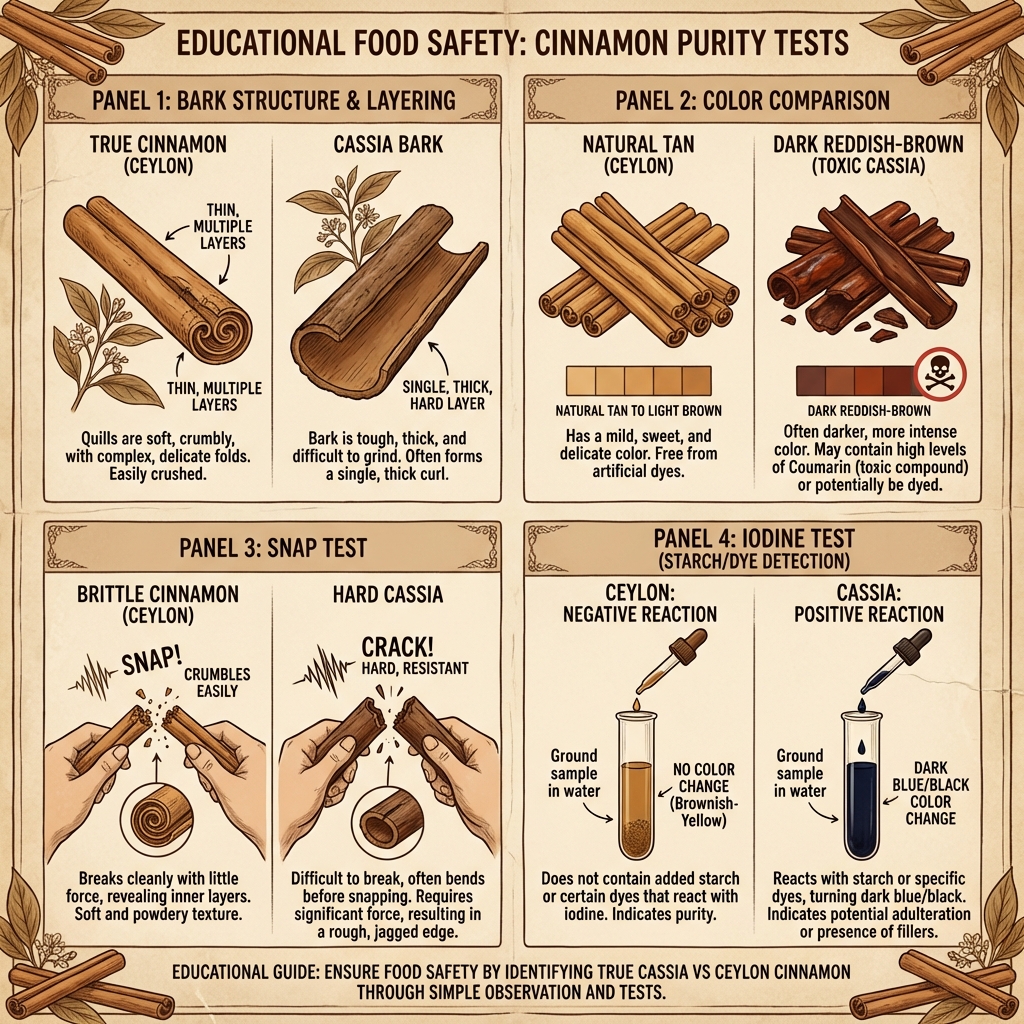
True Cinnamon (Ceylon) is often replaced with Cassia bark, which contains high levels of Coumarin—a compound that can be toxic to the liver in large amounts.
1. The Layer and Texture Test (Visual):
- True Cinnamon (Ceylon): Has multiple thin, paper-like layers rolled into a quill. It is brittle and can be easily crushed with fingers.
- Cassia Bark: Is thick, hard, and usually forms a single thick layer or a few coarse layers. It is very difficult to break.
2. The Shape Test:
Look at the ends of the sticks. Ceylon cinnamon looks like a cigar with many fine layers inside. Cassia bark often curls inward from both sides like a scroll or forms a single thick "U" shape.
3. The Color Test:
Ceylon cinnamon has a light tan to medium brown color. Cassia bark is usually a darker, reddish-brown color. If the color looks too vibrant or uniform, it might be dyed with lead chromate.
4. The Iodine Test (Starch Detection):
Mix a bit of cinnamon powder in water and add a drop of iodine. If the solution turns blue-black, it indicates the presence of starch or certain fillers. Pure cinnamon has a very minimal reaction.
5. The Aroma and Taste:
True cinnamon is sweet and delicate in flavor. Cassia has a much stronger, spicy, and "hot" flavor with a coarser texture.
Quick Safety Tips
- True Ceylon cinnamon has many thin layers like a cigar
- Avoid thick, hard bark (Cassia) for regular consumption
- Light tan color is a sign of Ceylon cinnamon
- Cinnamon quills should be brittle and easy to break
Chemical Concerns
Step 1: AI Visual Scan
New to BioLens? Try a sample test