
Avocado Safety Inspection
Inspect Avocados for artificial ripening, copper fungicides, and uneven chemical patches
Inspection Guide
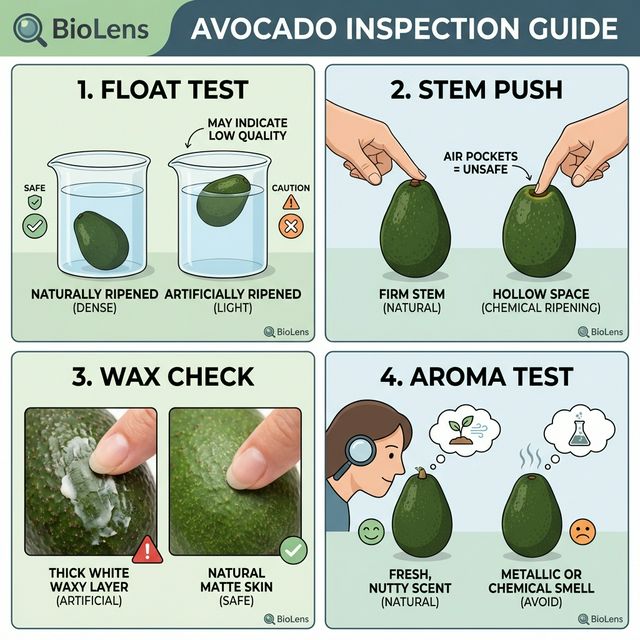
Click to enlarge
Avocado Safety & Ripening Guide
Avocados are frequently ripened using industrial gases or treated with copper-based fungicides.
1. Sink or Float Test: Place the avocado in a bowl of water. Naturally ripened avocados are dense and usually sink. Artificially forced/gassed ones often float due to internal air pockets and rapid cell breakdown.
2. Copper Rub Test: Rub the skin with a damp white cloth. Any green/blue residue suggests the use of copper sulfate (a fungicide) to hide fungal growth.
3. Stem Nub Check: Pull the small stem nub. If it is bright green/yellow, it's safe. If it is brown/black, it's overripe. If it is unnaturally bright green despite the body being very dark, it may be chemically treated.
4. Ripening Map: Look for patchy, uneven ripening. Natural ripening happens gradually; forced ripening creates "hard spots" in an otherwise soft fruit.
Quick Safety Tips
- Naturally ripened avocados should sink in water
- Check for blue-green residue on the skin (Copper Sulfate)
- Avoid avocados with hard spots and soft patches
- Inspect the color under the stem nub for natural indicators
What CANNOT be Verified (Lab-Only)
Invisible Risks (Lab-Only):
* Lipophilic Pesticides: Chemical residues that bind to fats (common in avocados) require advanced extraction and GC-MS testing.
* Ethylene Levels: Trace concentrations of industrial ripening gases.
Chemical Concerns
Step 1: AI Visual Scan
New to BioLens? Try a sample test