
Asafoetida (Hing) Safety Inspection
Detect chalk, starch, and synthetic resin adulteration in Asafoetida
Inspection Guide
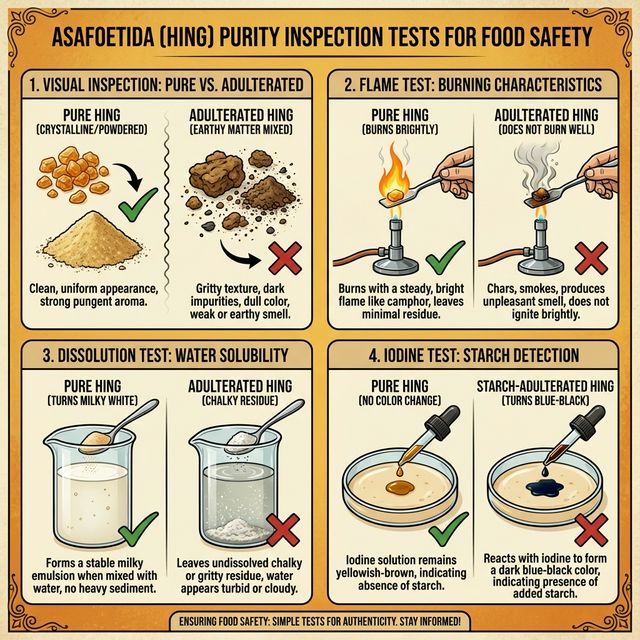
Click to enlarge
Asafoetida (Hing) Purity Audit
Hing is often mixed with cheap fillers like chalk, starch, or even harmful synthetic resins to increase weight and mimic aroma.
1. The Dissolution Test:
Add a pinch of Hing to a glass of lukewarm water and stir. Pure Hing will dissolve completely, turning the water milky white without leaving any sediment. If it leaves a chalky or sandy residue at the bottom, it is adulterated with soapstone or earthy matter.
2. The Flame Test:
Hold a small piece of Hing over a flame using tweezers. Pure Hing burns with a bright flame, similar to camphor, and leaves almost no ash. If it doesn't burn with a bright flame or leaves a large lump of ash, it contains resins or starch fillers.
3. The Aroma Intensity:
Rub a pinch of Hing on your palm. Pure Hing has an intense, pungent, and lingering garlic-like smell. If the smell is faint or smells like sawdust quickly, it is likely mostly fillers.
4. Visual Texture:
Pure "Bandhani" Hing should be uniform in color (yellow to light brown). Avoid Hing that has bright spots or feels overly coarse/gritty between fingers.
Quick Safety Tips
- Perform the water dissolution test - should stay milky and smooth
- Flame test: Pure Hing should burn with a bright camphor-like flame
- Avoid Hing that leaves a sandy or chalky residue in water
- Check for a strong, pungent aroma that persists
Multilingual Local Names
Hindiहींग (Hing)
Tamilபெருங்காயம் (Perungayam)
Teluguఇంగువ (Inguva)
Kannadaಇಂಗು (Ingu)
Malayalamകായം (Kayam)
Bengaliহিং (Hing)
Gujaratiહિંગ (Hing)
Marathiहिंग (Hing)
FrenchAsafoetida
ItalianAssafetida
RussianАсафетида
SpanishAsafétida
GermanAsant
Chinese阿魏
Japaneseアサフェティダ
Chemical Concerns
Step 1: AI Visual Scan
New to BioLens? Try a sample test