
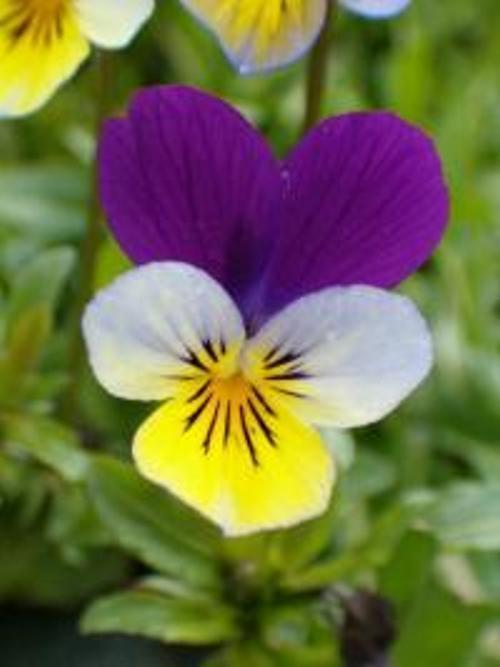
Wild Pansy
Viola Tricolor
Basic Details
Floral Formula & Features
Ebracteate (no bracts), Zygomorphic (bilateral symmetry), bisexual, 5 free sepals with appendages, 5 free petals (lower petal spurred), 5 free stamens with short filaments, 3 fused carpels with superior ovary typical of Violaceae
- Name 'Viola' from Latin for violet. 'Tricolor' means three-colored. 'Heartsease' refers to medicinal use for heart ailments and emotional comfort. 'Johnny-jump-up' describes self-seeding habit. Featured in Shakespeare's 'A Midsummer Night's Dream' as love potion ingredient
- Distinctive tricolor flowers 0.5-1 inch (1.5-2.5 cm) across with 5 petals - typically upper 2 violet/purple, side 2 white/pale, lower 1 yellow with dark lines (nectar guides). Zygomorphic (bilateral symmetry). Blooms April-September. Slightly fragrant
- Annual, biennial, or short-lived perennial herb. Low-growing with branching stems. Heart-shaped to oval leaves with scalloped edges. Self-seeds prolifically. Cool-season plant that may go dormant in hot summers. Reseeds for continuous presence
- Grows 4-12 inches (10-30 cm) tall with similar spread. Lifespan of 1-3 years depending on conditions. Propagated by seeds (self-sows readily) or division. Seeds need light to germinate. Can become weedy in lawns
- Native to Europe and temperate Asia. Naturalized in North America, Australia, New Zealand. Found in meadows, pastures, waste ground, roadsides, gardens. Prefers disturbed areas. Indicator of old grasslands in Europe
- Prefers full sun to partial shade (afternoon shade in hot climates). Needs moist, well-drained soil rich in organic matter. Tolerates poor soil. Hardy zones 4-8. Cool-season plant - thrives in spring and fall, struggles in heat. Deadheading prolongs bloom
- Traditional medicinal herb for skin conditions (eczema, acne, psoriasis), respiratory issues (bronchitis, asthma), and as anti-inflammatory. Contains salicylic acid, flavonoids, cyclotides. Edible flowers used in salads, desserts. Attracts bees, butterflies. Deer resistant
- Excellent for cottage gardens, rock gardens, borders, containers. Self-seeds freely - can be invasive in lawns. Remove spent flowers to prevent excessive seeding or allow to naturalize. High doses may cause gastric irritation. Seeds can be purgative. Generally safe in moderation
Names in Different Languages
What is Floral Formula?
A floral formula is a symbolic representation of a flower's structure using letters, numbers, and special symbols. It provides a concise way to describe the arrangement and number of floral parts.
This formula describes the flower's symmetry, sepals, petals, stamens, and carpels in a standardized format.
Formula Sequence
- Bract: Br or Ebr
- Bracteole: Brl or Ebrl
- Symmetry: % (Radial) or ⊕ (Bilateral)
- Sex: ♀ (Female), ♂ (Male), or ⚥ (Bisexual)
- Calyx/Sepal: K<number> (Free or Fused)
- Corolla/Petal: C<number> (Free or Fused)
- Androecium: A<number> (Free or Fused)
- Gynaecium: G<number> (Superior or Inferior Ovary)
Symbol Meanings
- Numbers: Indicate quantity of parts
- Parentheses (): Parts are fused together
- Plus (+): Parts in different whorls
- Underline: Superior ovary position
- Overline: Inferior ovary position
- ∞: Numerous parts (too many to count)
Understanding floral formulas helps botanists quickly identify and classify flowers based on their structural characteristics.
Similar Flowers
Discover flowers that share botanical characteristics
Similar Characteristics
4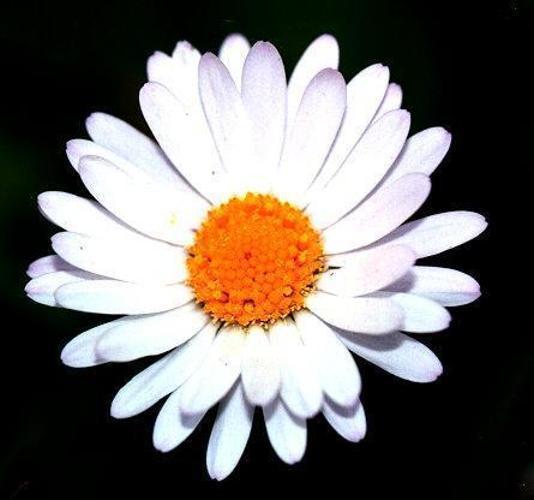
Oxeye Daisy
Leucanthemum vulgare
Classic wildflower with bright white petals radiating around golden-yellow cente...
Daisy
Bellis perennis
Charming perennial featuring classic white ray florets (petals) surrounding a br...
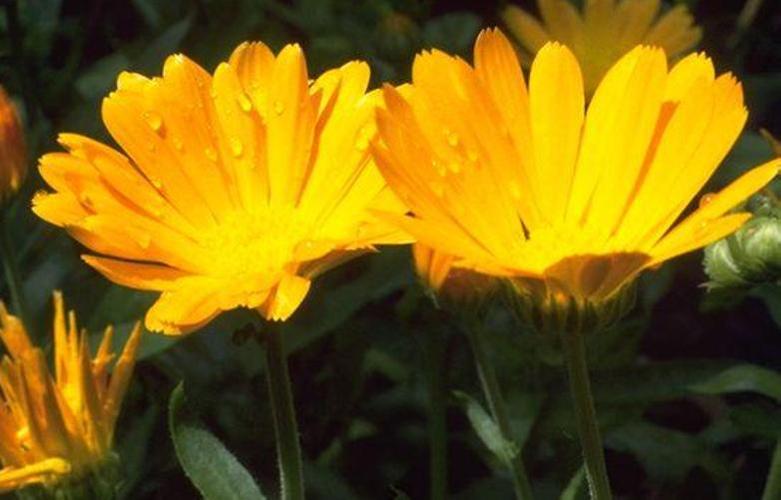
English Marigolds
Calendula officinalis
Cheerful annual featuring bright orange or yellow daisy-like flowers with a dist...
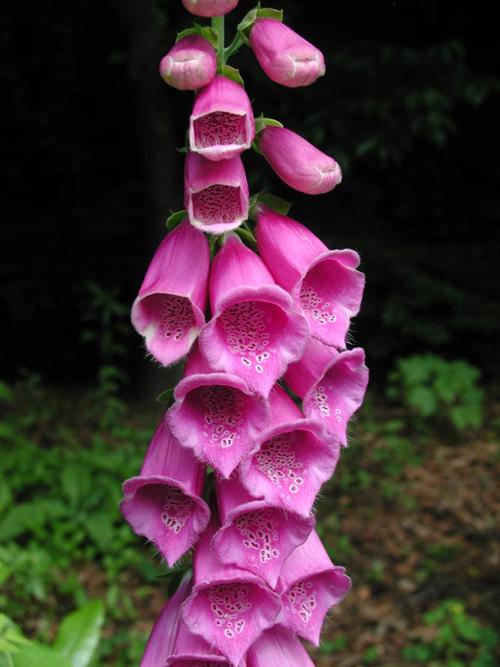
Foxglove
Digitalis purpurea
Majestic biennial featuring tall, elegant spikes of tubular, bell-shaped flowers...