
Maida (Refined Flour) Safety Inspection
Detect chalk powder and excessive bleaching in Maida
Inspection Guide
Click to enlarge
Maida Bleaching and Adulteration Detection
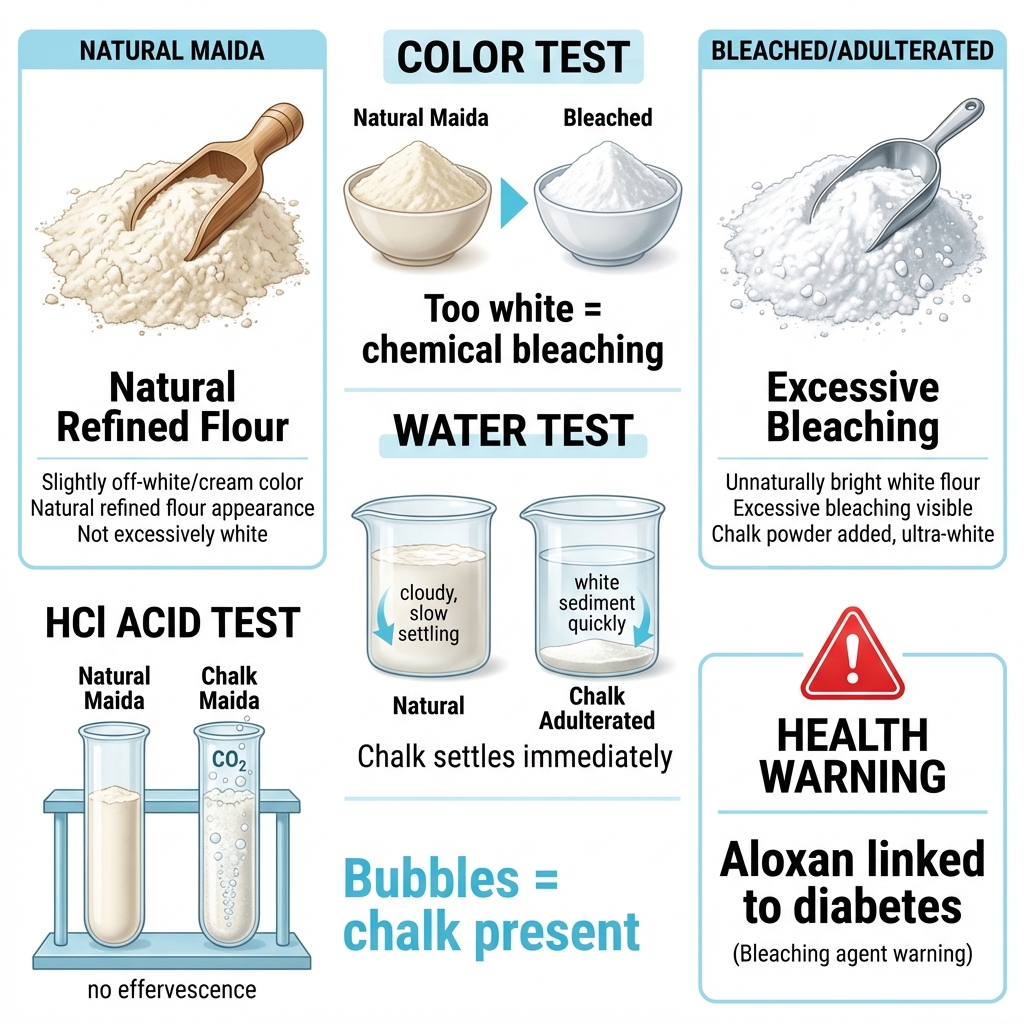
Maida (refined flour) is bleached with harmful chemicals like benzoyl peroxide and alloxan, and adulterated with chalk powder to increase whiteness and weight.
1. The Excessive Whiteness Test:
Natural Maida is off-white or creamy white in color. If the Maida is excessively bright white (like paper or chalk), it has been over-bleached with chemicals like benzoyl peroxide or alloxan. Alloxan is particularly dangerous as it can damage the pancreas and cause diabetes.
2. The HCl Fizz Test (For Chalk):
Place a spoonful of Maida in a bowl and add a few drops of diluted hydrochloric acid (HCl). If the mixture fizzes or bubbles, it indicates chalk powder (calcium carbonate) presence. Pure Maida won't fizz.
3. The Texture and Feel Test:
Rub Maida between your fingers. Pure Maida feels very fine, smooth, and silky. Chalk-adulterated Maida feels excessively fine but chalky, and may leave a white dusty residue on your fingers that's hard to brush off.
4. The Water Paste Test:
Mix a small amount of Maida with water to form a thin paste. Pure Maida forms a smooth, uniform white paste. Chalk-adulterated Maida will form a gritty paste, and you may see chalk particles settling at the bottom.
5. The Visual Comparison:
Compare your Maida with pure whole wheat flour (atta). Maida should be lighter in color but not stark white. If it's whiter than natural, it's over-bleached. Also check for uniform texture - no white lumps or particles.
Quick Safety Tips
- Avoid excessively bright white Maida - sign of harmful bleaching
- HCl fizz test for chalk detection
- Should be off-white/creamy, not bright white
- Limit Maida consumption - even pure Maida has health concerns
Chemical Concerns
Step 1: AI Visual Scan
New to BioLens? Try a sample test